It isn’t always easy to keep up with what’s happening in the US. “Shorter America” is a series where Dr Emma Shortis loops you in on what’s going on in America and shares news and analysis that you can trust.
By Emma Shortis
Fri 22 May 2026 09.45 AEST
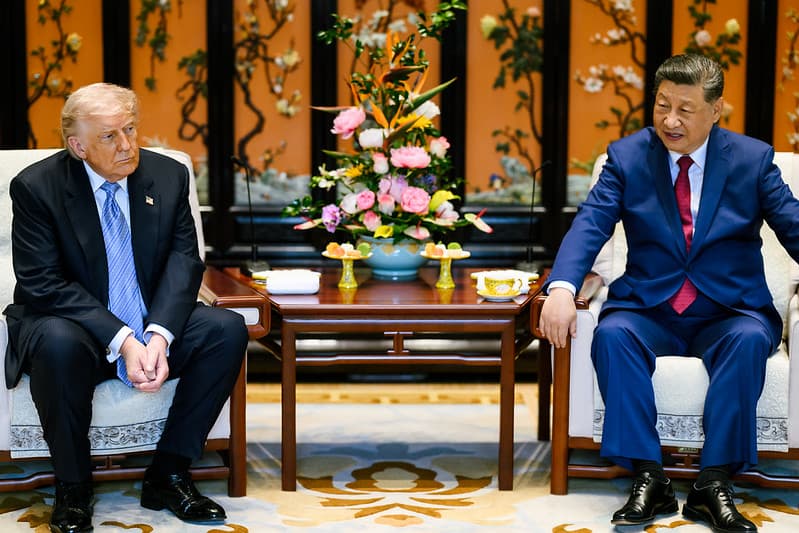
Photo: The White House/Flickr


This week, Xi Jinping got the commentariat talking about long-dead Greeks. As the 250th anniversary of the Declaration of Independence approaches, history remains ever-present.
This week:
The big brains are at it again. When Donald Trump visited China this week, Xi Jinping invoked the idea of the “Thucydides Trap”, and historians everywhere let out a collective groan.
The idea of the Thucydides Trap – explained really well in The Conversation by Neville Morley – was revived and popularized by Graham Allison, a political scientist at the Harvard Kennedy School. The western security establishment loved it.
As I argued on the After America podcast this week, I think that’s partly why Xi did it. But as this interesting piece from Associate Professor Seva Gunitsky argues, Xi was also playing a bigger game, and has perhaps once again succeeded at ‘mogging’ his American counterparts.
That’s startlingly easy to do to the Ivy Leaguers, who live in their own bubble – as evidenced by a series of cringey videos that emerged this week of graduation speakers at American colleges really failing to read the room – this time on AI.
Parker Molloy has some great analysis of that and why it’s ok to hate AI over at Handbasket. Molloy cited another predictably cracking read on the same subject by Dr. Tressie McMillam Cotton.
You know who else went to the Harvard Kennedy School? Pete Hegseth. The New York Review of Books has a great piece this week on Hegseth and how it is that Americans tolerate such cruel, mediocre men. Hegseth is, after all, quintessentially American.
It’s a big year for that. As the 250th anniversary of the Declaration of Independence approaches, there’s much to look forward to: UFC fights on the White House lawn, weigh-ins on the Lincoln Memorial, and an avalanche of commentary on what America is, and on what this all means.
I actually really enjoyed this New Yorker podcast on that, hosted by Jill Lepore. If you’re interested in the question of what America is – how it can make both a Lincoln and a Hegseth – Lepore’s book, These Truths, is very good (though if you can only read one, make it Don Watson’s).
What America is matters a great deal to us in Australia, as we tie our fates closer and closer. In Overland, Gwenaël Velge’s brilliantly written piece “Sacrificed for the Pentagon: on Australia’s “security” crisis” outlines the consequences of that decision in precise and harrowing detail.
“Environmental security, water security, energy security, and military security: each is being traded away in the name of the last one. And the last one, as the strategic record makes clear, is far from assured.”
Advertisement