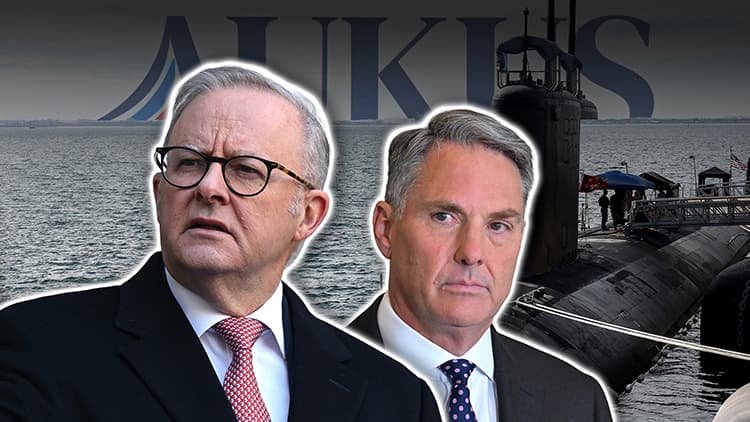
Australia cannot assume it will have any control over what US submarines do in its waters or while docked at facilities near Perth, an independent inquiry into the AUKUS deal has heard.
Dr Emma Shortis, director of the Australia Institute’s International & Security Affairs Program, challenged repeated claims that Australia will have “sovereign decision-making power” over the Virginia-class nuclear-powered submarines.
“This idea defies the reality of the history of Australia’s alliance with the United States,” she told the inquiry during its public hearing in Canberra.
“The historical reality is that the United States has never included Australia or any other country, for that matter, in its decision-making processes, especially really in conflict situations.”
As the public inquiry was being held, Defence Minister Richard Marles was meeting with his US counterpart Pete Hegseth in Washington DC to discuss expanding America’s military presence on Australian bases.
The ABC reported that about 1,000 US Navy personnel will be based at HMAS Stirling from next year to support a rotation of US and UK nuclear-powered submarines.
“It is assumed that Australia will decide what American submarines can and cannot do, and the historical evidence just does not support that assumption,” said Dr Shortis.
Dr Shortis pointed to an incident in March when a US submarine sank an Iranian ship off the coast of Sri Lanka.
In the days that followed, the Albanese government refused to disclose whether Australian personnel were on board before the Prime Minister eventually confirmed three ADF members had been on the submarine when the attack occurred.
However, as reported by the Guardian, Mr Albanese maintained the personnel had acted in accordance with Australian law and policy, insisting: “No Australian personnel have participated in any offensive action against Iran.”
Dr Shortis questioned that claim.
“So, we are to believe, as I understand it, that they did not participate, but they just watched. I suppose they were sent to bed — is the defence of this?” she said.
Get our newsletter
Quality research, analysis, explainers and factchecks from experts you can trust.
“Australian crew were sent to bed as their American co-crew members torpedoed the ship, killed more than 80 people and left the rest to drown.
“I think this demonstrates how AUKUS and the compromise of Australian sovereignty puts Australian service people in an impossible position.”
The historian warned that under AUKUS, situations like the March attack would become the “default position”.
She said the alternative would be a scenario that’s “very difficult to imagine”, involving Australia delaying a US submarine deployment until ADF personnel could be found and extracted.
“Put quite simply, there is no way an administration would hand over decision-making power over what are really the crown jewels of the United States Navy to another nation,” she said.
“The AUKUS narrative insists that this will not be the case: that sovereignty and independence will remain. But again, that defies the reality of our experience.”
“That would be a derogation of national power. Why would they do that? I think it’s the driving question that we need to ask ourselves.”
Dr Shortis also questioned why Australia would want to enmesh itself with a country whose administration she said had repeatedly undermined the International Criminal Court.
“When the Secretary of Defence Peter Hegseth is effectively purging the United States military of all but ideological loyalists, when he is degrading the institutions of international law — this is a Secretary of Defence who has quite literally said that he refuses to be bound by stupid rules of engagement, and that he’s not interested in the Geneva Conventions.”
She argued it would put ADF crew embedded on US attack submarines in an “untenable” situation.
Those were the scenarios she said the Australian government should be confronting and preparing for, rather than treating the Trump administration “as if it were an aberration”.
“I think we’re not ready for these kinds of scenarios in Australia being dragged into conflict, and we’re not ready for whatever comes next.”