Advanced search
The Point - home
DonateSubscribe
HomeWhat's NewOpinionOff the ChartsExplainersFactcheckAbout Us
The Point — home
DonateSubscribe
The Point — home
Advanced search
  • Home
  • What's New
  • Opinion
  • Off the Charts
  • Explainers
  • Factcheck
  • About Us
DonateSubscribe
Subscribe
  • Home
  • What's New
  • Opinion
  • Off the Charts
  • Explainers
  • Factcheck
  • About Us
The Point - home
Privacy PolicySitemapComplaints & CorrectionsNewsletter

The Point recognises the ancestral connections and custodianship of Traditional Owners throughout Australia. We pay respect to Aboriginal and Torres Strait Islander cultures and to Elders past and present.

©2025–2026 The Point, an initiative of The Australia Institute

WHAT'S NEW

“A neoliberal response to a crisis caused by neoliberalism”: Greens Senators cross the floor on disallowance

Three Greens Senators have crossed the floor to support a disallowance motion which would stop a new method to increase the supply of carbon credits. It comes after Greens Leader Senator Larissa Waters said her party would vote with the government this afternoon to allow the method.

By staff writers

Thu 10 Sep 2026 14.04 AEST

Environment & BiodiversityClimate
“A neoliberal response to a crisis caused by neoliberalism”: Greens Senators cross the floor on disallowance

Republish this article

This article is licensed under Creative Commons — Attribution-NoDerivatives 4.0 International (CC BY-ND 4.0).

Republishing guidelines

  • You must credit the author(s) and The Point.
  • You must link back to the original article.
  • You may not edit or modify the article content.
  • Images may be subject to separate copyright and are not included in this licence.

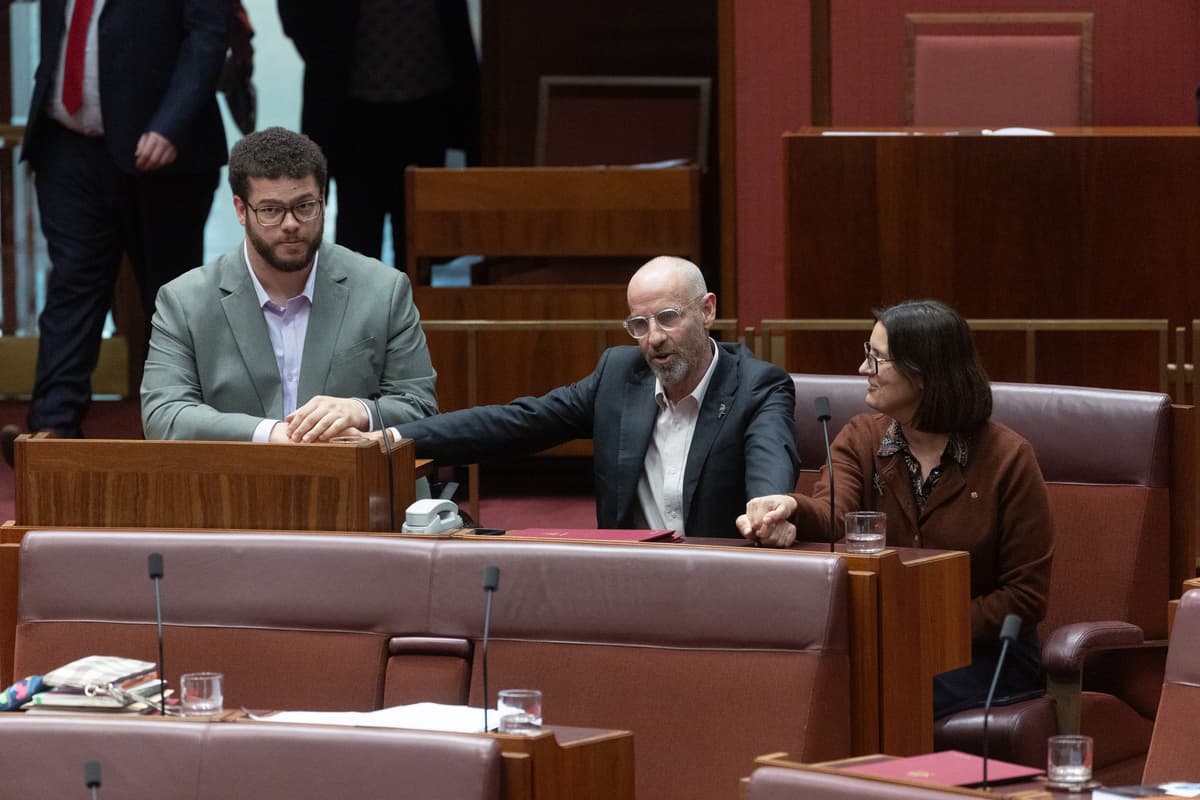
Three Greens Senators, Nick McKim, Jordon Steele-John and Vanessa Bleyer have crossed the floor to support a disallowance motion which would have stopped a new method to increase the supply of carbon credits.

It came after Greens Leader Senator Larissa Waters said her party would vote with the government to allow the method.

In a joint statement, Senators Nick McKim, Vanessa Bleyer, and Jordan Steele-John said “we have decided to exercise our right to take a position according to our consciences. We do not support the INFM, and will vote in the Senate to disallow it”.

Australia Institute co-CEO Dr Richard Denniss pointed out the policy is so bad that it split the Greens.

“The task of stopping Australia’s expansion of coal and gas is going to become a little harder today,” Dr Denniss said.

“In voting with Labor, the Greens have shown they now support putting publicly-owned forests into the ‘carbon marketplace’, and have tied the protection of trees and koalas to the expansion of gas and coal.”

Recent research has shown that the proposed new regulations would make a bad system even worse.

“Native forests are one of nature’s best carbon storage units – they truly are the lungs of the planet,” he said.

“The climate science makes clear that we need to protect these forests and stop expanding fossil fuels.

Get our newsletter

Quality research, analysis, explainers and factchecks from experts you can trust.

“Allowing fossil fuel pollution to increase because a forest wasn’t logged might take pressure off politicians, but it won’t take pressure off our climate.”

Previous research has also shown that selling carbon credits to polluters, which has been a core pillar of Australia’s climate policy, is plagued with integrity problems and faces questions over its effectiveness.

“There is no way to sugarcoat it, the parliament’s decision today is a setback,” he said.

“The unconditional protection of our native forests is one of the cheapest, easiest and most urgent things we can do to limit the effects of climate change.”

In a statement, Senators McKim and Bleyer said the INFM method was “a neoliberal response to a crisis caused by neoliberalism.”

“It sets an alarming precedent,” Senators McKim and Bleyer said.

“If it passes, we may never again see a National Park or marine protected area created unless carbon or biodiversity can be monetised in some way.”

The disallowance motion was defeated, 34 to 27.

Related Articles

OPINION

Australia must stand in partnership with the Pacific – not above it

By Ray Wills & Peter Newman

Australia should back Pacific-led electrification with affordable finance, local skills and measurable benefits. But clean-energy partnerships cannot substitute for a credible plan to move away from coal, oil and gas. True friendship means listening to our neighbours, acting on shared responsibilities and matching clean-energy partnerships with a credible transition away from fossil fuels. This is a big opportunity to show a real partnership in the Transition.

Climate
Australia must stand in partnership with the Pacific – not above it

OPINION

New data shows the shocking scale of Australia’s exported climate harm

By Ketan Joshi

Since Labor was elected in mid 2022, domestic emissions have fallen, on average, by about 0.6 megatonnes of carbon dioxide equivalent each quarter. But exported emissions have risen, on average, by about 2.5 megatonnes.

Climate
New data shows the shocking scale of Australia’s exported climate harm

OPINION

Kick the polluters out: COP31 hosts plan to continue digging fossil fuels

By Louise Morris

Imagine a conference on stopping smoking, sponsored by tobacco companies, hosted by tobacco exporters and crowded with tobacco lobbyists. Then imagine being told it is the world’s best hope for getting off the ciggies. That is the UN climate process as it rolls out every year.

Climate
Kick the polluters out: COP31 hosts plan to continue digging fossil fuels

WHAT'S NEW

Australia risks falling short of pledge to protect 30% of land by 2030

By Tegan George

Australia risks falling short of its global pledge to protect 30 per cent of the country’s land by 2030, with a new national review warning the biggest challenge isn’t just how much land is safeguarded, but whether it includes the ecosystems and species most at risk.

Environment & Biodiversity
Australia risks falling short of pledge to protect 30% of land by 2030