The Federal Government has released a new report that includes projections of how much gas Australia is set to use over the coming decades. There is no ambiguity in its message: Australia reached peak gas years ago, and it’s all downhill from here.
By Ketan Joshi
Thu 11 Sep 2025 15.48 AEST


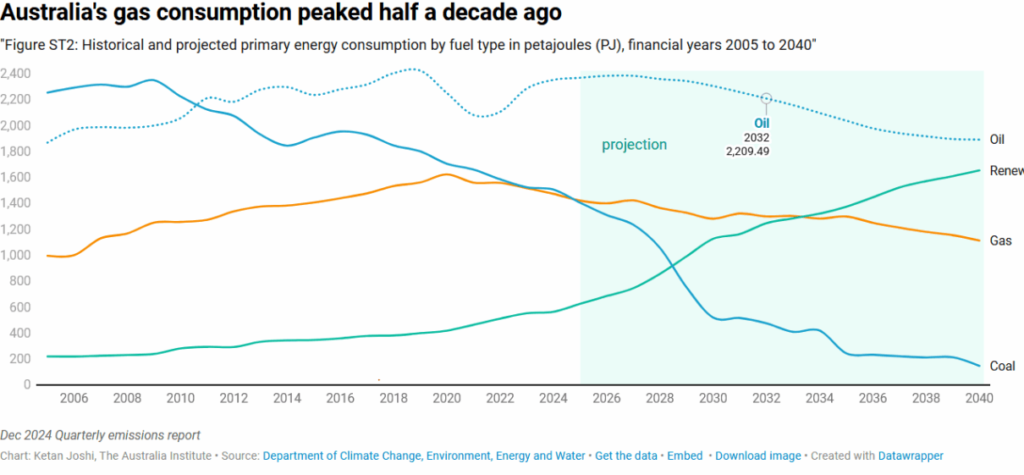
“Gas consumption is projected to decline to 2040 as electrification increases across the economy and renewables and storage take an increasing share of electricity generation”, wrote the Department of Climate Change, Energy, Environment and Water (DCCEEW).
This doesn’t sit well with the Prime Minister’s recent claims that more gas is needed for “firming” renewable energy. Figures from the Australian Energy Market Operator (AEMO)’s 2024 Integrated System Plan (ISP) show just how little gas is likely to be required in Australia’s electricity system.
In AEMO’s ‘step change’ scenario, there isn’t a single year where gas generates more than its historical peak in the National Electricity Market. In this scenario, more gas was burned in the past 16 years than is burned over the next 25 years.
In short: while gas might serve occasional use during low wind and sun periods, Australia simply will not end up using large amounts of it.
It is weird, then, that Australia has a massive pipeline of planned fossil gas extraction projects. Many of them are justified on the grounds that they’re required to help Australia decarbonise its power grids, with more than 1,000 new petajoules coming online by 2027, according to the latest government projects report.
The chart below compares the above projections of Australia’s domestic gas use to projections of the volume of gas exports, prepared by the separate Department of Resources and Energy (DISER). It makes it pretty clear where all the new gas is going – exports.
Only looking at new gas production capacity, and only looking at the proportion that has a clear operation date, that is still around 11 times the amount of gas projected to be used in the power sector. In fact, the use of LNG for FY23 was greater just for processing LNG than the entire power sector in Australia:
This analysis by climate expert Tim Baxter lays it out in even more detail.
“Again, more than 3,000 petajoules of gas were exported from Western Australia in 2022–23. If the entire transition to clean energy were to stand dead still as if renewables weren’t already going gang-busters — in Western Australia renewable energy generation has increased by an average of 20% each year for the past five years — we would need just 2.5% of that gas to keep the lights on for the state”.
It is pretty simple: Australia does not need to be expanding its fossil gas production, least of all to run fossil gas power stations. It’s a hollow fossil fuel industry talking point, and the Federal Government should know better than to repeat it.

