In March, 1.2 million South Australians went to the polls to elect 47 members of the House of Assembly, and 11 members of the Legislative Council.
Even amid a surge in support for One Nation, Labor’s victory was described by commentators as a “red tsunami” and “landslide victory”. Looking just at the seat totals, they’re right: Labor’s victory in 34 of the 47 House seats gives them their largest majority ever. But the votes tell a different story.
While Labor gained seven seats, their first-preference vote was actually 2.5% lower than the 40% they had achieved in 2022. Labor won over 70% of the seats on a preference vote of almost half that, 37.5%.
There is no doubt that South Australians preferred a Malinauskas Labor Government to one led by the Liberals or One Nation. ABC election analyst Antony Green estimated Labor won 55.7% of the vote against Liberal and One Nation candidates after preferences were distributed.
However, Labor’s seat count is out of all proportion with the party’s popular support, and it means the Government enjoys complete control over the lower house despite only getting a minority of the vote.
The Liberals formed the official opposition with 5 seats (just over 10% of the house) but received 19% of the popular vote.
One Nation got 23% of the vote, 4% more than the Liberals, but just four seats – the same as the number of independents, even though independent candidates only got 5% of the vote state-wide.
No Greens were elected to the house, despite the party receiving over 10% of the vote.
Clearly, South Australia’s Parliament does not accurately reflect the popular vote state-wide.
Why?
South Australia, like six of Australia’s eight states and territories, elects its lower house using single-member electorates. The country’s use of preferential voting ensures that the elected MP reflects the majority of voters’ wishes, but that doesn’t stop distorted results across the state as a whole.
Because each seat only elects a single MP, all they need to be elected is one more than half of all the votes in the seat. If, for example, Party A received 51% of the vote state-wide and Party B received 49%, you might expect Party A to get roughly 51% of the seats.
But single-member electorates don’t produce results like that. If Party B’s 49% of the vote was concentrated in the right places, it could still win a majority of seats by crossing the 50% + 1 threshold in enough places. That’s exactly what happened in 1998, when John Howard’s Liberal Party was re-elected despite losing the popular vote.
On the other hand, if Party A’s 51% of the vote was perfectly spread across all of the seats in Parliament, it would get 51% in every seat, winning every single one, and Party B would be left without representation.
These hypothetical scenarios illustrate the very real principle, which is that in an election with single-member seats, a party can win 72% of the seats off 37% of first-preference votes and 56% of two-party preferred votes – as Labor did in South Australia.
How to fix it
Two Australian states and territories already have a solution to this problem: proportional representation.
In Tasmania and the ACT, each seat elects multiple MPs, seven and five, respectively. That means if 40% of voters want Part A, another 40% want Party B, and 20% want Party C, each will get around that share of the seats in Parliament.
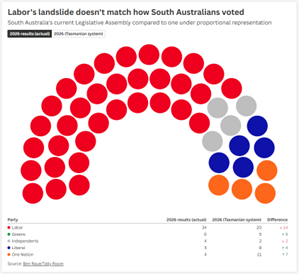
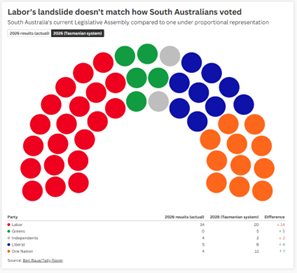
If South Australia adopted such a system, its parliament would better reflect the views of voters. Election expert Ben Raue simulated a system of 7-MP electorates using the 2026 election results on his website, The Tally Room.
Of course, in such a system, parties and independents candidates might make different decisions about whether to run and how to campaign, since seats would be more competitive.
But the 2026 election, at least, if applied to a Tasmanian-style proportional representation system, would have seen Labor win about 20 seats (42%), One Nation 11 (23%), the Liberals 9 (19%), the Greens 5 (11%), and independents about 2 (4%) – a result much closer to how South Australians voted state-wide.
As Mr Raue’s analysis shows, the result would have been a far more representative Parliament – but still with a Malinauskas Labor Government that was the clear preference of voters.