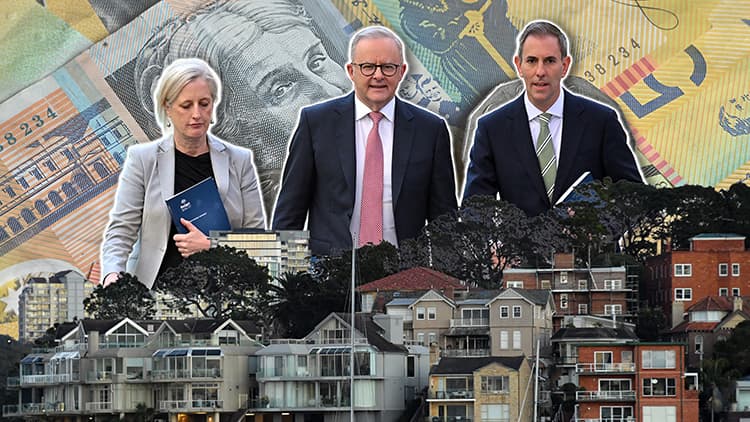
There has been a lot said about trust and honesty in politics in the days since Labor handed down its budget, but not a lot has had to do with integrity.
The focus has been on Labor’s broken promise about changing negative gearing or the capital gains tax discount, which was secured by journalists at the last election campaign.
In the past couple of weeks, Labor’s own research and polling showed people expected structural changes to make the housing market more fairer.
Under pressure on multiple fronts – rising inflation and, with it, rising anger and turns to One Nation, Jim Chalmers won one of his long-held reform wishes.
Labor isn’t angry about the focus on broken promises, and spent the days after it decided to make the changes workshopping answers and explanations; own it (at least in part, but don’t say broken promise), empathise making a right decision even if it’s hard, and point to the generational inequality.
If pushed, reference other, positive broken promises – like changed minds on stage-three tax cuts and halving the fuel excise.
So far, all has gone to script. Labor is having a fight where it feels it holds the higher ground, and there has been less attention on the parts of the budget that are not as fair – the devastating cuts to the NDIS, cuts to foreign aid funding, climate technologies, and the lack of support for people on benefits or low incomes.
It feels on firmer ground after Angus Taylor’s dogwhistling budget-in-reply speech. Taylor went back to the Fraser government’s first budget after the Gough Whitlam defeat, when then-treasurer Philip Lynch handed down a May 1976 budget that included personal income tax indexation, which he said “would produce a desirable discipline on future government spending decisions”.
Lynch offset the measure by abolishing tax rebates for children and putting a levy on Medicare. In August 1976, he referred to it as “perhaps the most significant reform of the personal income tax system in our time, and certainly the most costly in terms of revenue foregone”.
As The Australian Financial Review reported in 2005, Malcolm Fraser said in a 1977 Sydney Morning Herald interview the policy was “a very deliberate attempt to transfer resources to the private sector”.
But by 1978, the indexation policy was halved. It turned out to be a lot more expensive than planned. Then, in 1981, Fraser’s new treasurer, John Howard had to own abolishing it. It was one of the reasons he became known by the derogatory nickname, “Honest John”.
By 1996 when he was prime minister, Howard had embraced “Honest John” and flipped its original sarcastic undertones into something more genuine, awarding himself “a gold medal performance” in keeping promises during an interview with John Laws:
“Now I acknowledge there are some areas where that hasn’t occurred. I know some have been deferred, but I think when you take into account the promises which really, people really voted on in the election, it’s very, very difficult to find any of those that haven’t been honoured in their substance or in their entirety.”
Howard reframed election commitments into “core” and “non-core” commitments. Cuts to higher education, the ABC and Aboriginal and Torres Strait Islander funding were all “non-core” promises, Howard argued. People who voted for him, knew that. Laws summed it up in the interview as:
“Print media has fallen into line, their editorials are mostly glowing … and who mentioned the word broken promises, who said that? There are two classes of promises it seems now with this government, core promises which are kept and then those other not so important promises, the ones we really didn’t mean kind of promises, surely you knew we were joking kind of promises, I guess.”
Again, the argument over core or non-core promises filled the space, which meant that the actual cuts (and the changes that followed) received less attention.
It’s the same story here. This budget is one of the most disastrous for social services in modern political memory. The cuts to the NDIS, only compounded by the ongoing uncertainty, will reverberate for years.
The government is preparing for challenges, increasing the funding to the Administrative Appeals tribunal to deal with the number of cases it anticipates.
The budget papers also list the government’s potential liability in relation to compensation payments for welfare recipients impacted by unlawful compliance decisions as “unquantifiable”. Meaning Treasury doesn’t know how much the government will have to pay for a program it still hasn’t fixed, which is still impacting people’s lives.
So far, the potential number of unlawful cancellations identified sits above 300,000, and that’s before you consider the Commonwealth Ombudsman’s questions around the lawfulness of how payment suspensions are administered.
Every year around 2.7 million payment suspension notices are issued, and penalties attached to those suspensions remain, despite how many times the government is warned the issue risks becoming its own Robodebt.
At the same time as the RBA is raising interest rates to make more people unemployed, in a heavy-handed attempt to tackle potential future inflation, Treasury is revising down expenditure in Jobseeker, claiming there will be a 3.8 per cent drop or saving of $700 million over two years.
Poverty advocates like the Antipoverty Centre can’t make sense of it, and wonder if it means the government plans to make accessing the unemployment benefit even more difficult. You can’t blame them for their scepticism.
And if we want to focus on broken promises, in 2022, the Albanese government vowed to end compulsory participation in the cashless welfare card programs. Another $200 million has been set aside for BasicsCard and SmartCard.
Funding for foreign aid, in real terms, has fallen. While the numbers seem the same, adjusted for inflation, Australia is being less generous by about 4 per cent. And it’s carving up what little there is even further – while the Asia-Pacific share increased from 74 per cent to 76 per cent, there is a smaller pool in general.
That in itself may not seem like much, but it’s coming at a time where other wealthy nations, like the US, are pulling their funding and people are dying.
Australia gives just 0.2 per cent of its GNI (Gross National Income) in foreign aid, which is short of Labor’s own policy platform of at least 0.5 per cent and well short of the international expectation of at least 0.7 per cent.
The $60 million spend on subsidies to community organisations for youth homelessness seems like a win, but there is no increase in social housing stock attached to the promise to provide $6000 to up to 4000 tenancies.
Community housing providers do not have to provide shelter based on when someone was placed on a housing wait list, and can pick and choose their tenants (unlike public housing).
While this latest policy may make some previously undesirable tenants (because traditionally JobSeeker and Youth Allowance is a lower welfare payment than the pension or minimum wage) more desirable, it will still come at the expense of other people on the list, who will remain homeless.
Budgets are about choices. And this government has made its. The integrity at the heart of the budget should not be built around a political narrative of a “broken promise” but what it does for the people it should be serving.
Amy Remeikis is a contributing editor for The New Daily and chief political analyst for The Australia Institute
This article was first published on The New Daily.