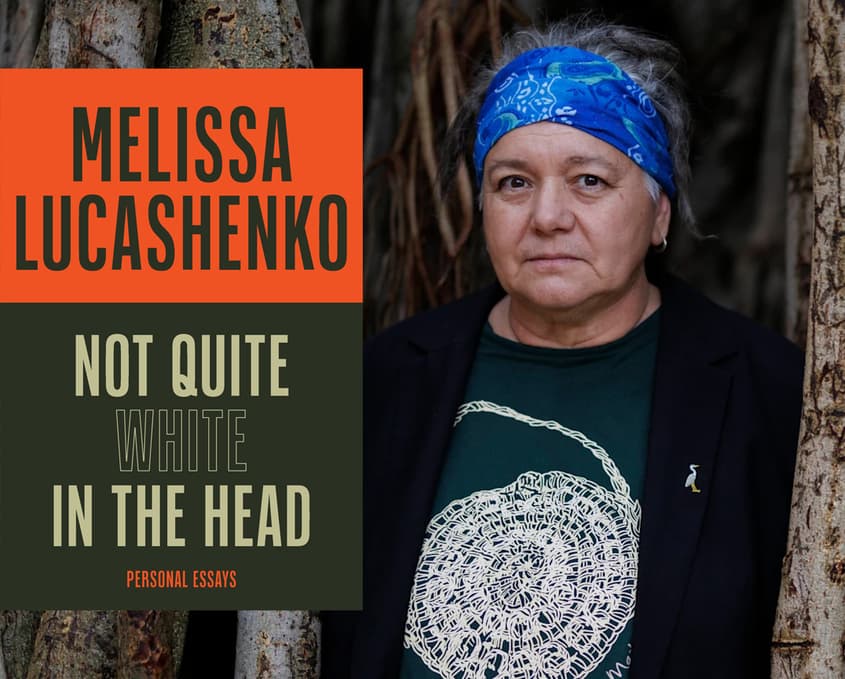
An edited extract of the introduction chapter of 'Not Quite White in the Head' by Melissa Lucashenko, out now via all good bookstores and online.
Fri 13 Feb 2026 14.00
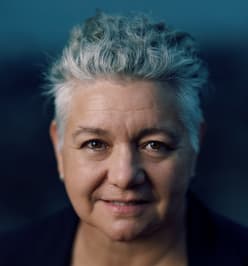
Melissa Lucashenko Photo: Glenn Hunt


I was having an extended break from writing.
After four novels, I’d turned aside to put my heart and soul into a property near Billinudgel on Bundjalung Country in Northern New South Wales. (That property later became the setting for my novel Mullumbimby – literally another story.)
Somewhat to my surprise, Professor Julianne Schultz, the brilliant founding editor of Griffith Review, rang me up with a proposal. I agreed and took time out from eradicating camphor laurels and ripping down rusty barbed wire fences to fly up to Palm Island. There, my kinship sister Gladys introduced me to one of her senior Elders, and at that Elder’s kitchen table I learned about life for Bwgcolman people in the aftermath of the killing in custody of Mulrunji Doomadgee.
Six months later, Griffith Review published ‘Who Let the Dogs Out?’
Fast forward two decades, and as this book goes to print yet another Aboriginal man, Kumanjayi White, has just met his death in police custody.
Kumanjayi, a Warlpiri man living in town due to his disabilities, died after being held down on an Alice Springs supermarket floor by two off-duty police. Frail, thin and, according to one former supermarket worker, clearly someone living with disability, Kumanjayi had allegedly been pinching chocolates.
Between the killing of Mulrunji Doomadgee and the death of Kumanjayi White, hundreds of other Indigenous men, women and children have died in the custody of the Australian state.
As one Koori community member asked angrily of the prison system while at a rally for another victim, the late David Dungay Jr: ‘How much training do they need to stop killing our people?’ A question worth repeating, again and again, until it’s answered, and until the killings cease.
This pattern of lethal state violence towards Blak people (the term ‘Blak’ coined by the late artist Destiny Deacon, who began spelling the word without the ‘c’ because, she said, she was sick and tired of being called ‘a Black c …’) seems so deeply entrenched in Australia as to be inevitable. It isn’t inevitable. We First Nations lived here successfully and fruitfully for thousands of years, and we can do so again.
As I write in ‘Staying White’ – the most recent of these essays – Australia can join us in a better future. You don’t need to be Indigenous to engage with First Nations mobs and our ancient, sustainable Law in the twenty-first century. You simply need to be a decent, mindful human who cares about your neighbours and the earth, and acts accordingly.
When we run our own communities in the future, using our own Aboriginal and Torres Strait methods of governance, our Blak lives will flourish. Our democratically elected First Nations body – Aboriginal and Torres Strait Islander Commission (ATSIC) – was beginning to slowly shift things in that direction, before former Prime Minister John Howard decided in 2004 to abolish it. He and much of white Australia took the position that, uniquely among Australian government bodies, ATSIC had to be entirely devoid of mismanagement or alleged criminality. No doubt the fact that ATSIC was an Indigenous institution pressuring the federal government on native title at home and embarrassing it on human rights violations abroad, was pure coincidence.
‘The First Australian Democracy’ explores First Nations governance and asks about ways forward.
Following the Liberal and National parties sabotage of the minimalist proposal – the 2023 First Nations Voice to Parliament Referendum – this essay remains, alas, just as relevant as it was when it was first published in 2015. The proposal for an Aboriginal and Torres Strait Islander Voice didn’t offer much, on paper, but I’m old enough to remember that a lot of the criticisms levelled at it were also levelled at ATSIC in its beginning stages, too. And we absolutely need an elected First Nations representative body if anything is going to change.
Some of these essays are specifically about writing. ‘On Bitin’ Back’ was commissioned for the re-publication of Vivienne Cleven’s extraordinary first novel. It is a genuine pleasure to bring extra attention to Cleven’s work, which is uproarious and gutsy in the best traditions of Outsider Art. ‘On Writing Edenglassie’ was a well-received keynote address, presented at the Brisbane Writers Festival in 2024. ‘On Keri Hulme’ allowed me to pay homage to the writer who has probably influenced me more than any other. ‘The True Hero Stuff’ – another keynote, delivered literally on the ground where my historical novel Edenglassie is set – is my attempt to explain why that novel was going be different to any mainstream novel of colonial Queensland, and why it needed to be written.
There’s a lot these essays don’t cover.
Despite my vague ambition to write a collection of travel writing – a non-existent collection which already has a title, A Blackfella Abroad – there’s nothing here on my wanderings to central China, Europe or Indonesia, or to the Pacific.
Given more time, I could have written about my great-grandmother Christina, and the ongoing mystery to us of her removal as an eight-year-old child.
There’s nothing much here on queerness, and my immediate family is absent: they deserve privacy. Nor have I written anything specifically about women in prison or about Sisters Inside, an organisation I’ve been involved with, one way or another, for thirty years.
In fact, only one essay, ‘A Voice from the Rooftop of Boggo Road Prison’, is solely about prison.
It documents the horrific conditions inside Boggo Road Gaol at the time of the 1988 prisoner protests, and it does so in the words of a Scots Australian man who was living inside and a key part of the protest. My editor was unsure about including it, given that the words are mostly Gary’s rather than mine, but I insisted. Own voices matter. My oldest brother, who did a couple of stints in Boggo Road before later becoming a successful businessman, is working on his own memoir. I hope one day you can read his words, as well as mine. In the meantime, Gary’s voice lives on, long after the rooftop protests, which forced some brief changes to the regime of abuse that existed in Boggo Road.
If there’s a connecting thread in these essays, it’s that First Nations aren’t going anywhere and that we are waiting to transform the nation for the better, given the opportunity.
Our First Voices are, as Uncle Wesley Enoch says, the Elder culture of the planet. We have a chance to share the knowledge of thousands of generations with other, younger cultures, as the planet boils and the old world order implodes. There are clear alternatives to the insanity of global capitalism and techno-feudalism, and they lie with us, the Indigenous peoples of the earth.
A memory to finish with: Larrakia Country, 1990. I’m working for the Department of Social Security alongside the late Aunty Barbara Cummings, a very big personality who will soon be elected the Darwin chair of the brand-new political organisation, ATSIC (a long way from growing up in the Retta Dixon Home, viewing her mother only through a wire-mesh fence). A passing Social Security colleague chides Aunty Barb for her habit of pinching office supplies off the federal government. A sigh, and a long pause – Aunty Barb always had exquisite comic timing: ‘Wee-e-ll, love,’ she explains, as though to a small, rather dense child. ‘They will go and put it on my land.’
Aunty Barb’s inimitable voice that day has informed all of my writing since. I hope you find an echo of it in these essays.
— Bundjalung Country, 2025
Excerpt from Not Quite White in the Head by Melissa Lucashenko (UQP), out now via all good bookstores and online.
Advertisement
The Australian National University (ANU) has spent the past eighteen months in a state of rolling crisis. The headline issues are now familiar. In October 2024, a large projected deficit was announced to staff. This was followed in 2025 by 'Renew ANU', a sweeping cost-cutting program that has reportedly seen over 1,000 staff leave the University.

On 24 March 2020, Scott Morrison took an unprecedented step: at the drop of a hat, he made the activities people on some Centrelink payments are forced to do completely voluntary as the COVID crisis loomed. It was a change that not only protected the community, but one that brought massive relief.
The oil crisis has not only caused petrol prices to soar, it has revealed just how little competition there is among the big oil companies. A couple weeks ago the ACCC announced that it would be looking into uncompetitive behaviour by petrol companies in the rural areas.