Life as a homelessness case worker is brutal. You often feel like the last stop on the train line of our country’s social failures. Hardest of all is knowing that people aren’t helped as well as they could be because of inadequate resources and a failure of political will and imagination.
Thu 12 Feb 2026 01.00
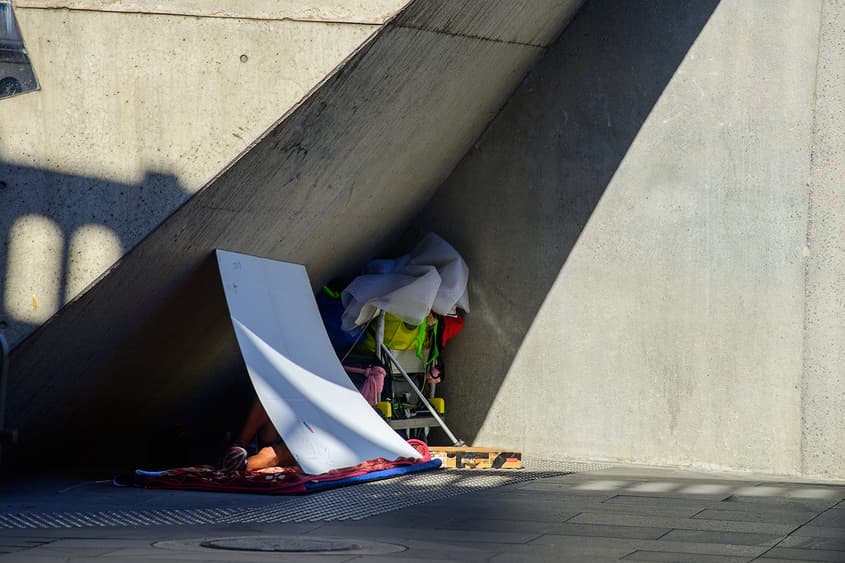
Photo: AAP Image/Michael Currie


Life as a homelessness case worker is brutal. You often feel like the last stop on the train line of our country’s social failures.
Hardest of all is knowing that people aren’t helped as well as they could be because of inadequate resources and a failure of political will and imagination.
I worked with a small homelessness service on the NSW South Coast for 18 months ending in 2023.That time included the aftermath of the Black Summer fires that brought devastation to the South Coast, including a spike in homelessness.
Ironically, the fires also brought a surge of funding for social services. Some was tied directly to bushfire recovery, some simply allowed chronically under-resourced services to function.
My job only existed because of bushfire funding, yet none of my clients had lost their homes in the fires. The extra funding did give our small team of case workers a rare opportunity: the chance to do our own research on homelessness.
It is disturbingly unusual for frontline workers to be empowered in this way. Research is typically done by academics and policy professionals who visit the field but have rarely done the work personally. Any ideas the workers might have about how to do things better must filter up a long and hierarchical chain. Rural homelessness is especially under-researched.
Our project sought to understand in more detail the needs of people experiencing homelessness in our locality and what type of housing they would need to achieve wellbeing.
In a nutshell, our study found that the majority of people experiencing homelessness in our area needed moderate to high levels of services and support – e.g. mental health, disability and drug and alcohol treatment – and very targeted housing in order to maintain tenancies and wellbeing. Many had endured lifelong trauma, abuse, neglect, severe mental illness, and chronic physical conditions.
Something else we discovered in our research was that the NSW Government was misusing a shiny new slogan imported from the United States: Housing First.
Housing First refers to a specific approach that emerged from an American program called Pathways. Its success was predicated not simply on providing housing, but on providing housing alongside immediate, intensive, and long-term support, delivered through persistent outreach and coordinated care. Housing was carefully matched to individual need and calibrated to specific vulnerabilities.
In short, Housing First means no preconditions for housing. It does not mean providing housing and working out the support later. Yet this is precisely how the NSW Government interprets it. What is presented as innovation is, in practice, business as usual. The most vulnerable people were already prioritised for social housing.
As the Housing First evidence base suggests, housing was necessary for most of our clients—but it was never sufficient. As one prominent Australian researcher put it, the level of care provided in the Pathways study is a “pipe dream” in the Australian context.
How far our local services needed to come to really take care of the chronically homeless is best exemplified by my interactions with the local NSW Health Community Mental Health team. These are the hardworking people tasked with caring for those experiencing the most severe and acute mental illness in our society.
“I have to warn you, his case notes sound extreme — but he’s now stable.”
These were the words of the community mental health worker trying to discharge a patient into my care.
This man had received an eviction notice from the house he’d lived in for years, gone into acute distress, and tried to slit his own throat. Following a period of hospitalisation and a few months of case management in the community, the case worker had been instructed to move him on from the service.
I was apprehensive. I was not a trained mental health worker, and my homelessness service was not a “crisis service”.
“We think he’ll be fine as long as he doesn’t face housing stress,” they said.
I couldn’t hide my feelings.
“You can consider housing stress a given,” I replied in shock. “He’s being evicted, and it will take time to get him rehoused. You need to rethink the discharge.”
To the mental health worker’s credit, they pushed back to their superiors, and it was agreed the man would be kept on as a patient until we were able to find him a new home. A care team of two was better than one.
But even the housing part of ‘housing first’ is not done well in NSW. A chronic shortage of housing means many people spend weeks and months in “temporary accommodation” – private motels that the NSW government pays to house people experiencing homelessness.
When a person in temporary accommodation is offered a house, no matter how unsuitable, they are pressured to accept.
I had one client who was bouncing between motels, while the Department of Housing took a “contribution” from his fortnightly Centrelink payment, leaving him with fumes to pay for food. He had no transport — crippling in a regional town — and was too physically and mentally unwell to work.
One morning I received a panicked call. He’d been offered a house from a large, government-funded community housing provider. It seemed like a miracle. But they’d only given him two business days to pay two weeks upfront. He’d asked his elderly mother and everyone he knew for a loan but couldn’t come up with the cash and was highly distressed.
I called the housing provider. They wouldn’t wait a few days for his next Centrelink payment.
Despite being contracted by the government, this organisation’s behaviour was contrary to government policy. And now this highly distressed person would continue to cost the government more than one hundred dollars per day.
I pushed back hard, and they agreed to halve the payment, which we were able to fund. But it didn’t feel like a victory.
The resources for homelessness services and research ran dry after the bushfire response funds were used up, even though homelessness support needs remained largely the same. My research project was written up but never published.
It doesn’t have to be like this. The bushfires and then COVID showed us that poverty is a policy choice – the government was able to lift over a million people out of poverty by doubling JobSeeker payments, then drop them back into poverty again months later.
In times of crisis Australians are great at doing the right thing morally and socially, which is also the smart thing economically. What would it take to do so all the time?
Lukas Ringland is an Anglo-Celtic Australian man decolonising on Yuin Country (South Coast NSW). His work grounds policy and research in frontline practice and lived experience. He formerly worked for a homelessness service provider on the NSW South Coast and is the co-founder of Earth Ethos retreats, alongside his wife, Dr Valerie Ringland.
The oil crisis has not only caused petrol prices to soar, it has revealed just how little competition there is among the big oil companies. A couple weeks ago the ACCC announced that it would be looking into uncompetitive behaviour by petrol companies in the rural areas.
Australia’s shrinking local media landscape has fuelled growth in independent news outlets, with publishers gathering in rural South Australia to discuss the challenges facing community journalism. The Local and Independent News Association (LINA) summit in Murray Bridge comes amid growing concerns about the sustainability of regional news.

Combined with the 50 basis points rise in February and March in less than 2 months households are paying the equivalent of a 90 basis point rise in interest rates.