Can we trust the USA?
Prime Minister Curtin’s Christmas 1941 newspaper column advised the Australian people that henceforth we would look to America as our protector rather than Britain. To have questioned our trust in the USA at that time would have been unthinkable. A decade later, under Prime Minister Menzies, trust was cemented into the ANZUS treaty, which has remained the cornerstone of Australia’ security and self-confidence ever since. It has become an article of faith.

Sat 28 Feb 2026 01.00
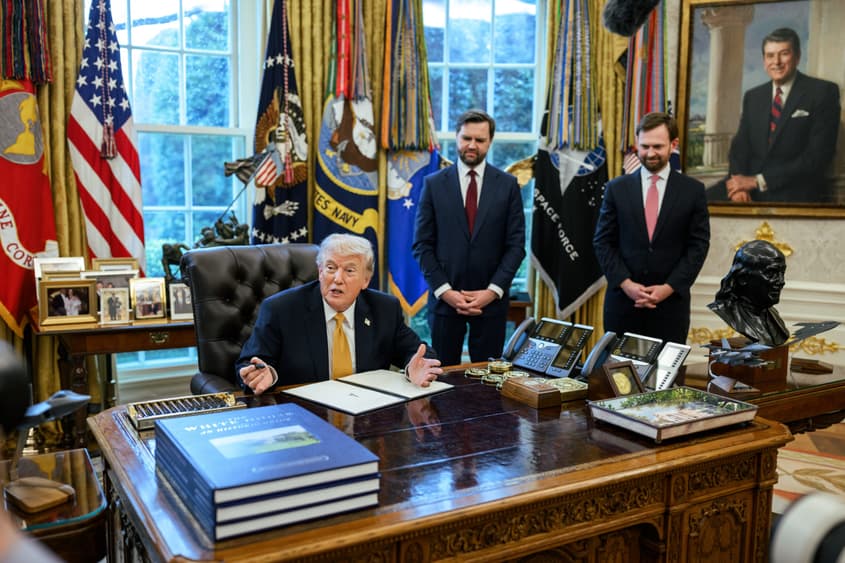
The White House/Flickr


Prime Minister Curtin’s Christmas 1941 newspaper column advised the Australian people that henceforth we would look to America as our protector rather than Britain. To have questioned our trust in the USA at that time would have been unthinkable. A decade later, under Prime Minister Menzies, trust was cemented into the ANZUS treaty, which has remained the cornerstone of Australia’ security and self-confidence ever since. It has become an article of faith.
So, what about now? Can we trust the US to stand by us as we have stood by the US through thick and thin – Korea, Vietnam, Iraq, Afghanistan and, through the Five Eyes arrangements, every other adventure on which the US has embarked?
At the very least, the jury is out. According to polling published in November 2025, about half the Australian population considers the US an unreliable ally.
Treaties have become little more than instruments of convenience for the US. President Trump is now notorious for his cavalier approach to treaties and agreements – his disdain for NATO bears witness to that. But Trump is not the first to ride roughshod over agreements: the US has been beating up on the World Trade Organisation (WTO), the International Labour Organisation (ILO) and the UN Educational, Scientific and Cultural Organisation (UNESCO), not to mention the UN itself, for decades.
But Trump has gone further than previous Presidents in reneging on treaties. The World Trade Organisation is at a standstill in arbitrating disagreements. The US simply refuses to agree to the appointment of Appellate Body members to determine disputes. And his imposition of tariffs across the board is directly in breach of its Free Trade Agreements (FTA), including the FTA with Australia.
The Australia-US FTA prohibits the imposition of tariffs. “Neither Party may increase an existing customs duty or introduce a new customs duty on imports of an originating good, other than as permitted by this Agreement” (Art. 2.3.2). The FTA does not provide for Trump’s tariffs. And what was the Australian government’s response? It simply rolled over whimpering “it’s not the act of a friend”.
This is not the first time that the US has disappointed Australia’s treaty expectations. In July 1963, President Kennedy pulled the carpet from under Prime Minister Menzies – and did the same a short time later to Treasurer Harold Holt – when he declined to be the backstop behind Australia (and the UK) in its confrontation with Indonesia.
Faith-based policy is rarely a recipe for success. The US interprets the ANZUS treaty, for so long the lynchpin of Australian strategic policy, entirely differently from Australian governments. We see the treaty as a guarantee, a promise to “act”. The Americans see it as an incentive, an agreement to “consult”. As we explained elsewhere, there is a massive gap between the two.
The gap cannot be bridged. So, Australia needs to rethink its dependency on the US, and construct a mature relationship with the US in response to the Trump experience. The Trump presidency is not an aberration: arrogance, bullying and exceptionalism have been stock in trade at least since Independence, domestically as well as internationally. The Trump administration’s misadventures in Minneapolis, where citizens and immigrants were abused in ways more reminiscent of a dictatorship than a democracy, echo the brutality shown to native Americans under Presidents Andrew Jackson and Grover Cleveland.
Australia needs a grown-up relationship with America, just as America needs a grown-up relationship with us. The institutional and structural alignments between Australia and the US run deep, and can be leveraged to the benefit of both. But that demands imagination and leadership.
So, what can the Albanese Government do?
First, it could “do a Carney”, following the lead of the Canadian Prime Minister. It could be straight with Trump and his administration and call the shots as we see them. Trust has been imperilled, and we must recognise that fact before we can remediate it. The great advantage America has over its competitors is its alliance network with like-minded partners. This is not based on values but on shared interests. Those interests can only be realised where there is trust.
Second, Australian Ministers must put the argument to American political leaders and opinion-makers that trust is critical to the realisation of America’s national interests and the exercise of its power – not just military power but also cultural, diplomatic, economic, political and social power. There is massive emphasis on AUSMIN, and AUKUS of course, but the multi-dimensional nature of the bilateral relationship is largely ignored, at least in the public conversation.
Third, our politicians must advocate the significant advances Australia has made in managing the politics of its democracy. Political inventions like compulsory voting (which universalises the franchise), proportional representation and, very importantly, the creation of the Australian Electoral Commission to manage elections are critical in preserving the integrity of our democracy and public confidence in its institutions.
And if you think that the Americans will never buy such trust-building measures, it is important to remember that the American people are nothing if not pragmatic when it comes to self-interest.
Allan Behm is adviser to The Australia Institute’s International and Security Affairs Program
Advertisement
Related Articles
Shorter America This Week: Ceasefire?; Madman theory; Group hugs in space
It isn’t always easy to keep up with what’s happening in the US. “Shorter America” is a series where Dr Emma Shortis loops you in on what’s going on in America and shares news and analysis that you can trust.
Australia has significant power in the world, we should be using it more wisely
Australia is not a small nation with no agency.