As we line up at the petrol bowser to pay 60 cents per litre more – and rising – than we did before the US and Israel attacked Iran, we should remind ourselves how indebted we are to Don and Bibi. And indebted is the word. Iran’s approach to asymmetric warfare hits the global community’s hip pocket hard, as it is intended to do. Erosion of political support is the result.

Fri 20 Mar 2026 11.00
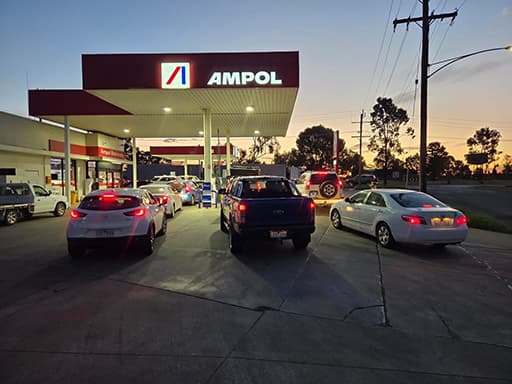
Photo: (AAP /Supplied by Nathan Falvo)


As we line up at the petrol bowser to pay 60 cents per litre more – and rising – than we did before the US and Israel attacked Iran, we should remind ourselves how indebted we are to Don and Bibi. And indebted is the word. Iran’s approach to asymmetric warfare hits the global community’s hip pocket hard, as it is intended to do. Erosion of political support is the result. There is scarcely a moderate to be found in Israel who supports Netanyahu, and Trump may well be heading for his Waterloo at the mid-terms.
Minister for Energy Chris Bowen is right when he says that panic buying rather than supply is responsible for long queues and higher prices. Australians, it would seem, are especially prone to supply phobias. As the COVID experience showed, our compulsive attention to personal hygiene led to panic-buying and hoarding of toilet tissue. Now the automobile takes precedence over the anus: panic-buying and hoarding of fuel is the new compulsion.
But Trump’s reassurances notwithstanding, energy prices are unlikely to drop anytime soon. Because Iran controls the Strait of Hormuz, it controls the oil supply. And Iran’s strategy is not to defeat America or Israel, but to squeeze the international community in order to put pressure on Trump and Netanyahu. The early indicators are that Iran is succeeding.
This confronts Australia with an acute energy vulnerability that is also a critical strategic problem. Our hasty acceptance of the attacks on Iran, their doubtful legality and strategic ambiguity notwithstanding, puts us at the whim of decision-makers in Tehran. Our precarious energy position is exacerbated by the repeated failure of Australian governments of all stripes to prosecute a rigorous national fuel stockholding policy and to construct the storage facilities to support such a policy.
Governments cannot say that they weren’t warned. Twelve years ago, Air Vice Marshal John Blackburn (Ret’d) conducted a study on Australia’s fuel supply and availability for the National Roads and Motorists Association (NRMA). At that time, Australia did not meet agreed International Energy Agency standards for fuel reserves. There has been no improvement since then. Indeed, the Morrison government’s 2020 decision to stockpile crude oil in Texas and Louisiana was described as little more than an absolute joke. The joke is no longer funny.
If energy and fuel insecurity is the immediate impact of the attacks on Iran, deeper damage to the global economy is on the cards. The AI boom is already leading to job cuts in the IT and software development industries. Increasing energy costs put additional pressure on interest rates, and these in turn increase the cost of borrowing. With rising levels of government, corporate and private borrowing, fears of a global financial crisis are rising.
And the longer that energy, food and other costs (such as the cost of borrowing) remain unstable, the greater are the risks of a significant global hiccup. If the growing chaos becomes the pretext for military adventurism elsewhere – stepping up the operational tempo in Ukraine, a naval blockade or an armed attack on Taiwan, or even further American military activity in the western hemisphere – the closer the world comes to a military calamity.
The energy crisis – for crisis it is – further destabilises already fractured strategic relationships, with possibly profound consequences. Trump has trashed NATO. French President Macron called Trump out in 2019 when he declared NATO to be “brain dead”. So how can Trump be surprised when NATO declines his request to provide warships to re-open the Strait of Hormuz, closed as a result of his ill-judged actions? NATO’s charter is the security of Europe, not cleaning up after petulant presidents. Yet Trump’s response to NATO’s reluctance to get itself involved in yet another US frolic is to threaten NATO even further, and to slag off at Australia, Japan and South Korea while he is doing so.
All of this was avoidable, of course, if leadership and good sense had prevailed. But the chances of that happening now look slim. Trump is mercurial and vindictive, delighting in the chaos he creates. Netanyahu is genocidal and opportunist, never missing an opportunity to pummel Israel’s neighbours in Gaza, Lebanon and now Iran.
So, as we all stand at the bowser, it is perhaps time for us to think the unthinkable. And if that fails to stimulate our national leaders to invest in some serious diplomacy to construct a set of inhibitors to war – a set of rules – then it is time for them to vacate the front benches of the Parliament and promote people with courage, leadership and vision.
It isn’t always easy to keep up with what’s happening in the US. “Shorter America” is a series where Dr Emma Shortis loops you in on what’s going on in America and shares news and analysis that you can trust.
It isn’t always easy to keep up with what’s happening in the US. “Shorter America” is a series where Dr Emma Shortis loops you in on what’s going on in America and shares news and analysis that you can trust.
Advertisement
While the initial Israeli and US air strikes on Iran are legally very dubious, the pace with which the war has escalated will result in those significant legal issues being set aside – for the time being at least.
Former Greek finance minister and economist Yanis Varoufakis has warned that fascism is re-surging in global politics, with extremist ideas gaining influence even in countries where the far-right is not in power.