The High Court has confirmed what Australia Institute research has shown for years: Victoria’s election spending and donation rules are undemocratic, and key provisions are unconstitutional.
In theory, Victoria’s donation cap meant no person could give more than $5,000 to a party or candidate.
In practice, loopholes allowed major parties to circumvent the cap and continue to fundraise and spend as they had before.
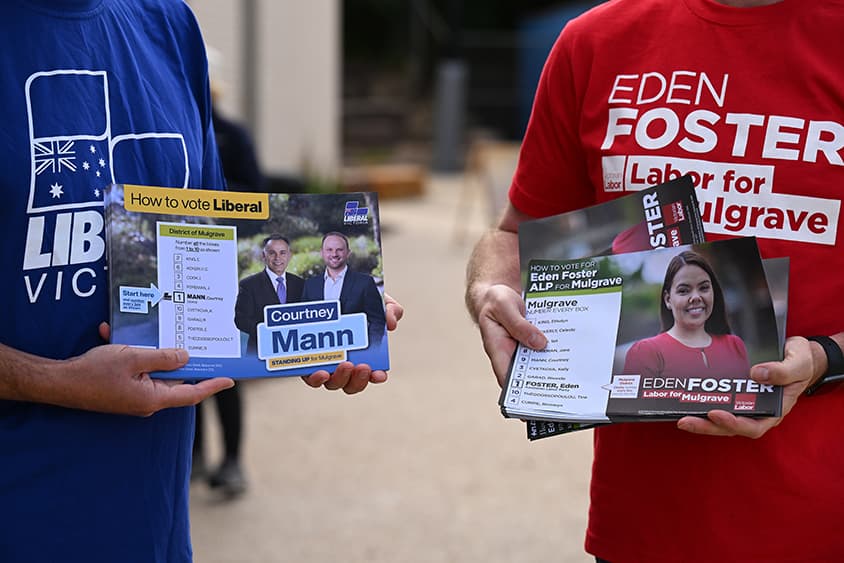
Two independent candidates from the 2020 Victorian election, when the donation cap first applied, challenged the laws. They took issue with one loophole specifically: the “nominated entity” exception to the donation cap. This carve-out allowed the fundraising/investment arms of the Liberal and Labor parties to ignore the cap.
Under the Constitution, a government needs a good reason to limit freedom of political communication. The High Court found this week that strictly limiting donations to independents and minor parties, while leaving an uncapped flow to major parties untouched, is unconstitutional.
The court did not want to step on the toes of elected representatives by redrafting the legislation itself. The High Court instead took the cleanest approach, striking out most of Victoria’s political finance laws: not just the donation cap, but also taxpayer funding of parties and transparency laws.
Victoria’s election is in November this year. That leaves a few months for the Parliament to decide between three courses of action.
The first is to reintroduce the laws, including the $5,000 donation cap, but with the nominated entity loophole excluded. This would be a missed opportunity, and could leave them open to another constitutional challenge, because the nominated entity loophole was just one of several ways in which the rules unfairly favoured the major parties.
Capping private donations may limit the influence of wealthy individuals and corporations, but it also puts independents and minor parties at a relative disadvantage. New candidates depend on private donations to fund their campaigns, while major parties and sitting MPs receive much of their funding from taxpayer sources.
Labor and Liberal have realised this is a win–win–win: look good on integrity with strict caps, secure taxpayer funding for their parties, and cut private funding that disproportionately benefits independents and minor parties.
The second course of action is for the Victorian Parliament to abandon donation caps, at least for this year’s election. This would be no bad thing. Of the 60 state elections in Victoria’s history, 59 were fought without donation caps – and they include some of the state’s most competitive, policy-driven, and vibrant elections.
The third is to find a form of donation cap that is fair and allows for competitive elections.
In place of a conventional donation cap, the Australia Institute has proposed a “mega-donor cap”. This still allows for private fundraising but limits the total financial influence that any one donor can have. A “mega-donor cap” would also close off one remaining loophole in conventional donation caps: that wealthy donors can split donations across many likeminded parties, provided each one comes under the cap.
The worst thing Parliament could do is rush through untested legislation – repeating the error that got the state in this mess to begin with.
The High Court decision demonstrates how commonplace slipshod and self-interested democratic “reform” has become in Australia – not just in Victoria.
Even after Australia Institute research showed that “nominated entities” were unfair and undemocratic, the Albanese Government federally and the Malinauskas Government in South Australia legislated donation restrictions with a nominated entities loophole. South Australia’s is particularly extreme: a ban on most political donations, combined with millions of dollars of taxpayer funding for the major parties and sitting MPs, now including One Nation.
South Australians will be left with the unpleasant thought that last month’s state election was contested under laws that may not survive a constitutional challenge. And all Australians have cause to wonder what laws will apply to the federal election in two years.
Fortunately, there is a way through. The Australia Institute has outlined nine principles for fair political finance reform. They fall into two main categories: all candidates and contributors should be treated fairly, and all reforms should be targeted and effective.
Guided by these principles, politicians could go back to the people and ask what they want from political finance laws.
How should the tens of millions of dollars of taxpayer funding for political parties and candidates be distributed?
How could the system accommodate new parties and independents, so elections are as competitive as possible?
What reforms would limit the influence of billionaires and lobby groups, not just pretend to?
These questions have been neglected but having the High Court breathing down their necks will give politicians fresh motivation to legislate for political freedom and a more competitive democracy.
Bill Browne is the director of The Australia Institute’s democracy & accountability program.