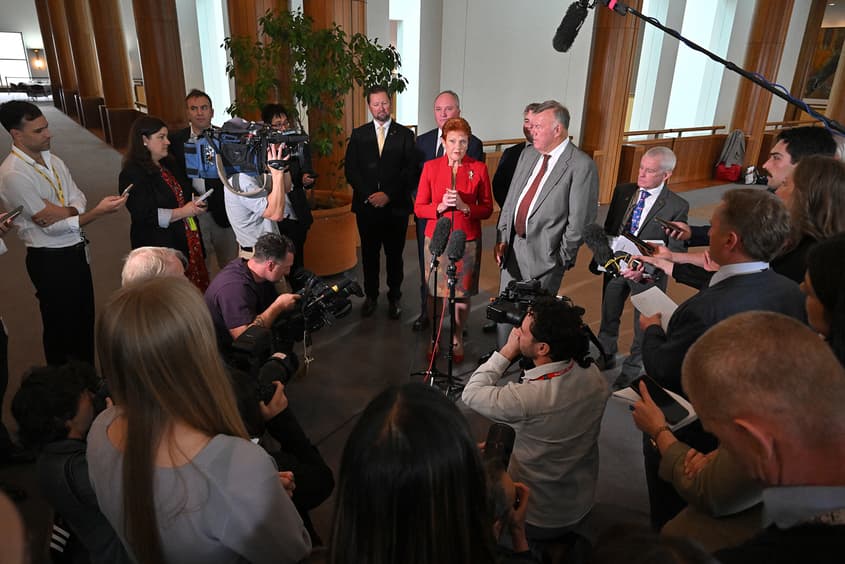
The Liberal Party will not back the Albanese Government’s proposed reforms to capital gains tax and negative gearing, and pledges to repeal them if elected.
For many policies, that would be the death knell.
The Albanese Labor Government makes a virtue of its willingness to work with the Liberal–National Coalition. During its first term it refused to act on truth in political advertising laws, religious liberty and religious discrimination protections, public hearings for the National Anti-Corruption, nature positive legislation or a modest increase in the number of territory senators – all because they failed to win the support of the Opposition.
The Government even changed political donation laws to uphold “the centrality of the Westminster, two-party system” (that is, prop up the two major parties).
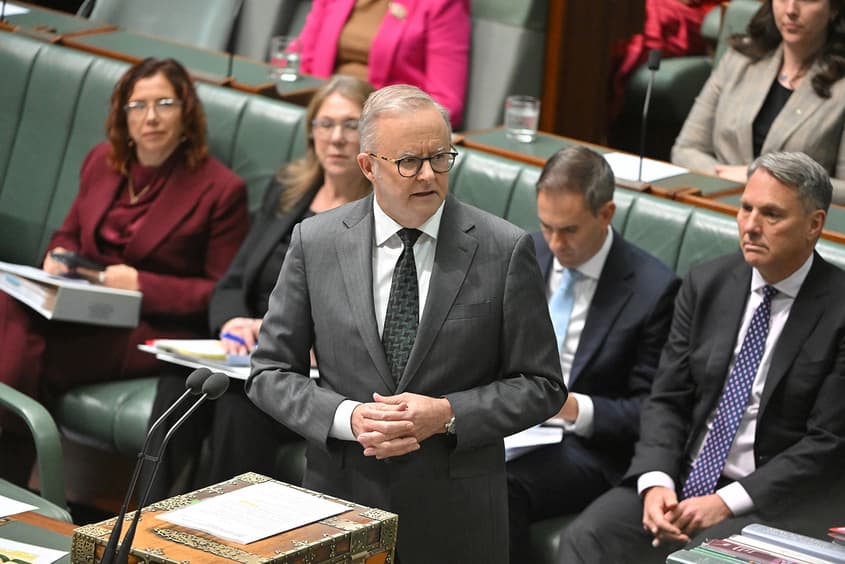
This term, Prime Minister Anthony Albanese backed away from expanding the size of Parliament just hours after Opposition Leader Angus Taylor announced he opposed the idea.
But Labor’s deference to the Liberal veto is a choice – not something forced upon the government.
Australians elected climate and integrity super-majorities, giving Labor two paths through the Senate: with the Greens and crossbenchers, or with the Coalition.
And while Labor is quick to blame the Coalition for Labor’s failure to act, the reality is that Mr Albanese has always been willing to negotiate with the Greens when he actually wants something to happen.
When the capital gains tax and negative gearing reforms pass the Parliament in compromise with the Greens, they will be following a well-worn path – just one less often acknowledged by a Government keen to be seen as moderate, “bipartisan” and centrist.
The Australia Institute looked at the 549 votes in the Australian Senate in the Albanese Government’s first term (2022 to 2025) that were classified as relating to motions (like statements relating to the Israel–Palestine conflict) or bills (like amendments to the National Anti-Corruption Commission Bill).
On successful votes on bills, Labor actually votes with the Greens about as often as the Coalition: 192 times with the Coalition and 191 times with the Greens. There is a difference in emphasis: most of Labor’s votes with the Coalition were to vote down a proposal, while most of Labor’s votes with the Greens were to vote up a proposal.
In most cases, at least some independent and minor party crossbenchers also voted with Labor and the Greens as the Greens did not have sole balance of power from 2022 to 2025 (the 47th Parliament). Crossbenchers are harder to capture in voting figures because they are numerous and rarely vote in a bloc.
There are also examples of the Coalition and Greens voting together to successfully vote up or down a proposal: 52 cases in the 47th Parliament. A further 28 times, Labor, the Coalition and the Greens voted together.
While votes relating to bills were finely balanced, Labor’s successful motion votes were generally with the Coalition: 50 such cases versus 21 with the Greens.
These metrics are only a small slice of the business of the Senate. Many bills do not have any votes recorded in association with them, and the votes that are recorded are not necessarily the most important matters considered by the Parliament. For example, there may be a vote recorded on an amendment to a bill but not on the bill itself.
Most proposals pass or fail “on the voices”, which is to say that votes are not recorded. And votes are not all of equal significance: who votes with whom is less important than why they are voting together and what they are voting on.
Nonetheless, even this small slice of data is a reminder that the Labor Government has two paths to get its laws through the Parliament.
When it wants to, the Government works with the Greens, the Coalition or both to achieve its goals. Anything else – whether truth in politics or religious liberties – is not really a priority, whatever Labor’s rhetoric.
Thanks to Anara Watson for preparing the data for this article.