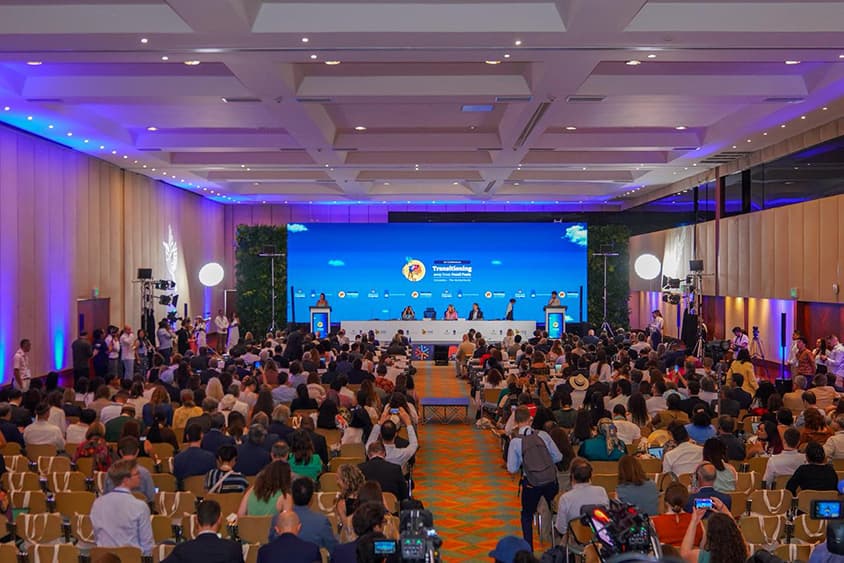
Delegates from more than 50 countries arrived in Santa Marta already primed by disruption: higher prices, tighter supply chains and renewed volatility.
Many arrived with scaled-back delegations, absent Ministers (including Australia), or not at all, as the same fossil fuel-driven conflicts dominating the agenda constrained travel, strained government bandwidth, and diverted political attention at home.
The result has been a notable hardening of tone and urgency. Fossil fuels are being recast not just as the cause of climate change, but as a systemic risk to economic and political stability.
It came in the language leaders chose – not the usual careful choreography of “pragmatism” and “balanced approaches”, but something sharper. Fossil fuels were no longer framed as merely an emissions problem. Instead, being described as a driver of instability, conflict, and economic and social vulnerability.
And hanging over it all: the Iran war.
Because when oil and gas prices spike and shipping routes wobble, the abstraction of “energy security” becomes painfully literal. The geopolitics of fossil fuels reassert themselves, and with them, a question that governments can no longer dodge: how long do we want to remain exposed?
The interconnectedness of climate and security
As global energy markets convulse under geopolitical strain, momentum behind the need to phase out fossil fuels has shifted from moral obligation to strategic necessity.
The reframing matters. It broadens the coalition of the willing for change. It is focusing collective minds and helps explain why countries are now moving, publicly, to map their exits.
France draws a line under fossil fuels
France has moved to formalise that shift, with what is being widely described as the first comprehensive national roadmap to phase out fossil fuels.
Announced by climate envoy Benoît Faraco, the plan sets explicit end dates across the economy: coal by 2030, oil by 2045, and gas by 2050.
This is not, strictly speaking, new policy, but a consolidation of work already underway — a commitment to a fossil fuel phase-out. And in doing so, it has made the phase-out legible, and able to be legislated.
That clarity is the point. It says: this is possible… this is happening. Most importantly, it says to other governments, you can plan for it.
A conference searching for momentum, and finding it
Santa Marta was never expected to deliver binding agreements. It was designed to do something subtler: shift the centre of gravity and provide a platform for ambition, action, and to work alongside existing UN processes, without getting lost in consensus negotiations which can be knobbed by fossil fuel interests.
And there are signs that it’s working.
Countries, including Colombia and Brazil, are now developing their own transition roadmaps.
The conversation in Santa Marta is not whether to phase out fossil fuels but how to do it and at what speed.
Even the framing of solutions is evolving. Renewable energy is no longer just the cleaner alternative; it is being positioned as the stabilising force in an increasingly unstable world. And fossil fuel supply is being clearly pointed out as the tide that needs to be stopped.
That argument is difficult to counter when the alternative is a system tied to volatile global markets and geopolitical flashpoints.
Australia: still exposed and hesitant
Which brings us, inevitably, home to Australia. Who, due to global volatilities, did not send Ministerial, Assistant Ministerial, or even ALP backbenchers to this conference.
The lesson of the past few weeks is that fossil fuel dependence equals exposure to price shocks, to geopolitical conflict, to decisions made far beyond national borders – and Australia remains deeply exposed.
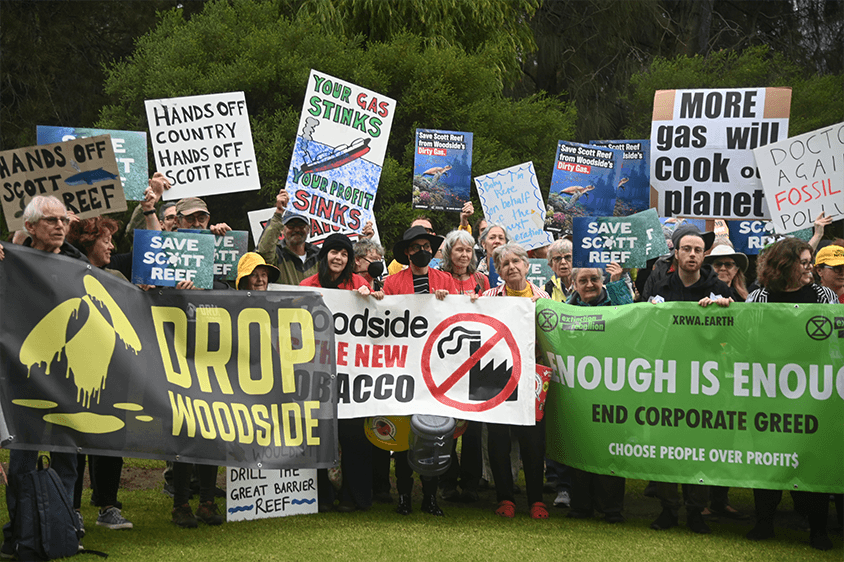
Analysis from the Australia Institute has been clear and consistent on both the problem and the solution. Continued expansion of coal and gas exports does not insulate the country from global volatility; it entrenches it. The domestic economy remains tethered to volatile international spot prices and supply cycles, while new projects risk becoming stranded assets in a decarbonising world.
What follows is not a vague transition plan, but a concrete starting point. Australia Institute analysis maps out how Australia could ban new coal and gas projects, establish a clear timeline to phase out fossil fuel production, eliminate fossil fuel subsidies, and increase taxes on fossil fuel extraction. These are concrete steps to enacting our commitments made at the Belem conference.
In other words, stop expanding the problem! Start planning its end, and remove the policy settings such as subsidies and start taxing gas fairly, rather than continuing to prop up fossil fuel companies.
These are not radical ideas. They are, increasingly, the baseline. What Australia lacks is not capacity. It is commitment, and frankly, political bravery in the face of the fossil fuel lobby.
The politics of inevitability
There is a particular kind of politics that emerges when a transition shifts from hypothetical to inevitable.
It is no longer about if but when, and not about whether but who benefits.
France’s roadmap is an example of that shift. It does not argue for the transition; it organises it. It creates timelines against which policy and politics can be measured.
And that is where the pressure will build. Because once one country sets out a clear exit, the policies, resources, and alternative ways to power our society are given room to move.
The risk of being last
There is a risk that sits beneath all this that Australia is exposed to. Not the risk of moving too fast, but of moving too slowly.
In a world accelerating towards electrification and renewable energy, late movers who are clinging onto the ways of the last century do not simply delay benefits; they accumulate costs: stranded infrastructure, lost investment, diminished competitiveness, and a redundant fossil economy.
France has decided it no longer wants to do that.
The question for countries like Australia is how much longer we are willing to cling to the polluting past.
Louise Morris is an award-winning advocate with 20 years’ experience encompassing climate, energy, forest protection, and law reform in the not-for-profit sector, and federal politics before joining The Australia Institute