This week, the Prime Minister announced $1.1bn in funding for the Kwinana Westport container terminal proposal. But while this project has long been argued by Western Australian governments as necessary, it relies on assumptions that have not materialised and would result in billions of dollars committed to an unecessary project rather than to the urgent and visible crises in housing, healthcare, and education infrastructure.
The case for a new container port rests on the assumption that the current port at Fremantle will soon be unable to meet the forecast increase in container volumes by the next decade.
But unfortunately for those spruiking the need for a new port, the evidence tells a very different story.
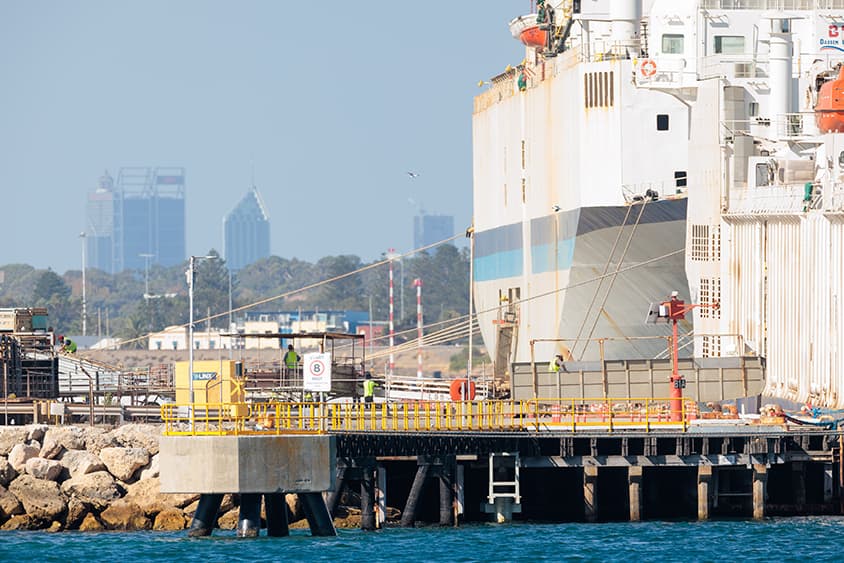
Fremantle Port currently handles well under half of its theoretical capacity – less than 900 000 TEU (the standard measure of containers) in recent years, well below the 2.4 million TEU capacity.
But more importantly, the Westport project is justified because of forecasts made back in 2016 for container volume growth.
10 years on, however, those forecasts have turned out to be laughably wrong. Container trade is increasing at roughly half the rate forecast. Rather than growing, recent data shows volatility and even decline. Monthly throughput in 2025 shows year-on-year decreases, with total trade down and growth stagnating.
This is not a temporary anomaly – it is part of a broader structural reality.
Independent expert consensus has long suggested Fremantle has decades of capacity remaining. The 2025 Infrastructure WA report explicitly recommended delaying Westport by at least a decade, recognising that current demand does not justify immediate construction and that better use of existing infrastructure should be prioritised.
At the national level, Infrastructure Australia (IA) has also raised serious concerns about when and how major projects should proceed.
IA analysis highlights the importance of construction sequencing, particularly in WA, where a surge is already underway in major projects. The AUKUS submarine program alone is expected to generate enormous demand for labour, materials, and construction capacity. The addition of Westport to this pipeline would significantly intensify these pressures.
WA is already experiencing a severe housing crisis, driven in part by labour shortages and escalating construction costs. Diverting scarce labour and resources into an unnecessary mega-project will only worsen these conditions.
A massive spike in construction demand, driven by AUKUS and compounded by Westport, would further constrain the workforce, inflate wages, and push housing costs even higher. Westport would therefore directly undermine the state’s ability to address its most pressing economic and social challenges: the chronic shortage of public and affordable housing.
At the same time, the economic efficiency of the existing Fremantle Inner Harbour continues to improve. Fremantle is already one of the most efficient ports in Australia, with industry-leading crane rates, truck turnaround times, and competitive costs. More importantly, proven operational improvements have demonstrated that capacity can be significantly expanded without building a new port.
Meanwhile, relocating the port to Kwinana would also introduce permanent inefficiencies into the supply chain – increasing transport distances by 20 to 30 kilometres or more for key freight routes, effectively doubling some journeys, and resulting in higher fuel costs, longer travel times, more road congestion and more wear on infrastructure.
A second container port in a state with a relatively small population duplicates infrastructure and services, while fragmenting supply chains. This would increase costs, logistical complexity, and reduce efficiency – hardly the outcome you want from a more than $7 billion investment (before even counting the requirement for road and rail upgrades).
And all of this is ignoring the fundamental design flaws of the Westport design. The site is exposed to weather such that there will a substantial increase in lost shipping days due to weather and sea conditions, compared to the more protected Fremantle Inner Harbour.
If it continues, Westport will become a classic white elephant: expensive infrastructure that sits underutilised for decades while taxpayers carry the increasing cost.
These warnings echo past mistakes. Have we learned nothing from the well-documented delays and cost overruns of the Gorgon Project, where underestimated logistical challenges led to significant blowouts?
Every dollar spent on Westport is a dollar not spent addressing the more urgent and important needs of the state.
Western Australia’s public hospital system is under severe strain. Many public schools rely heavily on old transportable classrooms that lack basic amenities such as air conditioning.
Critically, Western Australia is facing a worsening housing crisis. A chronic shortage of public and affordable housing is leaving thousands without secure accommodation while driving up rents and cost-of-living pressures. A multi-billion investment in an unnecessary port in preference to much needed investments in housing, education and health infrastructure is both bad policy and bad politics.
At its core, the Westport proposal violates a fundamental economic principle: optimise existing assets before building new ones. Fremantle Port has received significant investment, remains underutilised, and is capable of meeting the state’s needs for decades. On the other hand, the case for Westport is undermined on every front: demand, cost, timing, design, and priority.
The WA and Australian governments should adjust their decisions according to the growing body of evidence, and put taxpayer dollars into what people need most: properly resourced emergency services, and improved housing, school, and hospital infrastructure.
Will Tracey is the WA Branch Secretary and National President of the Maritime Union of Australia.