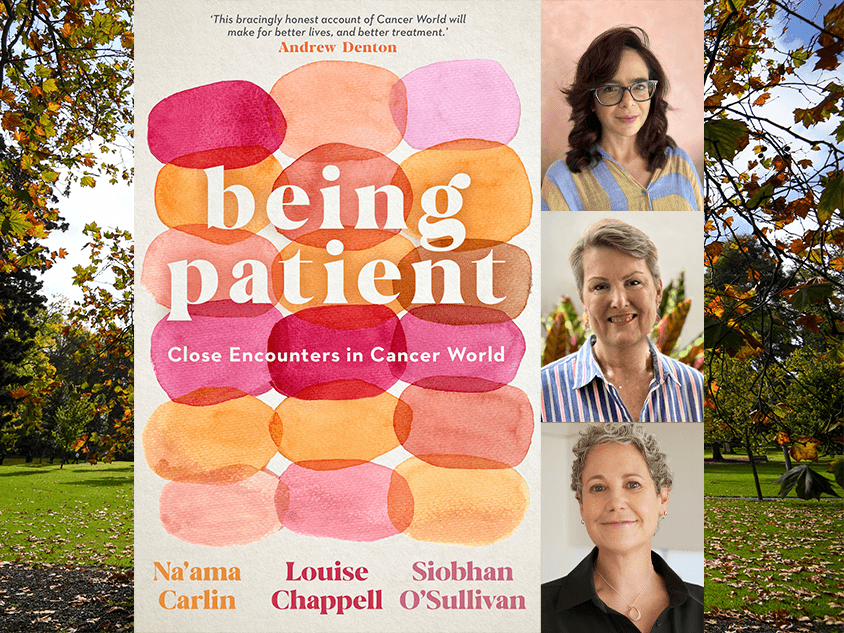
Our initial motivation for writing the book sprang from our own experiences.
Despite the devastation, fear and stress that a cancer diagnosis brings, our experience of Cancer World is defined by our relative privilege.
We are educated, white, middle-class cis women, with secure employment at a reputable university. We had financial security in the form of flexible work and generous sick leave provisions that we each drew upon, and a superannuation system that enabled Siobhan to access a life insurance payout before she died, and which also provides us with a financial bedrock, should we need it. Living in urban Sydney, in proximity to cancer research hospitals and well served by public transport, we each had access to some of the best care in Australia, if not the world.
Nevertheless, having moved from what American writer and critic Susan Sontag calls the ‘Kingdom of the Well’ to the ‘Kingdom of the Sick’, we jointly realised that we were completely disoriented.
Despite our privileges, and knowing how to manoeuvre within labyrinthine bureaucracies thanks to working at a university, we found Cancer World overwhelming. Suddenly we were confronting our own mortality, experiencing a newfound dependency on medical professionals and an associated sense of infantilisation, all while having to navigate complex systems and siloed expertise across the healthcare system.
Discussing our responses to this disorientation, we realised that each of us had engaged in ‘magical thinking’ – a state that psychoanalyst Thomas Ogden describes as employing a fantasy, an illusion (or, at times, a delusion) that somehow, you exist outside of the laws of nature.
Put simply, magical thinking is the belief that certain actions, thoughts and attitudes can influence events, even when there is no apparent connection between them.
Magical thinking is a way of coping with traumatic and uncertain situations. Cancer patients resort to magical thinking as a way of exerting control over situations where we have little. It becomes a way out of reckoning with our own inevitable mortality, and even with reality. It is so ubiquitous that wellness influencers have built empires on people’s tendencies towards magical thinking, by convincing people that their cure from cancer is one yoga stretch, positive thought or juice cleanse away.
We each felt that magical thinking enabled us to hide from the weight of cancer-related anxiety and distress.
Cancer patient Alysa Cummings landed on this connection long before us, characterising magical thinking as ‘an attempt to control the uncontrollable’ aspects of a cancer diagnosis.
Magical thinking is seductive because it offers an alternative to a reality that is overwhelmed with surgeries, toxic drugs and painful treatments that can – at their worst – kill you, and at their most tame, leave you with lingering side effects.
Finnish-Canadian philosopher Mari Ruti revealed her magical thinking about her cancer diagnosis: ‘nothing is easier than entertaining the hope that I will be the exception to the rule, that somehow miraculously I will survive when others perish’.
In the early days of diagnosis and treatment, the three of us manifested magical thinking in a similar way.
We made efforts to endear ourselves to our treatment teams, as if being liked was a condition of survival. Before entering Cancer World, none of us were easily intimidated by those in authority. We were used to using our voices to express dissent when university management made decisions that we and our colleagues disagreed with, for example. Nonetheless, in Cancer World we were very conscious of the hierarchal relationship we had with our medical teams – they controlled the course of treatment, after all – and our desire, conscious and unconscious, was to impress our medical ‘saviours’. We did this by attempting to be likeable, obedient, punctual, non-questioning and friendly.
From our perspectives, these qualities made us ‘good patients’, building on our mutual fantasy that ‘if my doctor likes me, and I behave well, they will save me’. Magical thinking meant we each felt as if we could influence the success of our treatment through our behaviour.
Clearly, not all patients adopt this approach. That said, during our conversations with healthcare professionals, carers and patients, we learned that efforts to comply and impress are far from unusual. Callum, an oncology nurse, told us he sees this happen all the time:
I’ve had patients tell me: ‘I don’t want to make a fuss here because it might mean that I don’t get good care.’ They fear that if they need to press the bell too many times, then the nurses aren’t going to like them, and they’ll begin not to come at all. Or they won’t be put in a trial because they’re seen as a problem person. I do see people thinking that they can impact their treatment … that they don’t want to be problematic for fear that it will have poor outcomes for them, whether that’s from a day-to-day basis or from the treatments they receive.
Magical thinking can be a coping mechanism, but it has risks. Over time, we came to realise that attempting to be the good patient to be ‘saved’ had its drawbacks, especially because we each became less likely to advocate for our own health and to question our doctors’ decisions when we, in our bodies, felt they were wrong.
While waiting for her diagnosis during the first Covid-19 lockdown, Siobhan wanted to be seen as a compliant patient. She strongly sensed that she had initially been misdiagnosed by her general practitioner, who had dismissed most of her concerns and focused only on her increased weight.
Telling Siobhan that she had ‘lockdown weight gain’, the GP sent her away with instructions to exercise and watch her diet. The GP’s tone was decisive, leaving Siobhan feeling unable to assert herself and stand her ground to ask for a second opinion. She did not want to be a troublemaker. Siobhan’s intuition was correct: the bloating and weight gain were symptomatic of ovarian cancer.
Her magical thinking – that being a good patient would save her – had failed.
Similarly, Louise felt unable and unwilling to challenge her surgeon when he claimed to have removed ‘all the bad weeds’ from her breast, even though she continued to feel a lump growing under her arm.
Wanting to remain a good patient, she decided against seeking a second opinion, believing that the surgeon knew best. When she finally had the lump biopsied, she learned that the nodal spread was significant. Soon after, liver lesions were detected.
Louise now lives with a terminal disease, the consequence of having tried to be ‘the good patient’ and not advocating more fiercely for herself.
In Na’ama’s case, her urge to be the ‘best patient’ was rooted in the belief that if her doctors liked her, they would cure her. This is irrational, Na’ama admits. But still she tried, thinking that this would make her medical team try extra hard in her case. ‘If they like me, they’ll give me the top-shelf chemo,’ she joked.
The implication, of course, is that if Na’ama wasn’t cured, the fault would be hers. It would have been her who had done something wrong, an extension of the internalised magical thinking superstition that positive thinking is curative.
Such magical thoughts have no age barriers, as Kirsty Everett explains in her searing memoir Honey Blood, reflecting on her experiences of childhood leukaemia. When she was diagnosed, she believed her parents thought she was intentionally trying to upset them, while her young friend apologised for giving her cancer because he had not been nice enough to her.
Our experiences taught us that while magical thinking is a panacea of sorts, it can have serious consequences. Ogden puts it bluntly: ‘[A]s convenient as magical thinking is, it has one over-riding drawback: it does not “work” – nothing can be built on it or with it except additional layers of magical constructions.’9 As the nurses and doctors we interviewed told us, treatment protocols do not change based on behaviour. Penny, an oncology nurse, explained:
The doctors may inform us that the patient is potentially a difficult person and we may need to manage that, but ultimately personality does not affect your treatment. I’d like to think we are more professional than that … as far as treatment goes, the doctors don’t discriminate and nor do we.
It is irrational to think that if your doctor likes you, they’ll cure you.
Cancer cannot be cured with a change of attitude. Nor does thinking bad thoughts give you cancer. But it is no surprise that patients resort to such thinking to maintain some sense of control after being thrown into a bureaucratic medical system where individuals become defined as a set of symptoms and problems to be solved.
Together, the three of us gradually came to realise that you cannot think yourself out of cancer. Nor does being a good patient mean you’ll be cured. We have recognised that a cancer diagnosis placed us in a world much bigger than ourselves. Understanding the dynamics of this world is more important than any magical game we can play.
This is an edited extract of Being Patient: Close Encounters in Cancer World, by Na’ama Carlin, Louise Chappell and Siobhan O’Sullivan. Available from 1 May in all good bookshops.
Na’ama Carlin is an award-winning educator and Senior Lecturer in Sociology at the University of New South Wales. She has written about the need for policy reform concerning pregnancy and cancer and has advocated for equitable access to cutting-edge cancer medication.
Louise Chappell is a Scientia Professor at the University of New South Wales, where she researches gender justice in relation to politics, policy, and law. Committed to improving cancer patients’ experiences and supporting health professionals in delivering informed care, her work highlights the power dynamics that can influence treatment decisions and outcomes.
Siobhan O’Sullivan was an Associate Professor of Social Policy and Research at the University of New South Wales, where she worked on inequality, welfare-to-work policy, and animal protection. Siobhan was diagnosed with ovarian cancer in August 2020 and underwent extensive treatment, including chemotherapy and surgery. She dedicated her final years to advocating for greater investment in research into ovarian cancer early detection and more effective treatment options. Siobhan died in June 2023.