Here is a truth that those in power have never quite figured out how to deal with: change doesn’t start at the top. It starts at the fringes. It starts with people who have the least and stand to lose the most. And eventually, it ends up in the halls of power.
Not because those in power decided to lead. But because the people gave them no other choice.
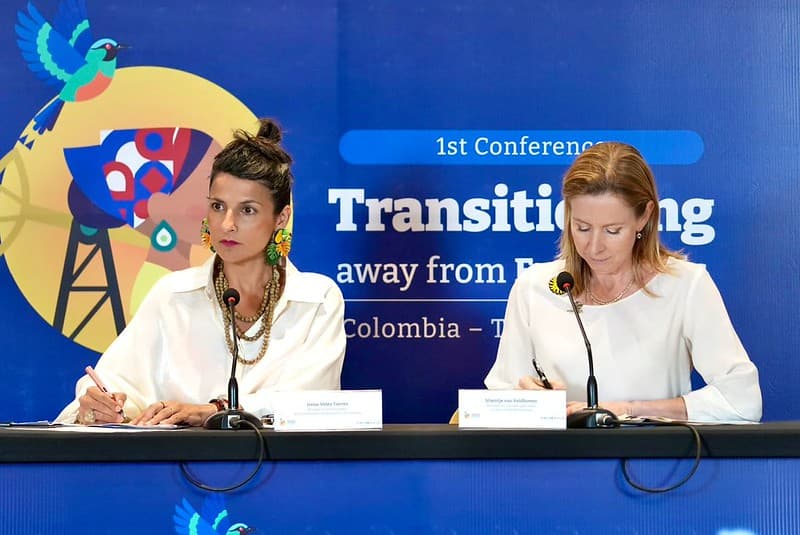
This week, in the Colombian port city of Santa Marta, – a city that exports coal – the world’s first international conference dedicated to Transitioning Away from Fossil Fuels arrived on the global stage. Co-hosted by Colombia and the Netherlands.
The conference brought together 57 governments, academics, civil society groups, Indigenous leaders, trade unions and scientists, to do something the The United Nations Framework Convention on Climate Change (UNFCCC) has conspicuously failed to do: talk seriously about actually ending oil, gas and coal production.
The symbolism is almost too perfect. A coal-exporting city, now hosting the world’s most ambitious conversation about making fossil fuels history. It didn’t happen by accident. It happened because ordinary people wouldn’t let it not happen.
Power isn’t given. It’s taken.
If you want to understand how political will is created, don’t look at the ministers who flew in. Look at what happened before they arrived.
On April 26, the streets of Santa Marta filled with multiracial, multinational and multigenerational fury and hope. Residents, Afro-descendants, women, youth, and Indigenous peoples from the Sierra Nevada de Santa Marta joined global climate justice activists in the “March for a Fossil Free Future,” moving down the Avenida Ferro Carril to the Plaza de Bolivar in a river of banners and drums.
That march didn’t happen because a politician asked for it.
Goldman Prize winner Yuvelis Morales put it plainly: “We come from the rivers, from our territories. We are young people standing up to say that our future is one of water, biodiversity, joy, and song – a future without fossil fuels.”
That’s not a diplomatic communique. That’s a demand.
For three days before the ministers got to work, the People’s Summit for a Fossil Free Future ran in parallel. Coordinated by over 900 organisations, including the Global Campaign to Demand Climate Justice and Climate Action Network International.
On April 26, it produced the People’s Declaration for a Rapid, Equitable, and Just Transition, 15 principles forged over months of global community dialogue.
The next day, civil society representatives walked into the formal process and delivered it directly to government delegates through the Assembly of the People. “The era of negotiation has passed,” the Declaration stated, “The era of implementation must begin.”
Indigenous peoples didn’t wait to be invited.
Perhaps no voices at Santa Marta cut more directly to the truth than those of Indigenous leaders, whose communities have been burning whilst global negotiations get lost in minimum sum game consensus processes.
Oswaldo Muca, General Coordinator of the Organisation of Indigenous Peoples of the Colombian Amazon (OPIAC), was not diplomatic: “We talk about a just transition, but in practice it is not true. Mining continues. Extraction continues. Deforestation continues.” The resources from extraction, he noted, “do not reach Indigenous territories, but they destroy the territory and leave the damage.”
Xananine Calvillo Ramirez, an Indigenous activist from Mexico’s Ngiwa territory, who marched in the streets, was direct about the conference’s official processes: “It reproduces the same exclusion as the UN conference.” Of the 1,000-plus civil society attendees, only a handful could enter the ministerial space. That’s not a technical problem. That’s a political choice. And people are documenting it loudly and will push for change in the coming conferences.
The political stream is catching up. Slowly.
The academics confirmed what frontline communities have been saying for years. The UN Special Rapporteur on Climate Change and Human Rights, Professor Elisa Morgera, noted the International Court of Justice made explicit last year what science has said for decades: fossil fuel expansion is incompatible with states’ legal obligations.
The Fossil Fuel Non-Proliferation Treaty initiative now has over 3,000 scientists, 101 Nobel laureates, and the World Health Organisation behind it. The science is not in dispute. What’s been missing is political will.
And that, as every grassroots organiser who has ever won anything will tell you, is created by people, not discovered in ministerial offices.
Something has shifted. Colombia’s Vice-Minister Mauricio Cabrera Leal told civil society attendees something that would have been unthinkable at previous COPs: “The transition must be built from the bottom up.”
A coalition of 18 nations called for a binding international instrument on fossil fuels. The Brazilian COP30 presidency indicated it would take Santa Marta’s outcomes to COP31.
None of that happened in a vacuum. It happened because at COP30 in Belém, petrostates blocked a fossil fuel decision while 80 countries, communities, medical professionals and climate movements watched from the sidelines. The frustration didn’t dissipate. It organised. Santa Marta is what happens when people organise.
History has a pattern that those in power continue to be surprised by. The movement to end slavery. Universal suffrage. Marriage equality. In every case, change came from people who were told they were asking for too much, too fast. And in every case, once the movement became impossible to ignore, politicians suddenly discovered they had always believed in it.
That is where political will comes from. The politicians in Santa Marta know it. They’ve been told. Now they must act.
So, what did five days actually produce?
The official co-host takeaways released by Colombia and the Netherlands on the closing evening are worth reading carefully. Because they show both how far things have moved and how much further they must go.
Five concrete outcomes were delivered. A second conference has been announced for 2027, co-hosted by Tuvalu and Ireland – with the main event in Tuvalu, a nation whose survival is in question due to climate change.
A coordination group will keep things moving between now and then. The conference report will be formally handed to the COP31 co-presidency and fed into the UNFCCC process ahead of Bonn in June.
Three working groups have been established: on national transition roadmaps; on overhauling the financial architecture that keeps fossil fuels cheap and clean energy expensive; on aligning what producers supply with what consumers are willing to phase out.
And a new Science Panel for the Global Energy Transition has been launched to give countries the technical scaffolding to build credible plans.
These are significant. A second conference. A science panel. Three workstreams with actual mandates. A direct pipeline into COP31, which Australia holds a Co-Presidency role. For a process that didn’t exist eighteen months ago, that’s serious movement.
But read the fine print. The co-hosts are careful to note that the conference “did not aim to develop new targets, but how to advance and accelerate the implementation of agreed goals.”
In other words, the political ceiling was deliberately kept low.
The grassroots movement came demanding a managed, urgent, binding phase-out.
The official process produced coordination mechanisms and working groups.
That gap, between what the people demanded in the streets and what the governments committed to in the rooms, is not a failure of Santa Marta. It’s the gap that every social movement has always had to close. And historically, the way it closes is not by being patient. It’s by being louder, by applying more pressure, and organising further, until the rooms have no choice but to move.
The conference outcomes give the grassroots movement something to hold governments to.
The next conference in Tuvalu provides a deadline. The COP30 to 31 handover provides a moment of accountability. And the people who marched, who wrote the People’s Declaration, who delivered it to ministers’ faces… they will be watching every step of the way.
That’s how change works. From the fringes. Always from the grassroots. And, eventually, it becomes inescapable.