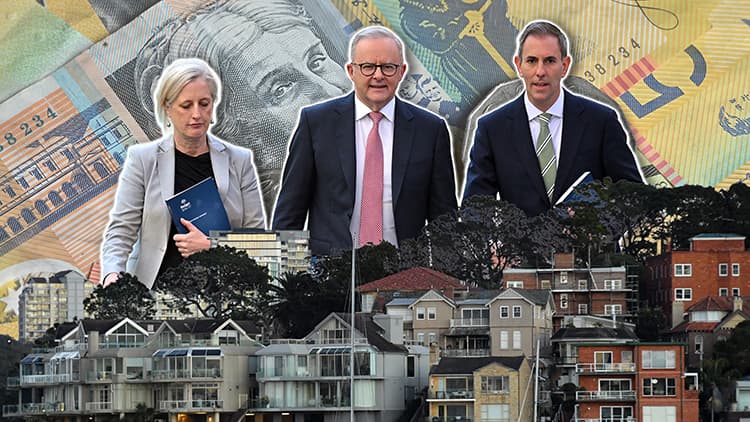
The Albanese Government has broken an election promise. The Prime Minister ruled out changes to negative gearing and capital gains tax before the election, but Tuesday night’s Budget confirms that these tax concessions will be reformed to discourage property speculation and lower housing prices.
A broken promise is worth calling out. People should keep to their commitments or explain why they have broken them.
But the policy debate is useless if, having called out a broken promise, journalists and politicians have nothing more to say.
That monomania was on public display in Treasurer Jim Chalmers’ interview with Sarah Ferguson on the ABC on Tuesday.
“Will you first acknowledge the broken promises, and then we can talk about why?” she said.
“Yes,” said Chalmers. “I acknowledge the government’s come to a different view.”
But Ferguson wouldn’t hear it. Her next question began: “No acknowledgement of broken promises, despite the fact that they are blindingly obvious to everybody watching.”
So much for getting to “why” the government had broken its promise. Fearless journalists don’t let little things like acknowledging a broken promise stop them from holding the government to account for … not acknowledging a broken promise.
This is not the first time that the Government’s critics have put knee-jerk reactions over detail. At the end of its first term, the Albanese Government broke its promise to keep the Stage 3 tax cuts unchanged. The media and Liberal–National Opposition had threatened that a broken promise would hang around the Government’s neck like Julia Gillard’s “no carbon tax” statement did ten years earlier.
But when Labor actually bit the bullet, it was a very different story. The Liberal–National Opposition held out for all of a day before breaking their own commitment by backing Labor’s Stage 3 changes.
Australia Institute polling research gives an insight into why. Two in three Australians said it is more important to adapt economic policy to suit the changing circumstances, even if that means breaking an election promise, than to keep an election promise regardless of how economic circumstances have changed.
As they did for the Stage 3 tax cuts, the media and Opposition have focused on form and process – the broken promise – instead of outcomes. They know Labor wins the argument on outcomes.
The housing market is a horror show, and capital gains tax and negative gearing are partly responsible. Young people are locked out of home ownership. Even the well-heeled beneficiaries of these unfair tax concessions will know less fortunate friends and relatives who are harmed by them.
Albanese and Chalmers are not the first politicians to break a promise. John Howard made a distinction between “core” promises, which he intended to keep, and non-core promises after his first budget in 1996 cut funding for higher education, labour support and the ABC. By the end of the decade, Howard would also break his “never ever” GST promise, but that has not stopped the Liberals from celebrating the GST as a reform victory.
When the Australia Institute criticised the GST plan in the 1990s, it was more interested in the package’s potential positives and negatives than whether it constituted a broken promise. Some of those criticisms were even addressed in the final package, showing the benefit of dealing with the substance of a reform.
The media applies a double standard when deciding which broken promises are forgivable. Peter Dutton’s pledge to hold a second referendum on Indigenous recognition was broken just two days after Australians voted down the Voice referendum. The NT Country Liberal Party broke its emissions reduction promise after winning election.
There was little criticism of either. Rather than core and non-core promises, there are sacred “promises to property investors” and then there are disposable “promises to Indigenous Australians” and “promises to future generations”.
There are three lessons here for politicians and journalists.
Firstly, the Stage 3 tax cut changes prove that when the Government can make a case for reform, Australians will overwhelmingly get behind it.
Secondly, it is unproductive for journalists to provoke politicians into ruling things in or out before an election and unseemly for politicians to take the bait.
Thirdly, people are going to stop believing that the papers genuinely care about economic reform if every proposed reform is met with talk of “broken promises” without constructive critique.
A broken promise should be criticised. But when the only thing the enemies of a reform can find to criticise is that it breaks a promise, the Government can be confident it is onto a winner.