Most would agree that the Premier of South Australia, Peter Malinauskas, is an extraordinarily adept politician. Maybe, even, a generational talent.
He has a considerable ability to communicate clearly and control the narrative – capacities that are most plainly visible when his carefully considered political strategies are rolling out as intended.
However, when things go awry, the wheels tend to come off, if only temporarily.
Consider the fallout from the Premier’s role in the cancellation of Palestinian Australian author, lawyer, and academic Dr Randa Abdel-Fattah’s appearance at Adelaide Writers Week earlier this year.
Regardless of how you feel about political censorship of the arts – I am opposed to it, by the way – it is hard to argue with the fact that the Government’s response to the controversy misread the moment and came up severely lacking.
This resulted in the cancellation of the entire festival and a replacement event at Adelaide Town Hall that reinstated Dr Abdel Fattah’s previously rescinded platform.
Some explain away this strategic stumble by pointing out that the Premier, who is more comfortable at a football match than a literary festival, misunderstood the politics and passions of the arts community in Adelaide.
This may be true. But it is only a part of the answer.
The salient fact of the matter is that the politics of the Writers Week cancellation, in the wake of the Bondi massacre, were febrile and moved extremely quickly.
For someone who prefers their politics to be planned long in advance, with each move calculated well ahead of time, that environment proved to be extremely challenging.
Considered, intentional political positioning gave way to indignation, frustration, and uncharacteristic miscalculations.
This is an unfortunate tendency for a leader in a time of significant upheaval, such as we find ourselves currently. The teal wave of the 2022 Federal election has been followed by a flood of support for One Nation that is upending Australian politics as we knew it.
While some see these as two separate and oppositional forces working against each other, they are in fact a mutual rejection of politics as normal.
Across the spectrum, voters are frustrated by cost-of-living pressures, policy inertia, and a political system seen to favour entrenched interests.
Which brings us to this week’s energy policy mess in South Australia.
The gas lobby are in town this week for their big annual conference, humbly billed as a key national forum that “sets the agenda for Australia’s energy future.” And here I was thinking that was the job of parliaments.
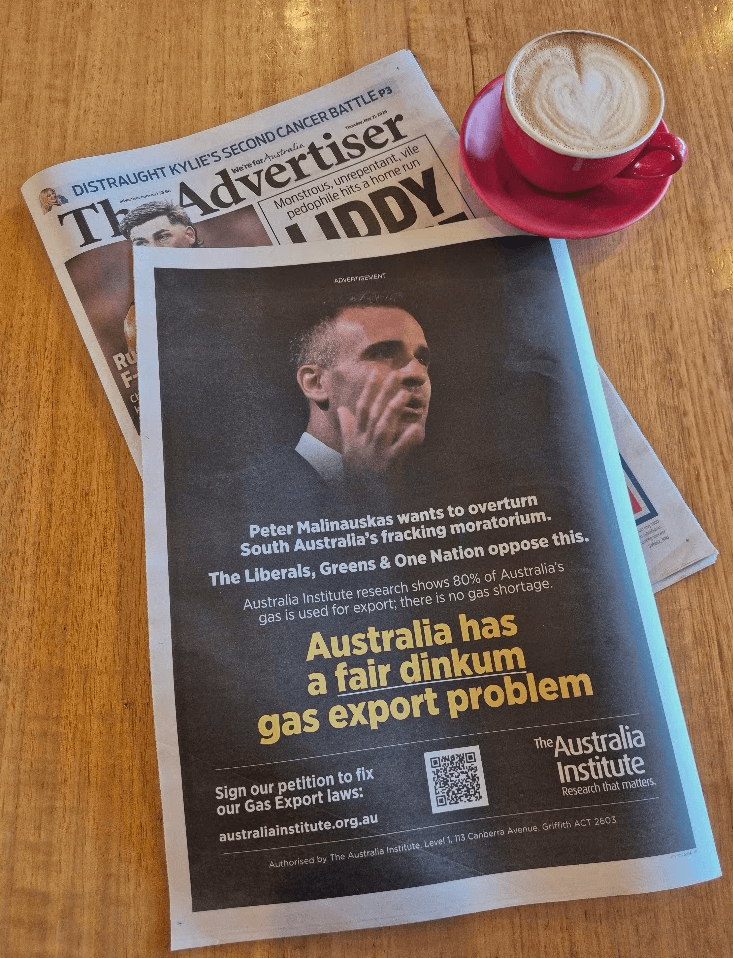
With this backdrop, the Premier announced late last week that his government would be pre-emptively lifting a ban on fracking for gas in some of the state’s best farming land.
With complete control of the lower house of parliament and an upper house stacked with a fresh crossbench of One Nation and Liberal MPs, the passage of the Premier’s pro-gas bill might have appeared guaranteed.
What the Premier failed to realise though, was that the national conversation around gas has changed dramatically in recent months.
The push for a 25% gas export tax at the federal level has united an extraordinarily broad coalition of political entities, from Clive Palmer to the Greens, while simultaneously showing Australians just how comprehensively they are being ripped off by multinational gas companies.
Australians increasingly understand that there is no gas supply problem in this country, but that we have a gas export problem.
They know that around 80% of the gas extracted in Australia is sent overseas, producing massive profits for multinational companies who pay little to no tax. And they now understand that more than half of the gas exported from Australia is given away to those companies for free.
The situation is so bad, in fact, that the Japanese Government makes more money from taxing Australia’s gas exports than the Australian Government does from actually exporting it.
Australians also know that, if we had a 25% gas export tax in place, it would raise around $17 billion a year that could then be reinvested to support Australian schools, hospitals, and essential services.
National polling shows that voters are frustrated with this ridiculous situation and are increasingly supportive of a tax on gas exports.
So, it was in this fast-moving political environment, that the Premier decided to announce that he was going to do the gas lobby yet another favour.
It took just a few days for the Greens, One Nation and the Liberals to all rule out the possibility of backing the Premier’s big gas plan, meaning a move that once would have been a politically sure thing was effectively dead on arrival.
This little episode has revealed just how significantly energy politics has been turned on its head in South Australia, where Labor now backs almost unrestrained gas expansion, while One Nation wants to go full Norway and nationalise the industry.
Still, the larger question remains: will the Premier be able to read the winds of change or will he, once again, be caught flat footed due to his devotion to the politics of a bygone era, where gas was good?
The positive news for Malinauskas is that, after his resounding election win in March, he has nearly four years to demonstrate that his government serves South Australians, not the gas industry.
Noah Schultz-Byard is the Director of Strategic Partnerships at the Australia Institute.