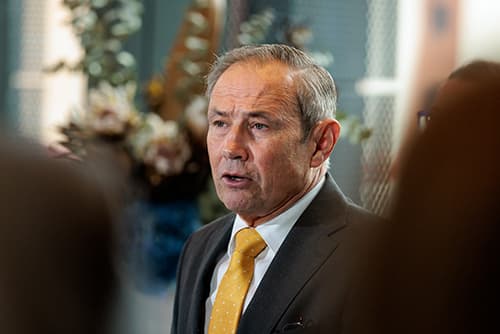
Premier Roger Cook wants Western Australians to believe the state is facing a looming gas crisis so severe that environmental protections, emissions targets, and community opposition must all give way to the urgent national interest of drilling more gas – and exporting it.
And increasingly, the Cook government is willing to pit communities against one another to sell that story.
In the Kimberley, communities resisting fracking are framed as standing in the way of regional prosperity. Around Scott Reef, conservationists and Traditional Owners opposing industrialisation and carbon capture dumping are cast as threats to ‘energy security’.
And now, with Darwin circling the Browse gas project, Cook has escalated the rhetoric further — warning WA risks losing investment and economic opportunity, unless gas approvals are accelerated, and resistance pushed aside.
The West Australian newspaper’s coverage of the Browse dispute showed the Premier effectively presenting Browse as a competition between states, with WA needing to move quickly or risk the Northern Territory taking the prize.
But beneath all the urgency lies a problem for the government. The facts do not support the crisis narrative.
Research from The Australia Institute into how gas dominates out west, shows around 90 per cent of WA gas is exported overseas or used by the LNG industry itself to process exports (they are their own biggest user, by the way).
This is in contrast – but not by much – of the 80% of all gas extracted (including WA gas) in Australia that is exported.
The liquefied natural gas (LNG) sector exports around 35 times more gas than WA uses for electricity generation.
WA is not running out of gas. WA is exporting it.
The so-called shortage is not geological, but political.
Governments have allowed multinational gas corporations to lock enormous quantities of Australian gas into export markets while domestic consumers face higher prices and growing energy insecurity. Then those same governments point to those pressures as justification for approving even more drilling.
It is circular logic designed to benefit one industry. And increasingly, Australian politics itself appears organised around preserving that industry’s power.
The gas export industry tail is wagging the political dog.
What is unfolding in WA is not simply a state policy debate. It is part of a much broader national pattern where governments of both major parties have become structurally dependent on fossil fuel expansion as an economic and political framework. Even while publicly committing to transitioning away from fossil fuels as part of climate action.
Australia is already the world’s third-largest exporter of fossil fuels. WA sits at the centre of that machinery. LNG exports are treated not merely as one sector among many, but as something approaching a national identity project – politically untouchable, permanently prioritised, and shielded from scrutiny.
That political influence matters because the gas industry’s actual contribution to public prosperity is routinely overstated.
Senior Economist at The Australia Institute Greg Jericho’s analysis of the state’s budget, shows that next year, WA drivers will pay more in car registration and licence fees than gas companies will pay in royalties to the state government.
Earlier analysis from The Australia Institute on WA gas royalties found motorists were expected to contribute around $1.3 billion in registration fees while gas royalties generated barely half that amount.
Jericho’s updated analysis shows the imbalance worsening, with gas royalty revenue forecast to collapse further over coming years.
So, while the industry dominates national political debate, ordinary Western Australians are contributing more to state revenue through car rego payments than multinational LNG exporters extracting publicly owned resources.
That should fundamentally alter the way this debate is understood.
Because the gas industry has successfully constructed an aura of indispensability around itself. Politicians speak as though Australia’s economic survival depends on continuously expanding LNG exports. Governments bend environmental laws, weaken climate safeguards, embark on dodgy offsets and carbon capture and storage (CCS) plans, and fast-track approvals because the industry frames any resistance as existential economic sabotage.
And the strategy works because the industry’s influence extends far beyond economics.
Former politicians move into fossil fuel lobbying and consulting. Industry advertising saturates public debate. Corporate access to government remains extraordinary. Policy frameworks are written around preserving “investor certainty” for gas exporters while communities are expected to absorb environmental risk, rising insurance premiums, and climate consequences.
Even the language of public policy increasingly mirrors industry messaging.
Gas is framed as a “transition fuel” despite mounting evidence that expanded LNG investment delays renewable deployment. Carbon dumping, via CCS, is promoted as climate action even though its primary political function is justifying and facilitating continued fossil fuel expansion. Domestic shortages are invoked while most gas is exported offshore.
The industry does not merely influence politics anymore. It shapes the boundaries of what governments believe is politically possible.
The Cook government still speaks the language of climate responsibility when necessary. It still invokes renewable energy ambition and emissions reduction targets. But operationally, the state behaves like a government preparing for decades more fossil fuel expansion.
Drill more gas. Approve more export infrastructure and offer subsidies. Protect LNG investment. And frame any opposition to fossil fuel expansion as anti-worker or anti-West Australian.
The tragedy is that WA genuinely could lead the world in renewable energy. It has extraordinary solar and wind resources, so much space, industrial capability and geographic advantages. It could become a clean energy superpower if governments chose to build that future.
Instead, political energy remains consumed by preserving the dominance of a gas export industry already sending almost all its product overseas.
Recent analysis from Renew Economy on WA’s gas network “death spiral” highlights how badly this contradiction is now distorting policy. As households electrify and move away from gas, governments are still politically committed to preserving fossil gas infrastructure and expanding LNG exports, rather than planning for a managed transition.
That is why the fights over the Browse Scott Reef gas drilling, and carbon dumping CCS proposal, and Kimberley gas fracking, matter so much.
These are not isolated community and environmental battles. They are tests of whether democratic governments still retain the capacity to govern in the public interest when confronted by industries with immense economic and political power.
Right now, the answer increasingly appears to be no.
The fossil fuel sector has become so politically embedded that governments now frame public debate around protecting the industry first, and managing public consent second.
Communities are pitted against one another by corporations and ably assisted by pro fossil fuel governments.
Climate targets become negotiable.
Environmental protections are treated as obstacles.
And ordinary Australians are told they must accept ongoing fossil fuel expansion for the sake of prosperity.
The real crisis confronting WA is not a shortage of gas. It is a shortage of political courage to imagine an economy beyond it.