How a bad policy is helping inflate Australia’s gas bubble
The “Safeguard Mechanism” sets declining targets for Australia’s biggest industrial emitters and fossil fuel mining projects (not including the emissions of coal and gas they sell), but also lets them “meet” those targets with a bunch of cheap cheats, like carbon offsets.
This is a statement in the federal government’s latest data release, for one of its biggest climate policies. The “Safeguard Mechanism” sets declining targets for Australia’s biggest industrial emitters and fossil fuel mining projects (not including the emissions of coal and gas they sell), but also lets them “meet” those targets with a bunch of cheap cheats, like carbon offsets.
“Work” is the operational word here. The logic is that the cost of buying up offsets is so crippling to these companies that they have no choice but to actually cut their emissions instead. That is not what happens. When the rules of the game allow cheating, everyone just cheats to win. That means Australia deepens its reliance on an increasingly unstable industry that’s dumping risk onto taxpayers instead of entering into a managed wind down.
In future pieces in this series, I’ll explain how these complex, messy loopholes worsen Australia’s greenhouse gas emissions and make the Australian public pay for it. These companies are scrambling to expand fossil fuel production at a time when they should be entering into a controlled decline, and aggressively taxed on the way down.
Fake success
Read the government’s report, and you’ll see the scheme’s falling targets highlighted prominently. This is where each facility’s emissions cap gets ratcheted lower, with the purported goal of incentivising real emissions cuts.
FY25 was the first year in the history of the scheme that the scheme-wide emissions target was lower than actual emissions. That sounds silly – surely the emissions target should be lower than emissions by default? It was an intentional design flaw of the old scheme that the total target hovered ineffectually far above actual emissions. So, the target is now an actual target: great.
The government says that “Over time this creates a progressively stronger incentive for emitters to invest in onsite abatement”. There are now two full years of data out for the Albanese government’s reformed scheme. Their claim: it works fine, pointing to a drop in total, unadjusted (i.e., no offsets) emissions for both years.
What they are doing here – and it’s dodgy – is claiming credit for things that almost certainly would have happened anyway, without this scheme.
To demonstrate, using one of my favourite clips:
For each of the two years, emissions dropped a couple of percent. That drop has been about 5% since the Albanese government’s reforms two years ago. But, as researcher Tim Baxter at Naru Research wrote recently: “Almost all of this change in total emissions is attributable to facilities entering and exiting the scheme”. This happens when a facility’s emissions drop below the threshold for inclusion (at least 100,000 tonnes). If you exclude that, the amount emissions fell for the facilities continuing in the scheme was merely 0.4%.
Why are companies dropping below the threshold? That too is mostly not due to decarbonisation. As Tim writes:
“In June 2024, a significant fire at the Grosvenor mine led to its closure for the full 2024-25 year. This also caused the mine to temporarily exit from the scheme as reported emissions fell below the safeguard threshold”.
Grosvenor went from emissions of 1.1 megatonnes of CO2-e in FY24 to essentially zero for FY25. If this fire hadn’t occurred, we would have seen an overall rise in greenhouse gas emissions for the whole Safeguard Mechanism, if you exclude the effect of those that exited the scheme for unrelated reasons.
As Beyond Zero Emissions recently wrote, nearly one third of the government’s headline number came from ‘crisis events’: “across eight facilities: nickel operations suspended because of a global price crash, a gas plant undergoing a maintenance shutdown, a petrochemical and a fertilisers facility in market decline – the combined effect was 1.94 megatonnes of net reduction”. And they warn that “a scheme that records a win every time a facility goes dark is not measuring decarbonisation. It is measuring absence”.
This is shocking. There’s nothing wrong with the data reflecting things like unplanned incidents and fires, but for the government to very explicitly claim this is the result of the mechanism’s effect of encouraging decarbonisation is pretty close to fraudulent.
Meanwhile, the latest data shows that fossil fuel companies are leaning far more heavily on carbon offsets, and even still being granted valuable, sellable credits for being ‘below’ targets that are clearly too high. There is a massive queue of new fossil fuel extraction projects waiting to be added to the scheme once they come online. And there’s the chance that measuring methane in a more accurate way will reveal much worse emissions, meaning the entire scheme is in a far worse position than we thought.
And our old friend, carbon capture and storage, is playing an increasingly massive role in justifying blowing up this fossil industry balloon even further, again so that when it pops, everyone but the CEOs cop the cost.
Welcome to this ongoing series about a climate policy that is blowing air into a fossil fuel bubble we are learning is going to pop at some point soon, and in doing so, putting everyone but the industry at real risk.
Ketan Joshi is a Senior Research Associate at the Australia Institute.
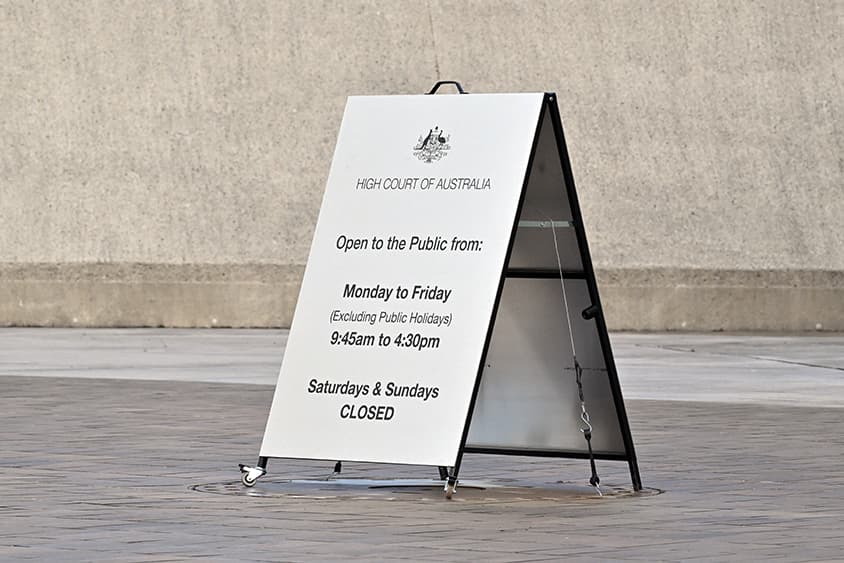
Every year, state and federal governments from both major parties approve ever more coal mines and gas projects. The task of protecting the environment from the harms caused by these projects falls to local community groups and environmental NGOs, who typically challenge them in the courts. Often, a key aspect of such legal challenges concerns the way the decision-maker deals with the climate change impacts of the proposed project. On Wednesday, the High Court of Australia—the nation’s highest court—for the first time heard one such case.
Former oil and gas executives are urging the Albanese government not to use the Middle East crisis as justification for expanding fossil fuel production, warning Australia risks locking itself into an “outdated” energy system as the rest of the world accelerates towards electrification.