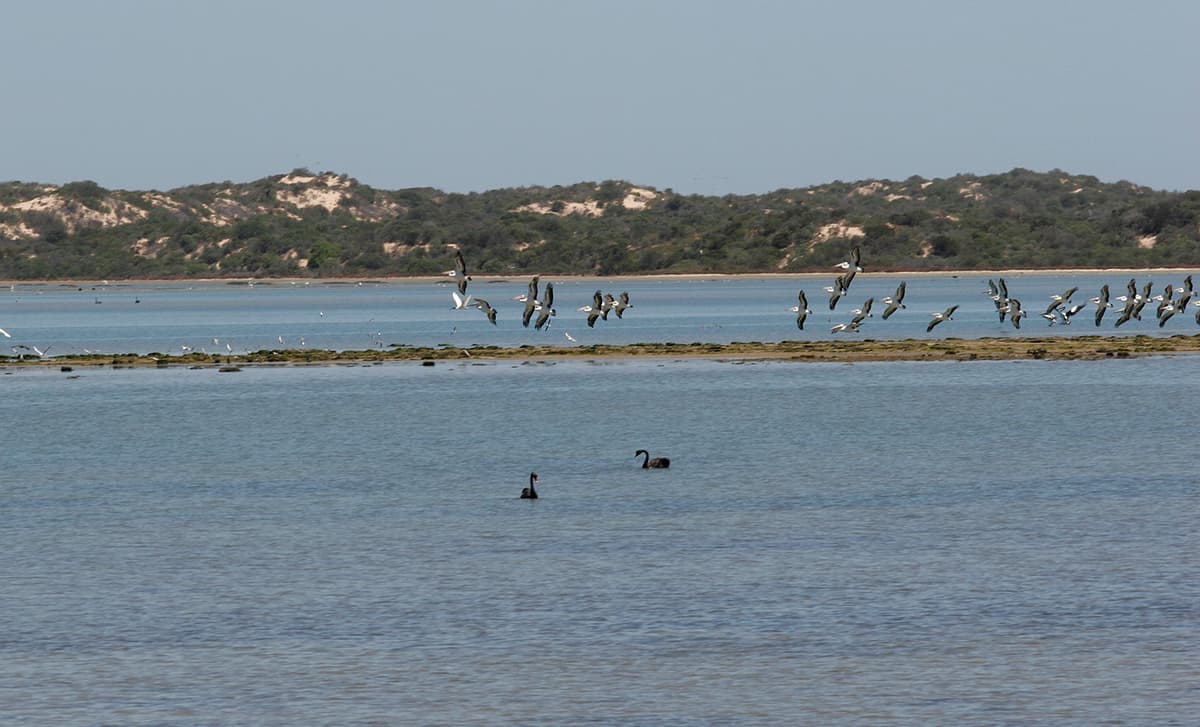
The Coorong and Lower Lakes sit at the end of the Murray-Darling Basin (the Basin) – Australia’s largest river system, which covers over one million km2 of the Australian continent. The Basin’s resources provide $30 billion to the Australian economy every year, and more than 3.4 million Australians rely on it for drinking water.
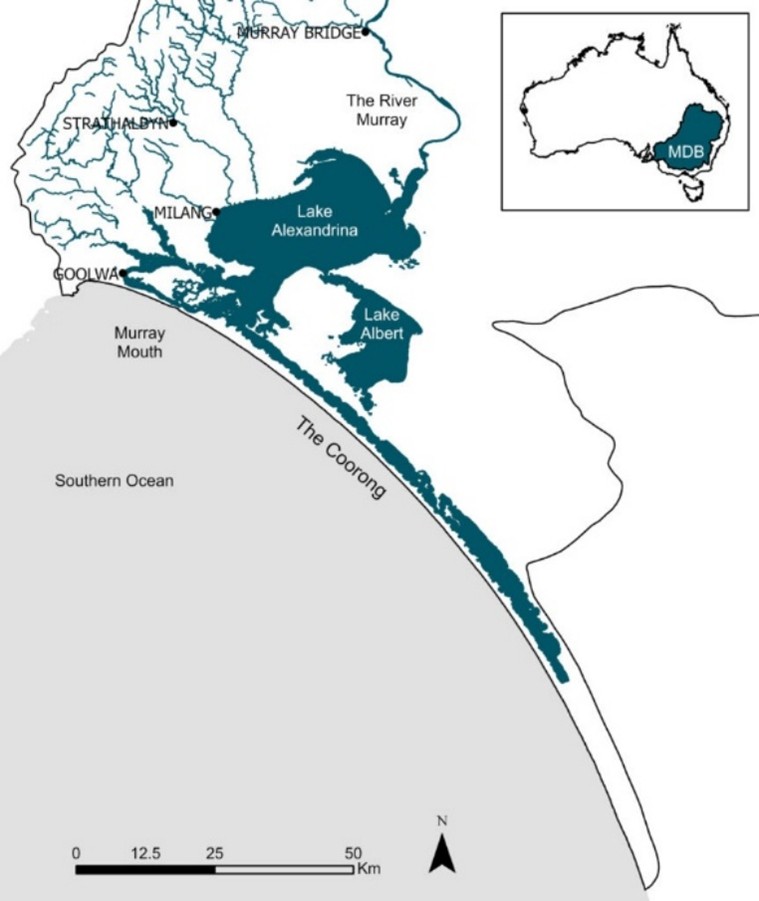
Source: Goyder Institute for Water Research, CLLMM Research Centre
In 1985, the region was listed under the Convention on Wetlands – commonly known as the Ramsar Convention – for its international significance in terms of its abundant birdlife, diverse wetland types, and cultural significance to local people. Indeed, for local First Nations peoples, it is a living body tied to existence itself.
But the region exists at the end of a heavily modified river system that has suffered through prolonged drought and unsustainable upstream water extraction.
The Basin Plan was agreed in 2012 to manage that extraction, but even with the Plan in place, the Coorong, Lower Lakes, and the Lower Murray were recently listed as critically endangered.
That Plan is now up for review.
Where to for river management?
More than one thing can be true at a time.
We can support farmers and still recognise that the river needs water.
We can care about food production and still understand that water reaching the lakes, Coorong and Murray Mouth is not wasted.
This discussion should not be upstream versus downstream. It should be about balance, honesty and responsibility across the whole Basin.
Irrigation towns matter, farmers matter, cultural water matters, communities matter, and no water reform should be spoken about lightly.
Water for the environment is not simply “sent downstream to be wasted at sea,” as Member of the NSW Legislative Assembly, Helen Dalton, claimed recently. In a connected river system, end-of-system flow is not wasted; it is one of the signs that the river is still functioning.
Water moving through the system supports river health along the way – wetlands, floodplains, fish movement, water quality, salinity management, the Coorong, the Lower Lakes and the Murray Mouth all benefit.
And we also need to remember what happened during the Millennium Drought: when flows collapsed, the Lower Lakes dried, acid sulfate soils were exposed, salinity increased, ecological stress was severe, and the Murray Mouth required constant dredging. That was not a healthy or cheap outcome for South Australia, the Basin, or Australian taxpayers.
Buybacks are not perfect, and regional impacts must be acknowledged and managed. But voluntary water recovery has been one of the most direct and effective ways to return real water to the environment.
Infrastructure projects, fishways, carp control, habitat works, and smarter river operations are also important – but they do not replace the need for actual water in the river.
Food security matters, but food security also depends on river security. A river system pushed beyond its limits cannot support farming, towns, wetlands, fisheries, tourism or future generations.
Policymakers use new rules, new dot points, new acronyms, new engineering fixes – but we still have not properly addressed or changed where the greatest volumes of water are being taken, who benefits from that extraction, and how much influence those with the largest water entitlements have.
If we want to protect the Basin, there are measures that would build a sustainable future.
We could build clear environmental safeguards into water licences and water trading, and reduce water extraction to within the system’s ecological limits. We could create a transparent national water ownership register so we know who holds water entitlements, how much they hold, and where those entitlements are being used.
Yet, we keep asking the river and its communities to absorb the devastation: the environmental and financial cost of decisions made elsewhere.
Too much of the value drawn from the Basin is captured far from the rivers, towns, wetlands and people who have to live with the consequences. It does not sufficiently return to Basin communities, local industries, river restoration, or the cultural flows and rights of First Nations people.
Julie Jones is the Chair of the River Lakes Coorong Action Group Inc.