
The Light on the Hill: An Updated History of the Australian Labor Party
This is an edited extract from the updated edition of The Light on the Hill: An Updated History of the Australian Labor Party by Ross McMullin (Scribe), out from 30 June.

Three delicious recipes from Smoke, Rice, Water: Recipes and stories from a Bengali home by Kishwar Chowdhury, published by Hardie Grant Books

Fri 5 Jun 2026 15.00 AEST



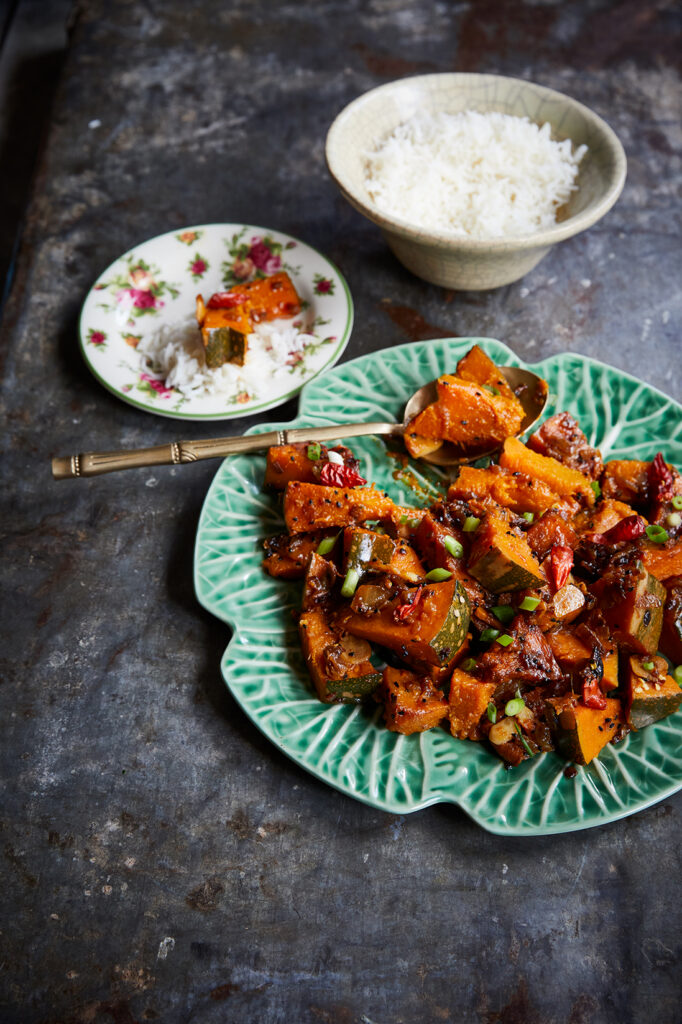
Serves 4
If there was one thing I could pass on about Bengali home cooking, it would be the light- handed use of a single spice to accentuate good produce. Pumpkin (winter squash) paired with nigella and finished with spring onion (scallion) was a flavour sensation to me as a child – its simplicity is why this dish is included over the hundreds of beautiful vegetable recipes in my mother’s repertoire.
Mishti kumra bhaja helped me understand at a very young age that flavour is as much about good produce and cooking techniques as it is about understanding flavour pairings. There’s something about the earthiness of nigella seeds that goes so well with pumpkin, squash, zucchini and most vegetables in the gourd family. There’s a culinary saying that provides a possible explanation: ‘What grows together, belongs on the plate together.’ I guess my ancestors were thinking along these lines when they created this very simple, very wholesome and perfectly spiced dish.
Ingredients
Peel the pumpkin, remove the seeds and cut into medium- sized cubes (this will help it cook evenly). Next, heat the vegetable oil in a frying pan over medium heat. Once the oil is hot, add the nigella seeds and let them crackle for a few seconds. Stir in the onion and garlic cloves and fry over medium heat until soft and translucent.
Add the pumpkin cubes to the pan, along with the ground turmeric and salt to season. Toss well, ensuring the pumpkin is well coated. At this stage, let the pumpkin cook over medium heat for a while, allowing the bottom to slightly char before covering the pan to help it cook through.
Once the pumpkin is tender and fully cooked, increase the heat to allow any excess moisture to evaporate. Add the slit green chillies for a touch of heat and adjust the seasoning if needed. Finally, garnish with the spring onion and serve hot.

Serves 4
There are dishes that are quietly magnificent, that hold their own even among the most lavish of spreads, and doi begun is unquestionably one of them. This vegetarian standout proudly takes its place alongside the meat, fish and poultry that usually dominate a Bengali dawat, a hosting table brimming with indulgent delights.
My mother, raised in Kolkata, had an almost magical way with vegetables. While my father’s side of the family treated vegetables as an afterthought when menu planning – a formality at best, with salads often relegated to decorative garnish – my mother’s dishes defied all expectations. Her velvety eggplant (aubergine), fried until golden and tender and nestled in a rich, creamy bed of thick yoghurt and dusted lightly with ground cumin and Kashmiri chilli, was nothing short of revelatory.
I still remember the gleeful anticipation of our guests, the way they’d sidestep the kebabs and biryanis, making a beeline for the doi begun. Even the most ardent meat lovers, usually the uncles, were utterly transformed. Time and again, it was the first dish to vanish, leaving everyone scrambling for seconds and my mother smiling quietly to herself, as if she’d pulled off the ultimate coup.
If you’re ready to channel that magic, head to your local grocer and choose the freshest eggplants you can find. Thick, good- quality Greek- style yoghurt or hung yoghurt is essential – its tangy creaminess is the heart of the dish. And the rest? You just need pantry staples like cumin, Kashmiri chilli and a drizzle of mustard oil to finish. It’s a dish best served at room temperature, making it a perfect time- saver for entertaining; you can prepare it in advance and assemble it effortlessly as your guests arrive.
Doi begun isn’t just a recipe – it’s proof that vegetables can shine with elegance and depth, holding their own in even the most meat- centric settings. And if you ask me, there’s no greater satisfaction than watching a table full of carnivores fall head over heels for a dish like this.
Ingredients
Temper
Slice the eggplant into 3 cm (1¼ in) thick rounds, patting each piece dry with a paper towel to remove excess moisture. Using a sharp knife, make shallow crisscross slits on both sides of each round – this helps the spices penetrate. Sprinkle the eggplant slices with the turmeric, chilli powder and salt, making sure they are well coated. Set them aside for 5 minutes to allow the flavours to absorb.
In the meantime, heat the mustard oil in a heavy- based frying pan over medium heat. Once the oil is hot but not smoking, carefully place the eggplant slices in the pan in a single layer. Shallow-fry in batches, flipping occasionally, until golden brown and tender on the inside. transfer the fried eggplant directly onto a flat serving tray. (Avoid using paper towel here, as a little of the infused oil adds extra depth of flavour to the dish.)
Whisk the yoghurt with a pinch of salt until smooth and creamy, then generously spoon it over the warm fried eggplant slices.
For the temper, heat the mustard oil in a small pan and add the paanch phoron and dried red chillies. Let the spices sizzle until the mustard seeds start popping and the oil takes on a deep, fragrant aroma. Carefully pour this spiced oil over the yoghurt- covered eggplant, letting it seep into the layers.
To finish, sprinkle over the fresh coriander and pomegranate for a pop of colour and freshness. Lightly dust the dish with Kashmiri chilli powder, ground cumin and chaat moshla for an added burst of spice and tang. Serve at room temperature.
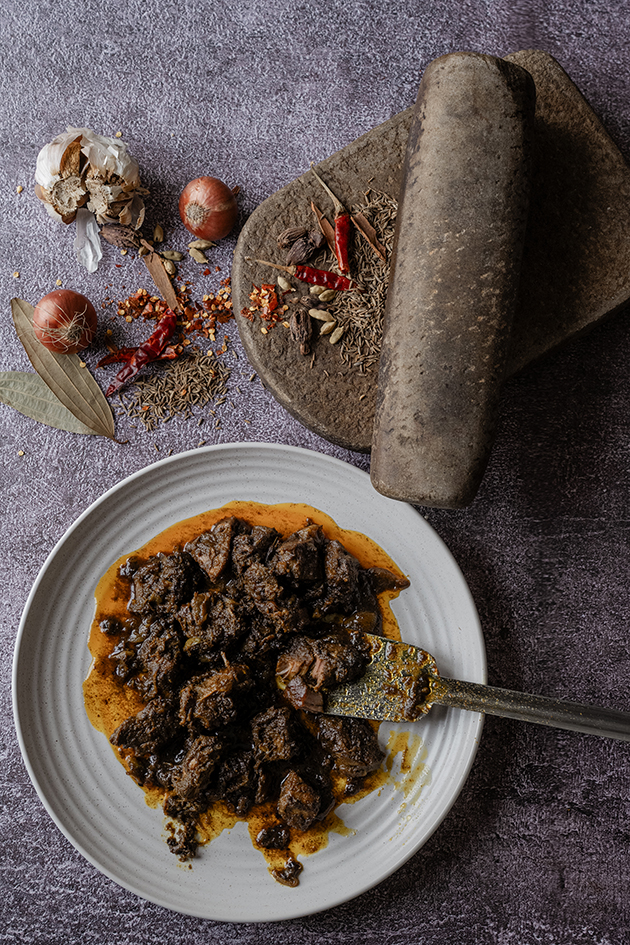
Serves 4
You may wish to begin this recipe a day ahead.
Bhuna mangsho is similar to its West Bengali cousin kosha mangsho, the key difference being the replacement of beef for mutton or lamb, as beef is restricted in the Hindu diet. ‘Bhuna’ or ‘kosha’ is a cooking method inspired by the Nawabs. It produced such delectable results that spin-offs have developed a cult status of their own. In Chittagong, a hilly Eastern port city in Bangladesh, people flock to restaurants dedicated to the famous khala bhuna or black braised beef.
The term ‘bhuna’ refers to a searing technique developed by the Mughals. It involves cooking meat at high heat to develop deep, caramelised flavours. The method requires patience and precision, as the meat is first browned to create a rich crust, then simmered slowly with aromatic spices and onions until tender. While the process looks simple on paper – constant stirring, gradual reduction, controlled heat – the flavour it achieves is anything but. The smoky, savoury richness that characterises the dish is intensified with each extra minute spent encouraging the onions to caramelise and each meticulous fold of spice into the meat.
the signature of bhuna (or kosha) mangsho is that the meat is cooked until it reaches a deep, dark hue, which not only imparts a striking appearance but also enhances the overall taste profile. Set aside an afternoon not only for cooking Bhuna mangsho, but for slow, hearty eating around a shared table.
Ingredients
In a large bowl, combine the beef with the garlic and ginger paste, turmeric and a pinch of salt. Let this sit for at least 30 minutes, but if you’ve got the time, overnight in the fridge is best. Trust me, patience here pays off in flavour dividends.
Now, heat the mustard oil in a heavy- based korai or wok. When it is almost smoking, lower the heat a touch and toss in the cardamom pods, cloves, cinnamon sticks, peppercorns and bay leaves. Let them sizzle for 3 minutes to release their aromatic magic.
Toss in the sliced onion, stirring gently as it caramelises slowly to a deep, golden brown. this step is non- negotiable because it lays the foundation for bhuna mangsho’s deep, dark colour and the intense sweet and savoury flavour.
Once the onion is caramelised, add the marinated meat. Turn up the heat slightly and stir so every piece gets a good coating of onion and spices. You’ll notice the meat will start to release its juices – this is exactly what you want. Cook for about 10 minutes.
Sprinkle in the ground coriander, ground cumin, gorom moshla and chilli powder, then season generously with salt. Stir until the spices cling to the meat. Lower the heat, cover the pan and reduce to a simmer for about 1 hour. The meat will cook slowly in its own juices; stir occasionally and, if needed, add a small splash of warm water to prevent sticking.
Once the meat is tender, uncover the wok and dry-roast the mixture over medium heat. Keep stirring, letting the oil separate and the sauce reduce until it’s thick, glossy and almost black. This will take an additional hour and is the step that sets bhuna mangsho apart.
When you’re almost there, add the ghee and some toasted dried red chillies. Stir and continue cooking for a few minutes more to marry the flavours together. Finally, garnish with bereshta and a handful of fresh coriander leaves for brightness.
Gorom moshla is the final flourish that gives many Bengali dishes their warm aroma. It’s always added at the end of cooking so that the fragrance stays fresh and bright.
To make gorom moshla: combine all ingredients in a heavy-based flat pan. Place on low heat and let the spices warm through, tossing occasionally; they will darken slightly as they release their oils and become fragrant. Remove from the heat, leave to cool, then grind to a fine powder using a spice or coffee grinder. Store in a dry jar.
First, make the bereshta. Heat the oil or ghee in a wide, heavy-bottomed pan over medium-low heat. Add the thinly sliced onions and a pinch of salt. Fry slowly, stirring frequently, until the onions turn a deep golden-brown and become crispy at the edges. This can take 20–30 minutes, but patience is key. When ready, remove from the heat and reserve for garnish. (Any unused bereshta can be stored in an airtight container for later use.)
Paanch phoron, a five-seed blend that blooms beautifully when it hits hot oil, sits at the heart of many Bengali dishes. Each seed adds something different: the warmth of cumin, the nuttiness of fenugreek, the brightness of fennel, the pepperiness of mustard and the gentle bitterness of nigella. Together, they create a balanced tempering that defines many traditional vegetable dishes, daals and fish preparations. Use paanch phoron whole (never ground) by adding a spoonful to hot oil at the start of cooking.
To make paanch phoron: combine all the seeds, mix well and store in a dry jar.
This is an edited extract from Smoke, Rice, Water by Kishwar Chowdhury, published by Hardie Grant Books. Available in stores nationally from the 26th of May.
Photography by Armelle Habib, Ata M Adnan, Rana Pandey (Koi Worldwide) and the Chowdhury family archive. Illustrations by DhakaYeah.
Advertisement


This is an edited extract from the updated edition of The Light on the Hill: An Updated History of the Australian Labor Party by Ross McMullin (Scribe), out from 30 June.
This is an edited extract of Getting Murdoched by Andrew Dodd and Matthew Ricketson, published by Hardie Grant Books. Available in stores nationally from the 30th of June.