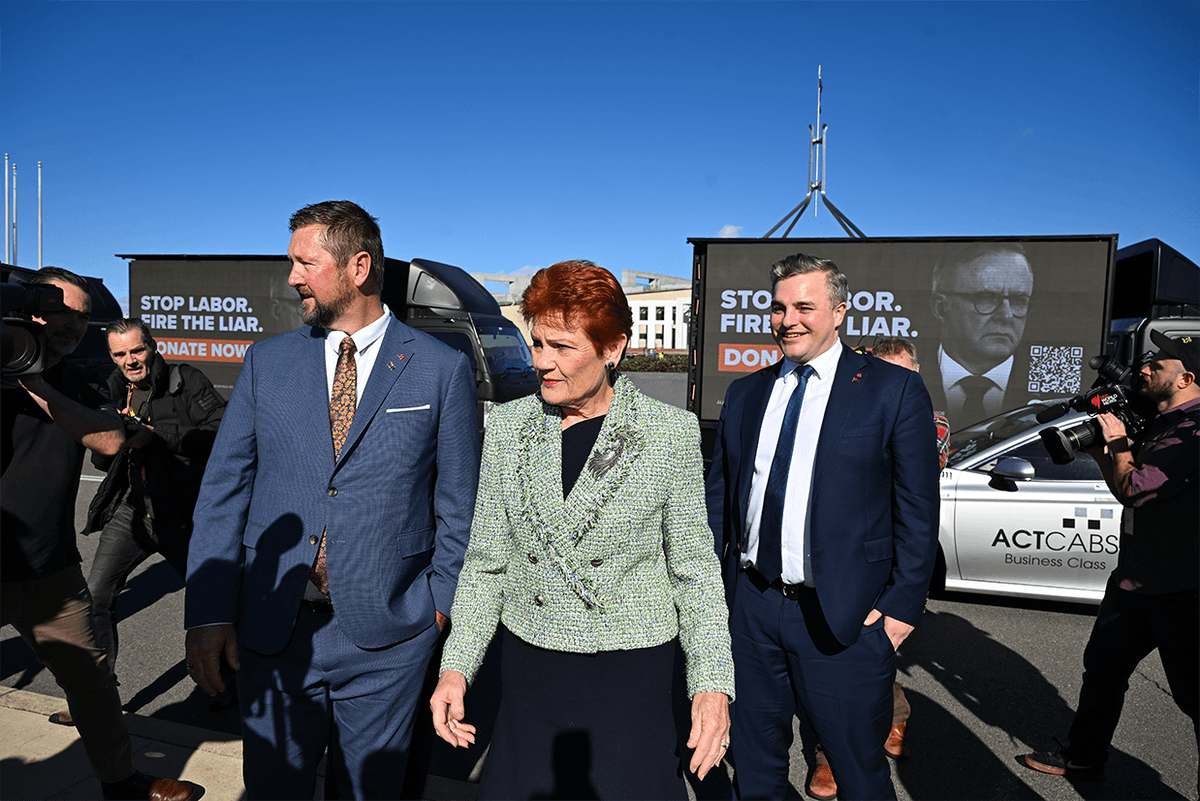
What makes One Nation so intoxicating right now has almost nothing to do with its policies. In our groups, over and over, what participants all bring it back to, is the raw power they feel Hanson herself projects.
These participants feel robbed of agency: crushed at home by the cost of living, and by powers (both distant and at home) whose interests simply don’t align with theirs.
Hanson’s promise is to destroy those powers. For those inclined to point out the ultra-wealthy and business elites Hanson is intimately connected with, as I have written, this is currently secondary to the public’s desire to force at least a semblance of change.
But reality does still matter. The fact that nothing in Hanson’s offering would materially improve lives, provides others an opening.
In order for this to work, though, we need to understand why the standard responses to Hanson keep failing.
Firstly, you do not beat a story about power with a story about technocratic competence. Still less with a costed list of policies.
You beat it by projecting power of your own and demonstrating how that power would be wielded to benefit ordinary people: in plain human terms and in ways that are genuinely engaging.
And what participants are telling us, is that the path there runs through a careful, planned roll back of the neoliberal project championed by both major parties with support (tacit or otherwise) from the minor parties and independents.
Because these participants have countless stories about living through the many failures of this project. They describe living them when a parent enters aged care and the system delivers what a royal commission could only call “neglect”; or when childcare is run for profit and a damning inquiry finds that corporatisation let predators in.
Our research participants frequently tell us private profit “does not mix” with essential services: they cost more, deliver less and often cannot be accessed at all.
Weak and poorly enforced regulation are also integral to participant frustrations around this model, because these not only allow rorting and other ills, but they create an environment in which monopolies and duopolies are free to set their own terms, even if that means more and more people feel they cannot afford to live.
This is all part of a story our participants have been sold for decades now: that the private sector is dynamic and the public sector is dead weight.
Economist, Mariana Mazzucato, has spent a career showing the opposite: the state is the boldest risk-taker we have. Yet because of certain orthodoxies, we instead socialise the risks and privatise the rewards. It is fascinating to watch the electorate now come to a similar conclusion.
This is all in service to – and integral to a system of – what another renowned economist, Thomas Piketty, writes about: wealth concentrates at the top while everyone is told there is no money for the things that make life liveable.
But there is money. We’re just not collecting it.
We need a way to pay for this systemic transformation. Tinkering with negative gearing and the capital gains discount, as this year’s budget did, barely scratches the surface. Getting the tax base in order means closing the loopholes that let multinationals shift profits offshore, and finally taxing our natural resources properly.
This is also a narrative about power: the power of a country to look after its own.
So here the vision must be braver than current technocratic instincts allow. This is true for every political actor, regardless of ideological background, because the case for change is overwhelming.
Our participants are so desperate for this change that they are willing to risk their own wellbeing to vote for One Nation. Indeed, people of colour from migrant backgrounds tell us that even though they worry about racial profiling, they are so desperate that they feel forced to give Hanson a shot.
But there is a deeper problem connected to all of this, and it is one that Hanson has exploited brilliantly. The collapse in institutional trust has, at its core, something I call ‘hostile complexity’ and in many ways, this is the master key.
Hostile complexity describes voters’ sense that our systems have grown so labyrinthine (sometimes deliberately so) that ordinary people cannot navigate them. The sense of overwhelm means disengagement is inevitable.
Ask people about various government programs or services, and they describe “gobbledygook”, systems they suspect are built to confuse them, that “sound like another scam”.
Hostile complexity thus does something really dangerous: it makes legitimate government and/or honest business indistinguishable from scams.
People turn down a real offer to put solar on the roof because they cannot tell it from a con, and feel cheated by energy retailers who keep reducing feed-in rates.
Meta earns around a tenth of its revenue from scam advertising. Search for an urgent care clinic and the enshittified Google that Cory Doctorow describes serves up sponsored results for private practices that will charge you.
Indeed, hostile complexity is turbocharged by tech platforms within a system that Yanis Varoufakis calls technofeudalism. This handful of tech companies don’t just charge rent on everything that passes through them, they often have business models built on filling the public square with impenetrable sludge, making the information environment impossible to navigate.
We grew alarmed hearing in focus groups that so many people said they could not afford a GP, but so few had even heard of the Medicare Urgent Care Clinics. It feels dangerous that a government can no longer cut through to tell its own people about the most essential things.
In this environment, the very simplicity of Hanson’s message is foundational to her appeal.
This is why good intentions and ‘honest’ representation from individual politicians will not be enough. Also needed is a rigorous, focused, coordinated and creative approach to the new information environment that is characterised by information operations I described earlier. It is worth learning the techniques the networked global far right has perfected.
But technique without vision and delivery will entrench hatred of politicians and everyone around them. Combining these new techniques with vision for profound reform will be what projects power.
We know it can be done, because it is being done.
In New York, Zohran Mamdani has spent his first months delivering for workers and small businesses at once, clawing back money from the big corporations and delivery apps gouging both.
He brought in Lina Khan, Joe Biden’s competition czar, now reviving dormant laws against predatory monopolies and private equity firms.
In Britain, Andy Burnham has just won back a seat in parliament, and is set to be Prime Minister, on the back of “Manchesterism”: returning water, energy, transport and housing back to public control.
In Hungary, Péter Magyar has just ended sixteen years of Orbánism on a kitchen-table platform and is dismantling the machinery of corruption and state capture.
The stakes could not be higher. We are living through what historian Adam Tooze calls a polycrisis, and this follows a worrying historical pattern. When wealth concentrates and elites multiply faster than the positions to hold them, as Peter Turchin and Luke Kemp both show, societies grow unstable and break.
The far right understands this and deploys techniques to distract and divide in order to entrench dominance and hierarchy. It does this, selling the only power it knows: the power to burn it all down while blaming the most vulnerable among us.
The alternative is not a louder argument or a better spreadsheet. It is a calm, confident, well-told human story about how power will be taken and then how that power will make life better.
Alex Fein is RedBridge’s Research and Intelligence Principal. However, these are her views and not a reflection of her employer.
This piece was originally published on RedBridge’s latest Insights & Intel substack. Read the original here. You can subscribe to the subsstack here.