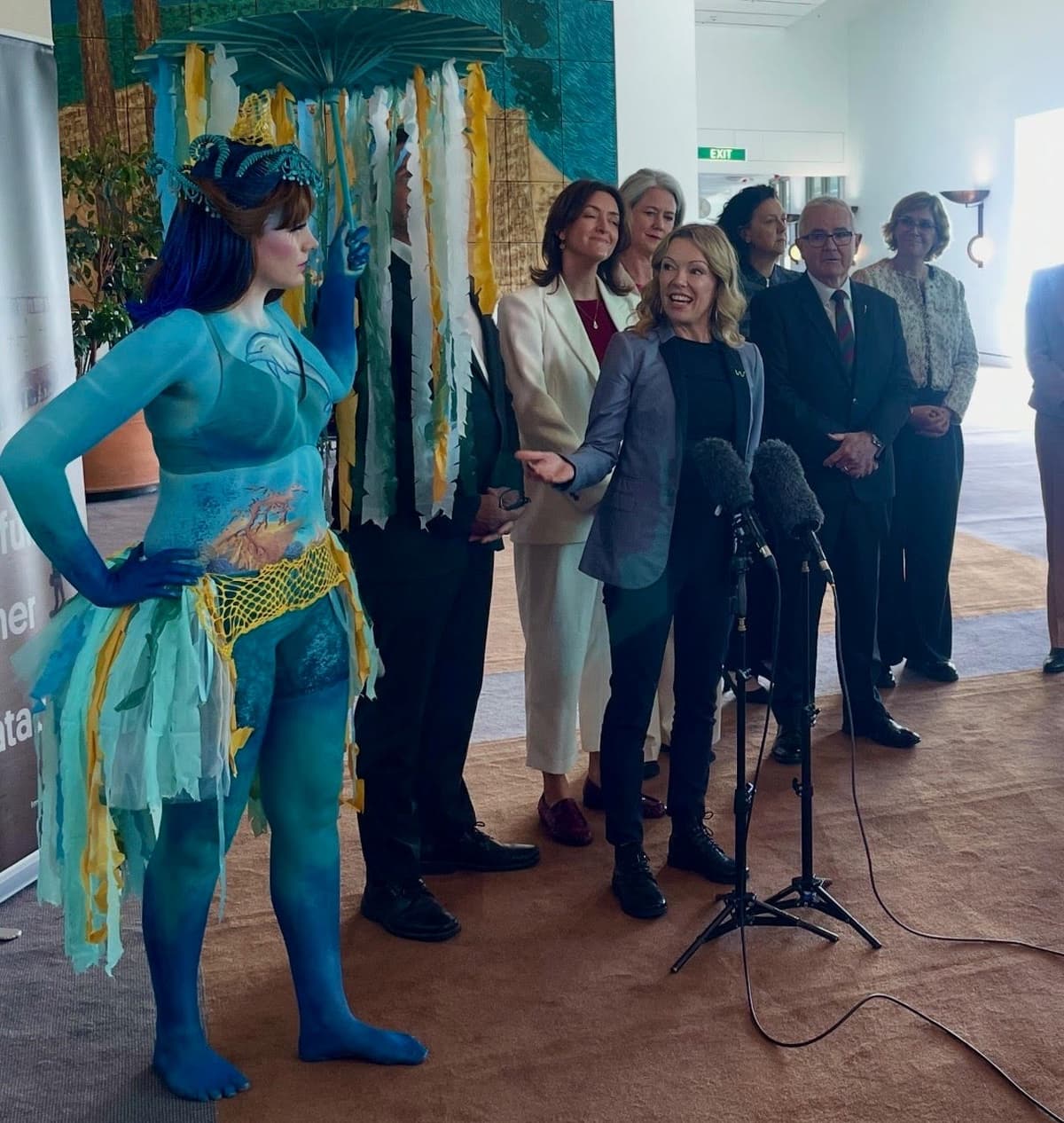
Last week in Canberra, our ocean persona stepped into the Mural Gallery at the Australian Parliament, carrying a cheque for $25,000. This is the fee oil and gas companies are paying right now to claim their slice of the ocean to blast and drill for new fossil fuels.
It was theatrical, yes. And definitely a bit absurd.
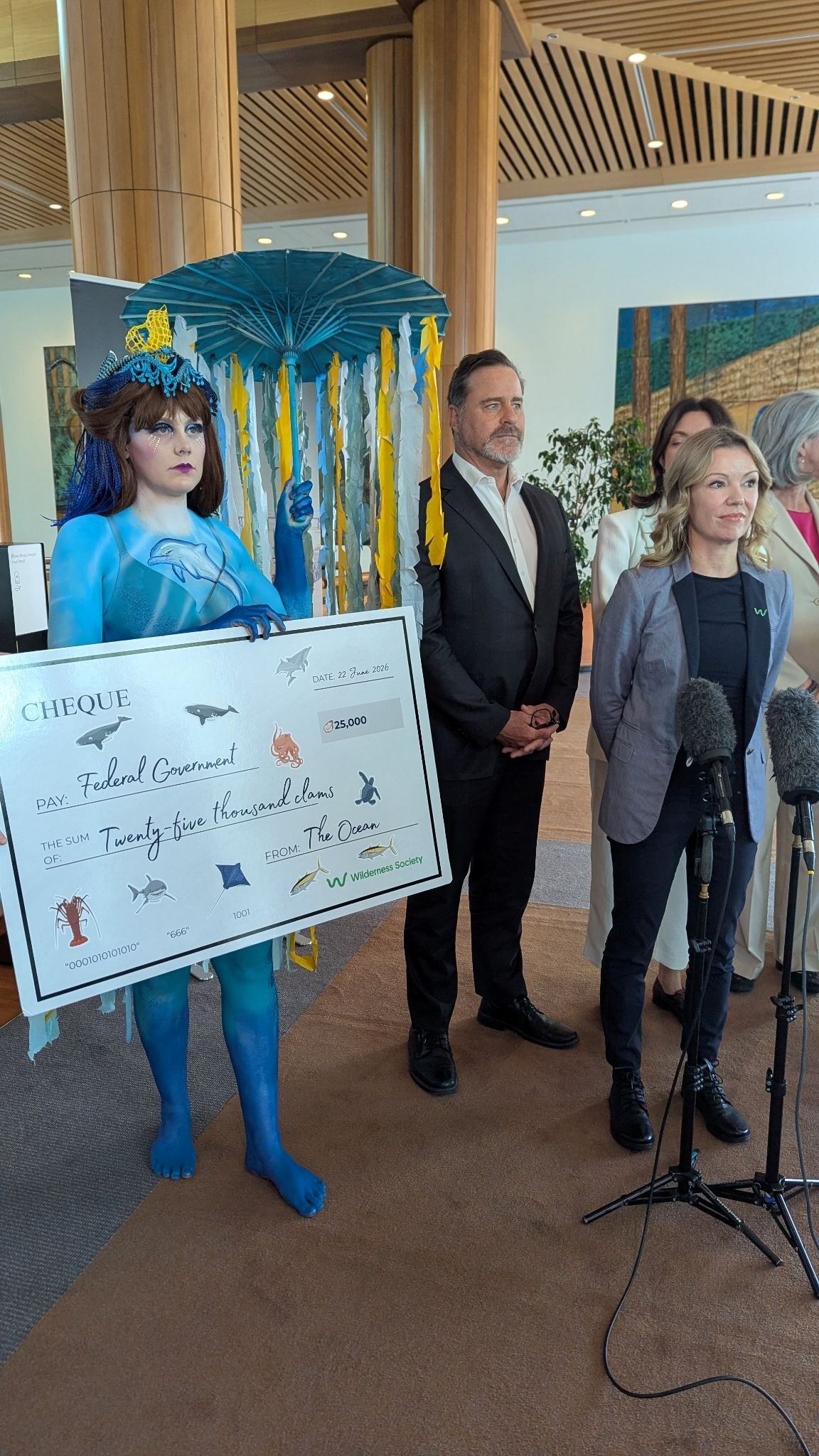
Photo: Supplied
But it is absurd that year on year, fossil fuel companies are asked to nominate the next ocean frontier, and then they bid for it. Quietly and secretly, bids are accepted by our government, and new legal rights are handed out for the next frontier of fossil fuel expansion.
In December 2025, the Albanese Labor Government opened 25,000 square kilometers of ocean near Victoria and Lutruwita / Tasmania for bidding. This region is a global biodiversity hotspot for whales, seals, dolphins, seabirds, seaweeds, sponges, crustaceans and many other globally unique species. It encompasses geologically unstable deep-water submarine canyon systems, where gas drilling is high risk and a spill would have catastrophic consequences for Tasmania’s World Heritage coastline.
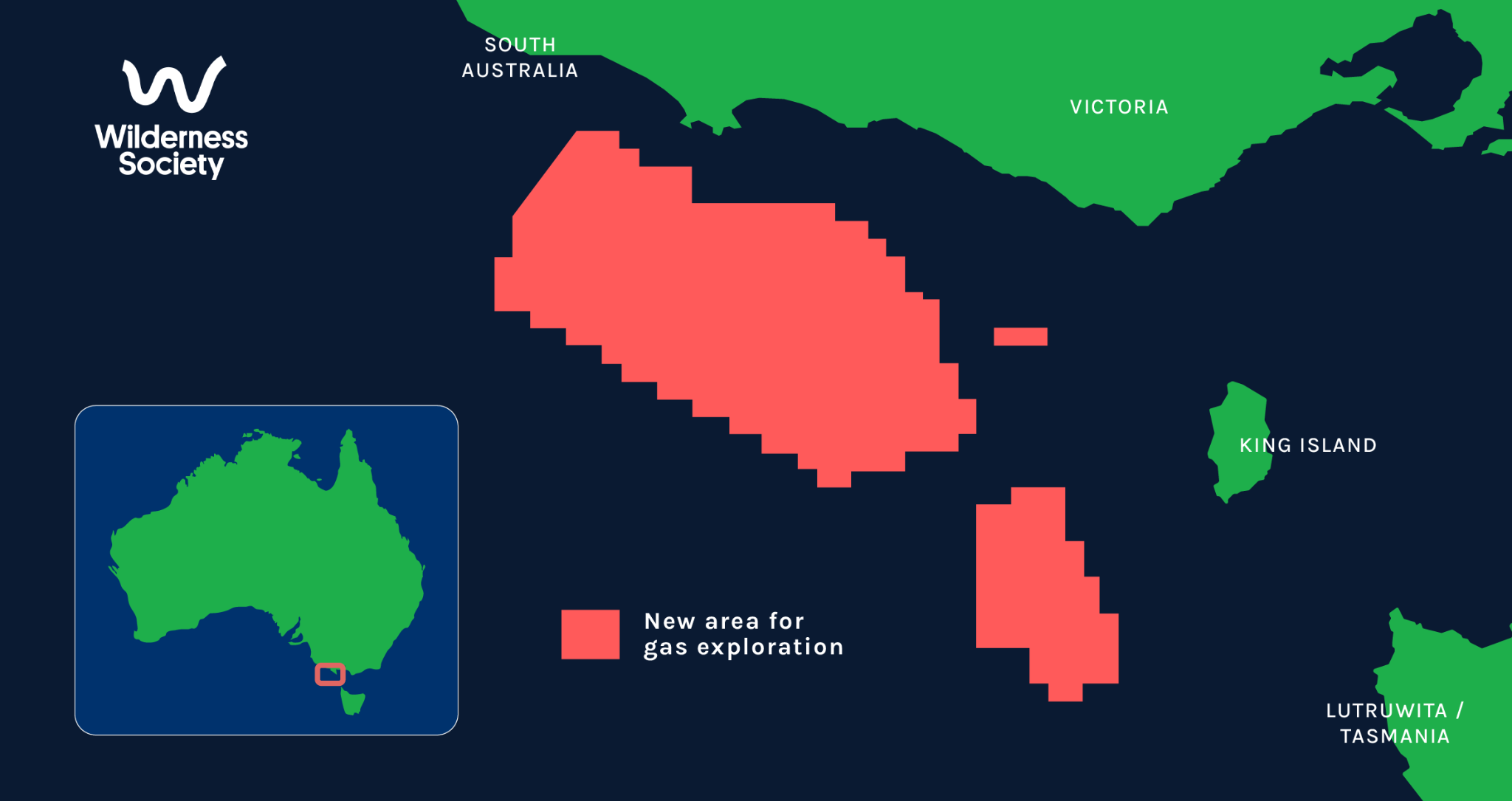
Photo: Supplied
As both a Tasmanian and someone who has spent years watching the offshore oil and gas system expand behind closed doors, I knew this latest round of ocean bidding on our doorstep couldn’t go unremarked. We needed a disruption that would make the invisible visible. And it worked.
MPs from across the Parliament joined our press conference, backing in the oceans bid against big oil and gas. We welcomed the support of Senator Steph Hodgins-May, Dr Monique Ryan MP, Mr Andrew Wilkie MP, Dr Sophie Scamps, Nicolette Boele MP, Senator Peter Whish-Wilson and Zali Steggall MP.
They were backing a message that has been building for years: Australia cannot keep treating the ocean as empty real estate for fossil fuel expansion.
This was an intervention in a system that has become too comfortable with abstraction. The offshore petroleum acreage release process is abstract by design. It reduces living marine systems to blocks on a map. It translates ecosystems into “prospective basins”. It turns migration routes, breeding grounds, and coastal livelihoods into “available areas.”
As our ocean persona stepped forward last week, they disrupted that language.
What governments describe as routine administration is actually a long-term commitment to more extraction at exactly the moment we are supposed to be winding it down.
Yesterday’s action was about collapsing the distance between a Ministerial announcement and the living ocean it impacts. The MPs who stood with us understand that. So do the communities that have fought offshore oil and gas projects for years. From Pep-11 off the New South Wales coast, to seismic blasting battles in Victoria, to the long resistance against new drilling in the Great Australian Bight.
The ocean is not an empty asset for exploitation. It is a living system with limits that policy cannot wish away.
If there is one thing I took from helping bring this moment into Parliament, it is this: we are long past the point where the ocean should need to be represented symbolically. It needs to be protected structurally through good decision making and long-standing protective policy.
Everything else is the real absurdity.
Ending offshore acreage release would not solve the climate crisis on its own. But it would do something more immediate and essential: it would stop the future pipeline of fossil fuel expansion at the point of origin.
Fern Cadman works as a Fossil Fuel Industry Campaigner with the Wilderness Society.