Most people know that if someone spends tens of billions of dollars building a gas export facility and then exports hundreds of billions of dollars’ worth of gas to Japan, Korea and China that it is “good for GDP”. Or at least that is what governments and gas companies seem to tell us. But having taught economics for 30 years I am confident that most people do not really know how GDP is measured and why the gas industry likes talking about it so much. Spoiler: the ABS publishes other figures such as Gross National Income (GNI) that tell quite a different story.
Gross Domestic Product is by far the most commonly used indicator of economic performance in Australia, but widely used does not mean widely understood, and nor does it mean internationally accepted. While the ABS provides a clear description of GDP and a range of other indicators of the size of the economy (REF), and The Australia Institute has been highlighting limitations of GDP for decades, in order to understand the gas export grift, the key feature of GDP that you need to understand is how important the D in GDP is.
Gross Domestic Product measures the value of all the things produced within Australia’s domestic borders. It is a measure of where things are made and in turn it includes all of the value of all of our gas exports even if we give the gas away for free and all of the profits flow to foreign owned companies. Gross National Product on the other heard measure who gets the value of production, regardless of where in the world it is produced. So while all of the value of the gas INPEX exports from Australia counts in GDP literally none of it would calculations in a measure like GNP. Just as it makes no sense to include the income of your rich flatmate who never pays board or rent in your household income it makes no sense for Australian governments to brag about the impact of tax free gas exports on our GDP when they know (or should know) that the profits made by foreign owned companies exporting gas they got for free does nothing to boost the economic wellbeing of Australians.
Before I dig into why the gas industry, and their allies in Parliament and the media, like GDP so much more than they like GNI, I need to convince you that the way accountants (the suburban tax kind or the ABS national accounts kind) categorise things really matters. So here goes.
Imagine you live in a house with your partner and two kids, and you both earn $100,000 per year. According to the ABS your household income would be $200,000, which seems pretty straightforward.
Now, how would you feel if a stranger who earnt $200,000 per year moved into your spare room without asking, didn’t pay any rent or board, and left a mess in the kitchen they never cleaned up?
I can guess how that would make you feel, but I can assure you it would not make me feel any richer or better off. But from the ABS’s point of view, when your uninvited guest moved into your spare room, your household income doubled to $400,000 per year.
You might not have thought much about the difference between your sense of your family income and the ABS record of your household income but hopefully you can now see the importance of what is included in a definition.
Which brings me back to GDP.
When a 100% foreign-owned company exports $10 billion worth of gas we gave them for free, having paid no royalties, no PRRT, and no company tax, the ABS still includes that $10 billion in Australia’s GDP because the “D” in “GDP” stands for “Domestic”. It does not matter who gets the profit, it only matters if the production occurred on Australian soil.
When the ABS calculates GDP, they do not care if some, or even all, of the profits from an industry flow to the Japanese government (a major investor in INPEX), the Norwegian government (a major investor in Equinor), or the US shareholders who own most of Chevron. So, when the gas industry says that their exports of our gas are “good for GDP” they are right, but unless they are paying lots of tax on those gas exports then an increase in gas exports by foreign-owned gas companies is of no more benefit to you or I than an increase in Elon Musk’s wealth.
While there is no one “true” measure of how the people in a nation are going, GDP is a particularly poor indicator for a country that has a high degree of foreign ownership of its major export industries. Put another way, GDP is a particularly poor measure of how a country like Australia benefits from an industry like gas.
There is no doubt that the gas industry contributes to Australia’s GDP. According to the ABS, Australia exported around $65 billion worth of gas in 2024–25 which is a large sum of money for you, me, or even the Commonwealth government. But the $65 billion foreign companies got for selling our gas to their foreign customers did not go to you, me, or the Commonwealth government. And as I will explain below, those gas exports definitely were not used to “pay for” your car, phone or clothes imports.
Again, this is not to say that the gas industry does not make a contribution to our economy. It does. The problem is that in giving the gas industry free gas, free infrastructure, free waste disposal for their giant, rusting offshore gas wells, and in letting it wreck our farmland and waters, we are helping it more than it is helping us.
Collecting, sorting and burying garbage contributes around $50 billion per year to the Australian economy but it is rare to hear politicians lauding the jobs the garbage collectors create, the tax they pay, or their exports (yes, we export millions of tonnes of garbage each year).
The gas industry employs less than 1% of Australians and pays less than 3% of all the tax collected by Australian governments but it takes up an enormous amount of our political debate. That is no accident; it is a very expensive PR strategy at work.
Dr Richard Denniss is an economist, Executive Director of The Australia Institute, author and public policy commentator, and has spent the last twenty years moving between policy-focused roles in academia, federal politics and think-tanks.
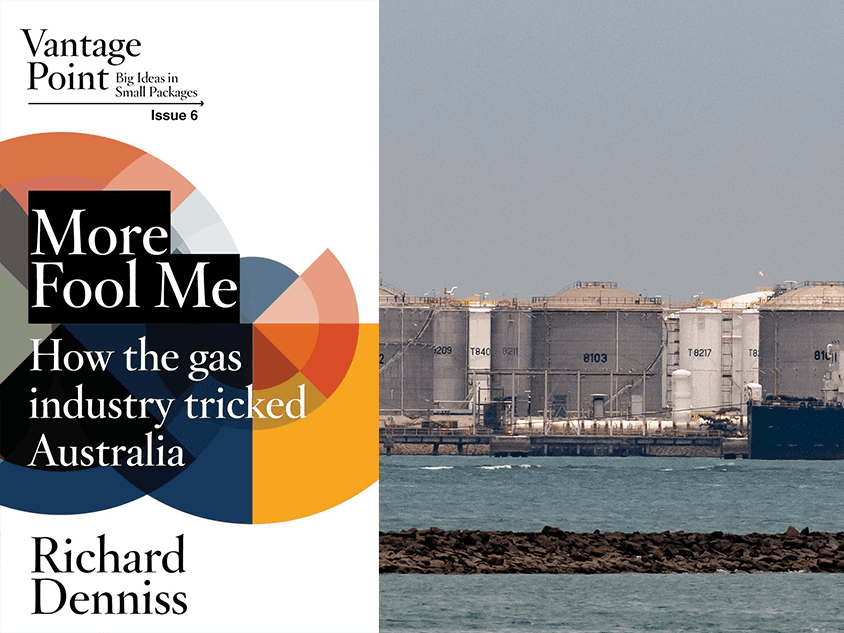
You can purchase copies of Dr Richard Denniss’s Vantage Point essay, More Fool Me: How the gas industry tricked Australia, from The Australia Institute store.