On 7 August, submissions opened on the review of the Safeguard Mechanism, Australia’s flagship climate policy.
The Safeguard Mechanism lets around 200 of the country’s biggest polluters buy unlimited carbon credits to use as so-called offsets instead of cutting their own emissions at the source. It is the single largest source of demand for the kind of credits now at the centre of the Great Koala National Park fight, and that is no coincidence.
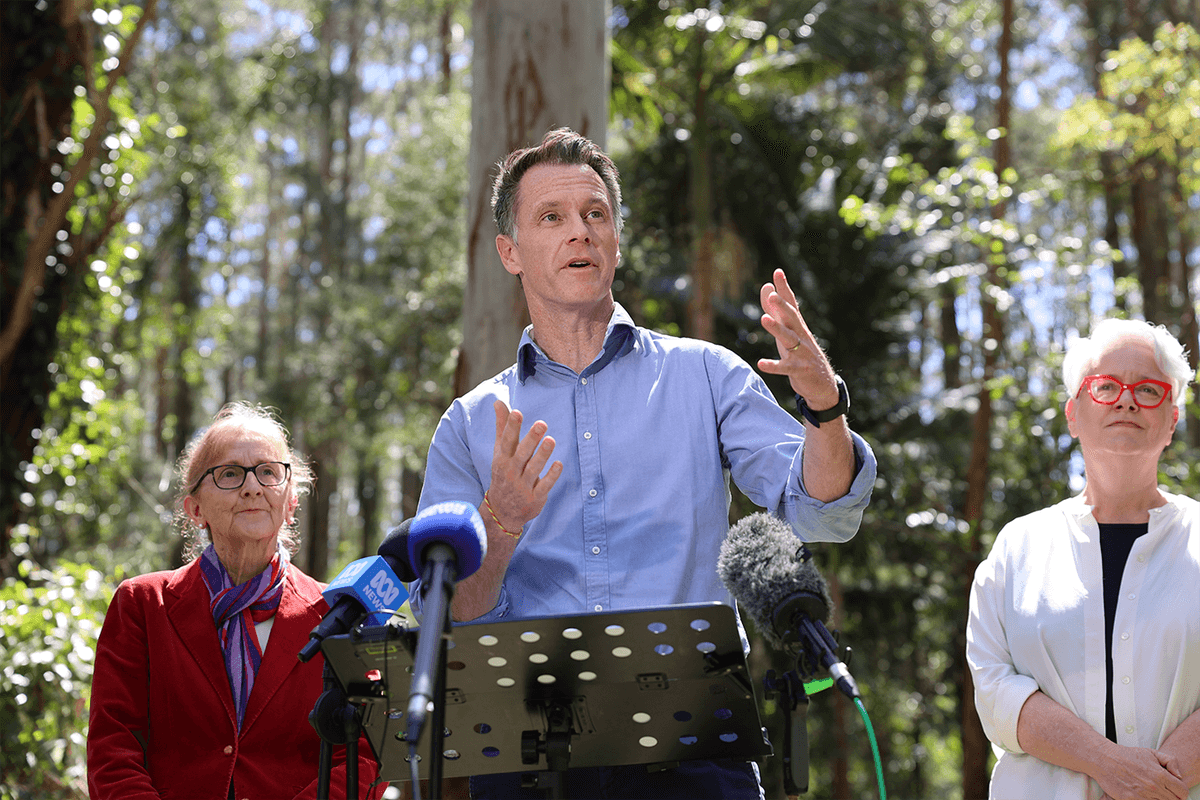
The Great Koala National Park was promised unconditionally by NSW Labor first in 2015 and again ahead of the 2023 election, but it will now only be created if it first becomes a carbon credit project, a condition the NSW Minns Government attached for the first time in September 2025, generating a whole new suite of Australian Carbon Credit Units (ACCUs) to add to the Safeguard Mechanism. Koala habitat has been turned into collateral for a carbon credit scheme built to supply the same market the government just opened for review.
Let’s start with the issue of additionality: the requirement that a credited project would not have happened anyway. The INFM method sets a general rule against crediting native forest a state already decided to protect, and then carves out an exemption that applies precisely, and almost only, to the Minns Government’s existing koala park logging moratorium.
The Emissions Reduction Assurance Committee, the statutory body meant to police this, resolved the problem not by testing whether the park was additional, but by deciding it was “reasonable for a state government to pursue an ACCU Scheme project to provide the means to deliver an election commitment.” That is not an integrity test; it is a permission slip. Generating credits for something already going to happen has a name in carbon markets: “hot air.”
Then there is the issue of permanence. Carbon dioxide lingers in the atmosphere for thousands of years. The INFM method requires forests to not be logged for just 100 years. The forest is protected only because it is now a financial asset with penalties attached: log it early and the project faces deregistration and forced relinquishment or cancellation of the ACCUs it generated.
Once the 100 years are up, protection under ACCUs ends, and whether the forest can then be logged depends on land tenure, park status and whatever legislation exists then – none of which the INFM method itself addresses.
It’s worth remembering that ACCUs are fungible: a tonne kept out of the market by one buyer simply frees that tonne for the next, dragging down the price everyone else pays to keep polluting. Premier Minns’ response to this has been to promise koala park credits won’t be sold to coal and gas companies.
This is the ‘Minns Principle’, the idea that no government should let fossil fuel companies buy their way out of cutting emissions using credits from public native forest. Applied to one park, it is token, and in a federal trading pool, hard to implement. Applied to the Safeguard Mechanism, it becomes a systemic pathway forward. The federal government could legislate the ‘Minns Principle’ nationally, barring coal and gas companies from buying ACCUs to meet Safeguard obligations, not just from one area of forest in one state scheme.
The creation of a long-promised Koala Park contingent on ACCUs, and the Safeguard Mechanism review are the same market. Every new credit created from a public forest that “would have been protected anyway” is currently a credit that a gas plant in Karratha or a coal mine in the Bowen Basin can use to avoid decarbonising, laundering emissions that will still be warming the planet in the 26th century through a credit that expires in decades.
The same dodgy offset rort can be seen elsewhere: the government has scrapped Climate Active, its “carbon neutral” certification scheme, after Energy Australia admitted, in a settlement with Parents for Climate, that offsets don’t undo the harm of burning fossil fuels.
Australia hands out $16.3 billion a year in fossil fuel subsidies. Redirect a fraction of that, and then the protection of native forests needs no carbon credit at all, and can get permanent protection, not a 100-year stay of execution.
The Senate can disallow the INFM method on 18 August. The public has until 18 September to tell the federal government’s Safeguard Mechanism review, in writing, that unlimited offsets for polluters from schemes like this one are not climate policy – they are a permit for increasing pollution – and that the Minns Principle belongs in Commonwealth law.
Louise Morris is the Head of Fossil Fuel Transition at The Australia Institute