Ember’s new The Age of Power report poses an argument that should land hard in Australia: the race of this century is no longer just about who controls fuel, but who can produce, finance, coordinate and use cheap electricity best.
Change is already underway – electricity overtook oil as the largest source of ‘useful energy’ in 2007, and those same technologies driving the digital revolution are now driving the energy transition as well — chips, sensors, batteries, power electronics and motors.
The global evidence shows electrification is no longer a distant or marginal pathway. The deployment of solar and batteries now represents the fastest energy shift in human history. Historical deployment indexed from the first year each technology exceeded 100 TWh shows solar, wind and battery dispatch scaling faster than earlier major electricity technologies (Figure 1). This is not simply an emissions story; it is a manufacturing, learning-curve and capital-allocation story in which each deployment builds supply-chain capability and contributes to lower costs.
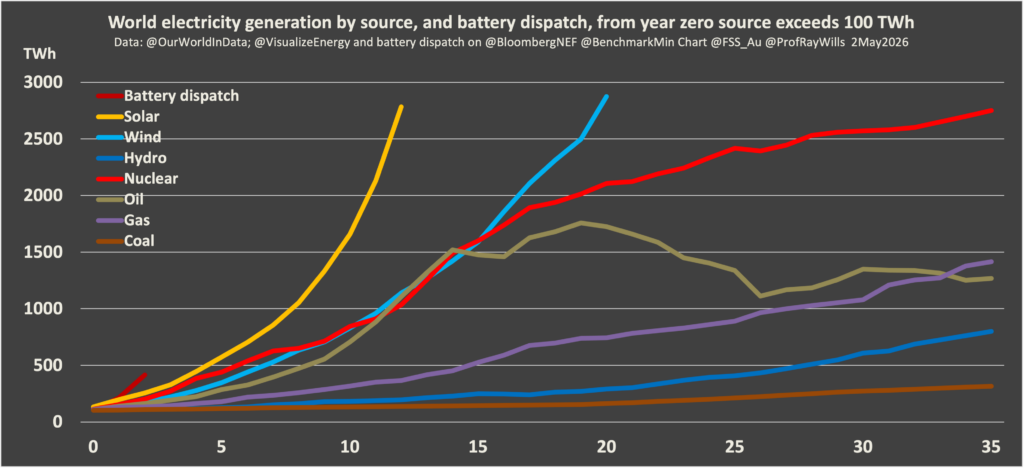
Figure 1. Global electricity generation by source and battery dispatch, indexed from the first year each exceeded 100 TWh.
Where should cheap electricity be used first?
This global shift should inform two policy consultations that are now before the federal government. Our submissions propose changes to:
The old policy instinct to answer these redesigns is to defend molecules.
The new strategic task is to accelerate electrons. Both federal mechanisms need redesigning around where electricity can replace fossil fuels most effectively. The answer is: almost everywhere, electricity can do the job directly.
The overall lesson for both Federal Mechanisms is simple: stop treating electricity, transport, industry, digital infrastructure and emissions policy as independent silos. The future is becoming one interdependent system, held together by various ways of using electricity. Countries that understand that will be cheaper, cleaner and more competitive. Countries that do not will end up paying more to prop up declining fuel-based systems while losing the race to build a new and sustainable industrial base.
What about Australia?
Six principles follow for Australia:
First, electrify the service, not just the supply. The real contest is not whether the grid gets cleaner in isolation, but whether mobility, heat, mining, minerals processing, freight and industrial work shift from combustion to electricity. Ember’s useful-energy framing is important here: electric systems do more with less, because combustion wastes so much energy before it reaches the task.
Second, build abundant renewable electricity and storage to provide these services. Cheap electrons are now the platform for industrial competitiveness and can be provided directly where they are needed. In 2025, renewable generation overtook coal generation globally, and clean generation met all net growth in electricity demand. IRENA reports that most new utility-scale renewable capacity now produces electricity more cheaply than the lowest-cost fossil fuel alternative. For Australia, the broad cost argument is largely over. The task now is pace, delivery, integration and local application.
Third, digitally coordinate the system. The next bottleneck is not just generation cost but orchestration: connection queues, curtailment, negative prices, badly designed tariffs and inflexible demand. Australia already sees this in rooftop solar, batteries and transmission delays. Western Australia is especially exposed, because the SWIS is becoming a high-DER, inverter-rich system that will need much smarter management, stronger networks and far more flexible demand.
Fourth, use China’s scale without becoming captive to it. China is not only the dominant clean-manufacturing power; it is also the only major economy scaling electrification, renewables, EVs, batteries, robotics and AI simultaneously. Australia should use the cost deflation that Chinese scale is delivering, but not kid itself that resilience comes from imports alone. Strategic capability in grid equipment, power electronics, charging, processing, software, recycling and system integration matters as much as access to bulk energy.
Fifth, build around Australia’s defensible niches. We are unlikely to dominate every part of the electro-industrial stack, but we do not need to. Australia can be globally significant in renewable-powered mining and minerals processing, grid integration, remote and regional power systems, heavy transport charging, battery deployment, and renewable-powered industrial production. Western Australia sits at the centre of that opportunity, with its resource base, export infrastructure, isolated grids and growing renewable buildout.