Prime Minister Anthony Albanese opened Climate Week NYC on Monday by leaning on Australia's renewables progress: massive rooftop solar uptake, ten thousand home batteries a week, enough wind and solar for six million households. Numbers worth noting. But they're not the numbers that determine whether Australia is doing its job on climate and phasing out fossil fuels.

Tue 22 Sep 2026 10.28 AEST
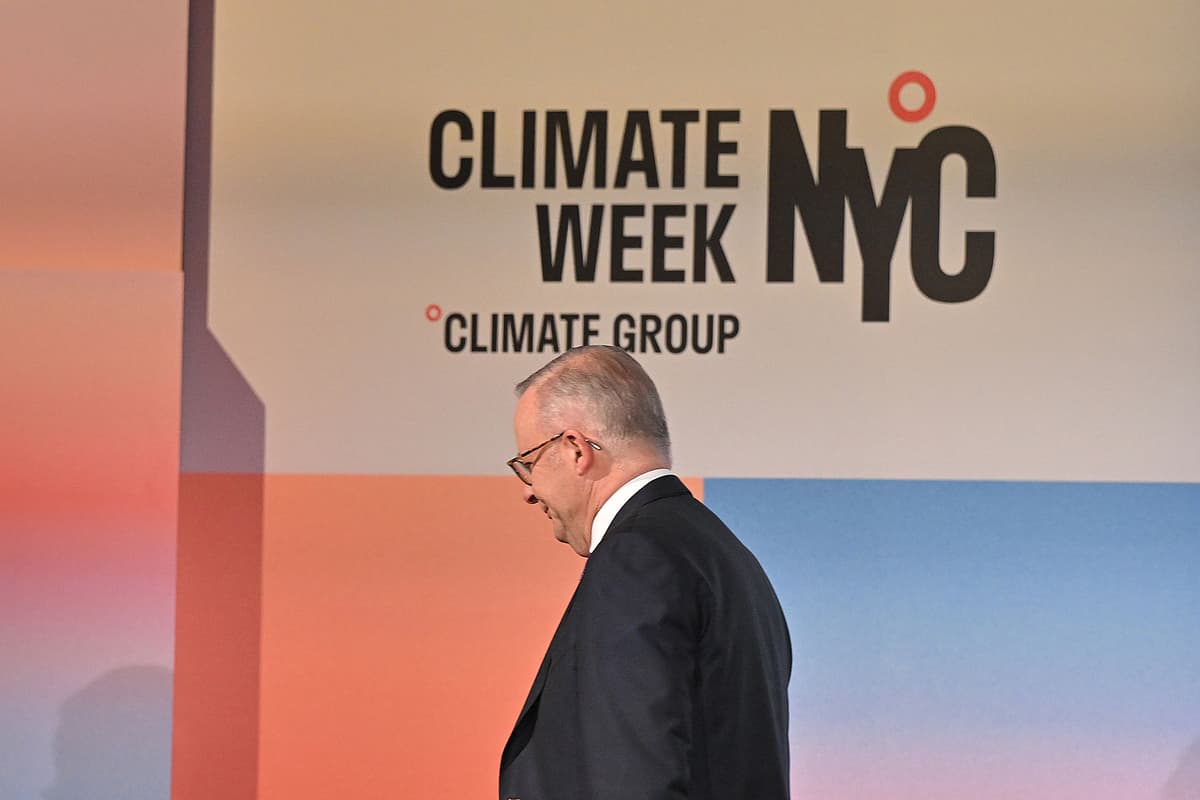
Australia’s Prime Minister Anthony Albanese at the opening ceremony of the Climate Week NYC event ahead of the United Nations General Assembly in New York. Photo: AAP Image/Mick Tsikas


Prime Minister Anthony Albanese opened Climate Week NYC on Monday by leaning on Australia’s renewables progress: massive rooftop solar uptake, ten thousand home batteries a week, enough wind and solar for six million households. Numbers worth noting. But they’re not the numbers that determine whether Australia is doing its job on climate and phasing out fossil fuels.
Buried in the same speech was a line that does more damage to climate action than the renewables spruiking does good: “Australia’s abundant renewable potential firmed by gas will get us there.”
It’s a phrase the Albanese government uses frequently, and it’s designed to sound reasonable – in isolation. What it cleverly does is turn gas from a fossil fuel we’re supposed to be transitioning away from, into a permanent feature of the plan, as outlined in the government’s Future Gas Strategy.
It is the framework for a government that has approved 37 new, expanded or extended coal and gas developments since taking office in 2022. That’s not inherited baggage. That’s this government, approving expansion in the same month our Prime Minister stood in New York talking climate leadership and Pacific partnership.
Australia isn’t a minor player here. Analysis shows we are reliably the world’s third-largest fossil fuel exporter, behind only Russia and Saudi Arabia. That ranking comes with an obligation the speech never engaged with. At COP30 in Belém, Türkiye and Australia agreed to share the job of turning the summit’s roadmap for a transition away from fossil fuels into more than a piece of paper.
Türkiye holding the COP31 presidency, with Australia as President of the negotiations. As reporting from the ugly final hours of those talks made clear, both countries need to show real leadership in turning that roadmap into action. Australia signed up to the Transition Away from Fossil Fuels (TAFF) process at the Belém COP. It owes the world an answer on how and when we will start acting on that.
Instead, our Prime Minister talked up rooftop solar and renewables roll-out, and left our fossil fuel export ranking and 37 new approvals out of the speech entirely. While Pacific nations go under and Australian homes burn through worsening fire seasons, that’s not an omission. It’s gaslighting the public, dressed up as good news and climate action.
Then there’s the Pacific – which, based on this speech, you’d be excused for thinking Australia is not a part of. The gap between talk and action is stark when the budget allocations are outlined. Albanese pointed to the Pacific Resilience Facility and the Falepili Union, the treaty giving Tuvaluans a pathway to live, study and work here as seas rise due to the burning of fossil fuels.
Quality research, analysis, explainers and factchecks from experts you can trust.
Real commitments. But hold them against Australia Institute analysis released last week which showed that between 2020 and 2025, Australia’s fossil fuel subsidies exceeded $62 billion, almost six times the $11 billion we gave the Pacific in total aid. Climate-specific finance to the region was smaller still, just $1.3 billion.
The Australian Security Leaders Climate Group were frank in their appraisal of the glaring gaps in the Prime Minister’s opening remarks at Climate Week. Former Defence Force chief Admiral Chris Barrie said Australia “cannot credibly claim climate-security leadership overseas” while continuing to approve fossil fuel expansion at home.
So, where is the actual transition plan?
A government genuinely committed to the Transition Away from Fossil Fuels process it signed up to at COP30 and will be discussed at the April 2027 Second Conference on TAFF would start with three things:
Until Australia bans new approvals, ends the subsidies and closes the dodgy carbon offset loopholes, “firmed by gas” will keep meaning what it always means: more gas, gaslighting the public on climate action, sold to the world as a fossil fuel transition plan.
Louise Morris is Head of Fossil Fuel Transition at the Australia Institute, with 20 years’ experience encompassing climate, energy, forest protection, and law reform in the not-for-profit sector, and federal politics.

