There is a difference between what Australia should do and what our most influential businesses would prefer we don’t do. Our energy debate too often blurs the two by insisting on being ‘realistic’.

Fri 6 Nov 2026 10.05 AEDT
Photo: AAP Image/Mick Tsikas


Australia’s energy future is rapidly adopting the renewable energy transition. However, the revenue needs of its fossil-fuel businesses are keen to slow this down under the slogan of not being ‘realistic’.
In 2024, Australian Energy Producers called for a “realistic and necessary vision”. They are often warning that batteries cannot do enough, or industry cannot change quickly enough, or regional communities cannot prosper enough, without continued fossil-fuel expansion.
So, ‘realistically’, we must continue using fossil fuels?
CSIRO and AEMO’s latest GenCost assessment finds renewables supported by storage remain the lowest-cost pathway for Australia’s electricity system.
So, why is it so hard to accept Australia’s major science and electricity institutions as being ‘realistic’?
Figure 1 shows Australia’s total electricity generation, wind and solar generation, and battery dispatch, with our projected scenario to 2030 based on current trends. Wind and solar are rapidly increasing their share, replacing fossil fuels. The net zero business model seems to be working.
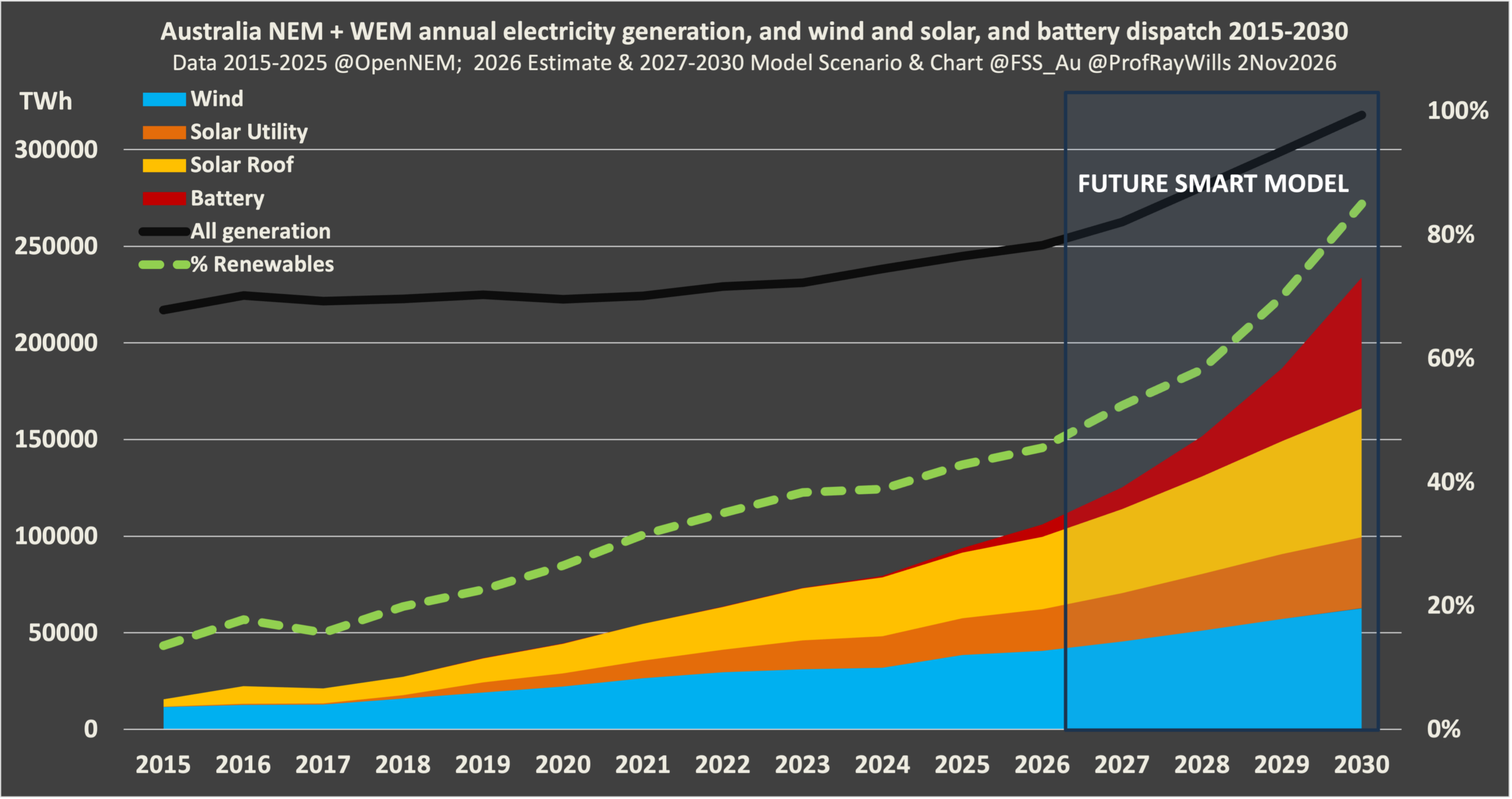
Figure 1. Australian electricity generation and battery dispatch, with a Future Smart Strategies projected scenario to 2030.
Slowing the transition risks higher costs and emissions. The real risk in Australia’s energy transition isn’t going too fast – it’s going too slow. The world is rapidly adopting renewables – in fact, the fastest in history.
Is slowing the existing net zero business model ‘realistic’?
Five sources of influence deserve scrutiny:
1. Political donors
Grattan Institute identifies the risk that political donors receive more access and their views greater weight in defining realistic growth of renewables. Democracy is distorted when some interests are heard repeatedly while others struggle to enter the room.
2. Influence networks
Christian Downie describes an influence network as encompassing corporations within industry associations, peak business groups, public relations firms and apparently independent campaigns. He reports that Australians for Prosperity received $3.68 million from Coal Australia, while Australians for Natural Gas was established by Tamboran Resources’ CEO with help from Freshwater Strategy.
The messenger matters. Corporate advocacy presented as spontaneous community concern can appear to carry a different democratic mandate.
Not every industry-backed campaign conceals its sponsor. Our examination of the Hands Off Our Fuel campaign identified a related strategy: foregrounding farmers while defending a scheme whose largest beneficiary is mining. Its Minerals Council authorisation was disclosed, but its framing deserved scrutiny.
Access helps an industry get heard. Presenting its future as ‘Australia’s future’ helps its preferred policies appear realistic. Civil society cannot be treated so poorly by these industries.
3. Carbon populism
Christopher Wright describes “carbon populism”, in which fossil fuels become entwined with jobs, prosperity and Australian identity. Defending an industry becomes defending the national culture.
The proposition is familiar: these businesses helped build Australia; therefore Australia must keep protecting their business models.
The conclusion does not follow. Past contributions deserve recognition, not permanent policy privilege, but we have some big firms that think they deserve better.
Quality research, analysis, explainers and factchecks from experts you can trust.
4. Regional communities.
Regional communities reliant on fossil fuel production or use, have legitimate concerns about employment, services and investment. But their future must not be confused with preserving a dominant employer’s existing business model.
Governments should ask what replacement investment communities need – not require them to defend fossil-fuel expansion as the price of being heard.
There is a distinct potential reality that regional communities will do much better out of the new technologies than the old ones.
5. Modelling
Industry-funded institutions try to establish the boundaries of debate through research and modelling.
Downie documents industry-funded research and peak-body campaigns that use modelling to determine what is ‘realistic’. But we must always ask what questions and assumptions are used in the modelling.
The Business Council’s 2025 report explicitly excludes longer-term climate damage and GDP benefits from new investment. That is an investment-cost study, not a full cost-benefit assessment.
Does an assessment of the future count the infrastructure required for electrification while treating continued fuel purchases as an unavoidable background expense? Does it compare transition investment with doing nothing, or with the actual cost of replacing ageing equipment versus remaining exposed to fuel markets?
As our productivity analysis argues, modelling assessments should consider lifetime costs, affordability and resilience – not merely initial expenditure.
All of these potential forces are trying to make a case for why the fastest energy transition in history should be slowed down.
The goal should be energy sovereignty that creates an economy that does not depend on fossil fuels for import or export, as both are phasing out – rapidly. The alternative renewable sources of energy can help create more energy sovereignty within cities and across regions.
Energy sovereignty means greater control over the energy services Australians need. We should not be preserving every business or every regional town selling yesterday’s fuels.
Our cities have moved rapidly towards energy sovereignty with solar, batteries and now EVs. We should now focus on the next transition, which will be happening in 2027 with the electrification of heavy freight trucks, agricultural and mining machinery, and with all the associated charging and enabling infrastructure.
Political funding and lobbying need more transparency, including disclosure of campaign sponsors from the companies with vested interests in large diesel rebates.
Boards should explain major fossil-fuel investments to shareholders.
Transparency alone will not build the alternative. Governments must also support infrastructure, workforce development and credible regional investment, while testing concessions against public outcomes.
We need leadership that builds on progress already made.
The national interest is not whatever incumbents call realistic. It is what Australia can build for the nation’s future without lobby groups sidelining new markets.
The net zero future is becoming more realistic every day.
Professor Ray Wills, Managing Director, Future Smart Strategies; Adjunct Professor, The University of Western Australia
Professor Peter Newman AO, John Curtin Distinguished Professor of Sustainability, Curtin University; advisor-at-large, Future Smart Strategies

