Both last year’s Productivity Commission’s figures and Treasury’s in the Intergenerational Report this week promise enough benefits from AI to roughly maintain the status quo, but not so profound an improvement that you might start to worry life will be completely different in 2046 than it is today.

Wed 23 Sep 2026 01.00 AEST
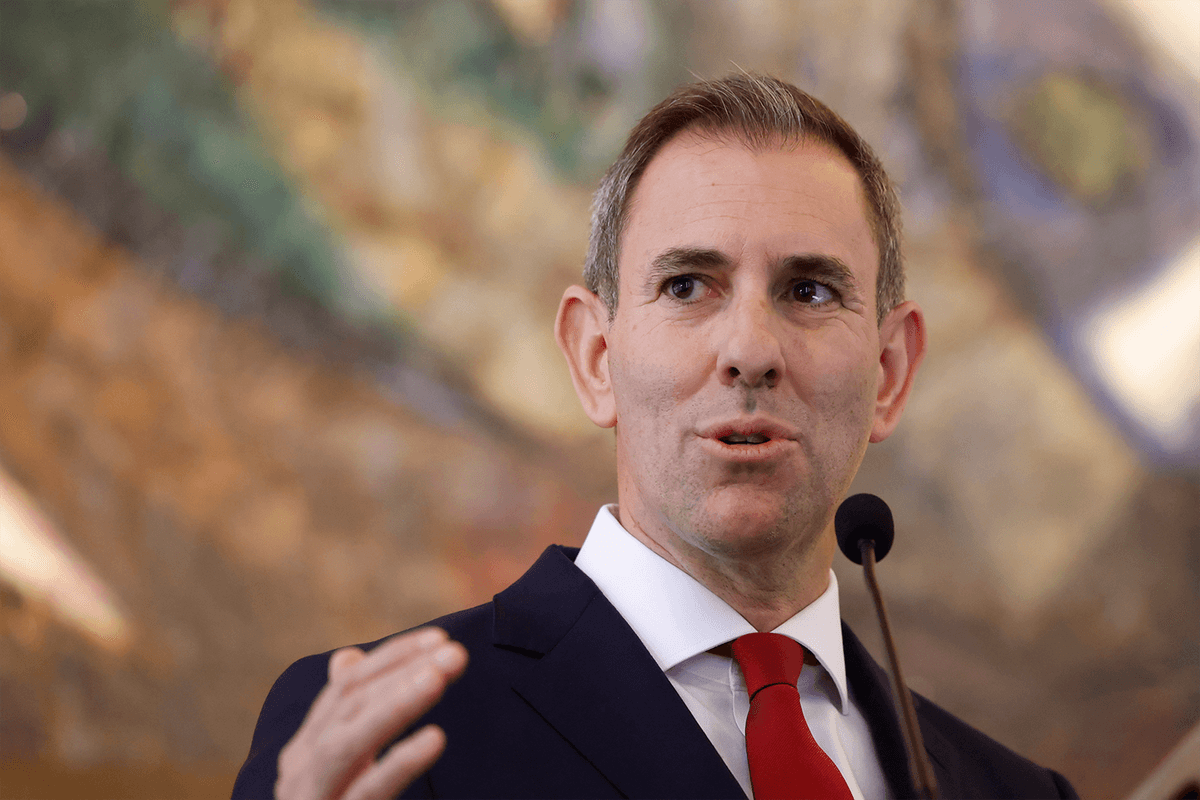
Treasurer of Australia Jim Chalmers speaks at University House prior to the release of the 2026 Intergenerational Report. Photo: AAP Image/Hilary Wardhaugh


The world is spending trillions of dollars developing Artificial Intelligence, with the stated aim of achieving “Artificial General Intelligence” (AGI), where machines are as smart or smarter than human experts. And since AI Large Language Models are infinitely replicable, immortal and potentially much cheaper to keep running than a human being is, we can expect smarter-than-human AI to totally transform the economy, society, democracy and life, as we know it. At the very least, it could be expected to replace knowledge workers like accountants, academics, public servants and, yes, think tank researchers and directors.
AI models are improving apace, but they are already brilliant: solving mathematical problems, creating images that pass for human-made art and making more accurate predictions of the future than even expert forecasters do. I know computer programmers with decades of experience who swear that an off-the-shelf Large Language Model is a better coder than they are.
But for all their awesome power, existing AI models have so far had little observable effect on employment or the wider economy. Some early corporate adopters have even found that AI costs outweighed benefits once the “try before you buy” subsidies came to an end.
So where does the Australian Government fall on the economic implications of AI?
It really depends on whether you look at their words or their numbers.
Going by rhetoric, the Australian Government is bullish. Last week, Communications Minister Anika Wells said “AGI is already here”. The Intergenerational Report out from Treasury this week mentions Artificial Intelligence 478 times, more than “productivity” with 399 mentions and twelve times more than climate change with 39 mentions. It concludes, “AI will be a defining influence on our economy”.
Being Treasury, they have put a number on the rate of economic change. They expect productivity growth to continue at an average of 1.2% per year, only a fraction of which will be due to AI.
Productivity growth of 1.2% is nothing special. That’s exactly what it was 10 years ago, before ChatGPT was a twinkle in Sam Altman’s eye. Before AI investment reached $1 trillion per year. Before Anthropic planned a $32 billion data centre in Queensland (at five times the expected cost of the Brisbane Olympic Games).
Quality research, analysis, explainers and factchecks from experts you can trust.
Are the machines going to get as smart as human workers, or not?
The words don’t match the numbers.
We saw the same kind of bait and switch with the Productivity Commission last year, who said that AI “could transform the global economy and speed up productivity growth” when they made the case for lifting copyright restrictions on AI training. But when the Productivity Commission put a number on the technology’s contribution to the Australian economy, their “back of the envelope” calculation was anywhere between an extra $26 billion and $116 billion in ten years’ time.
Australia is a $2.7 trillion a year economy, and GDP is already growing without AI. Even on the higher end of the scale, $116 billion higher GDP in 10 years would mean AI had made only a minority contribution to Australia’s already improving labour productivity. If it ends up being $26 billion, that is almost invisible. If the Productivity Commission’s modelling is right, AI will have failed by the standard set by its creators. It will be far short of human intelligence.
Conveniently, both last year’s Productivity Commission’s figures and Treasury’s in the Intergenerational Report this week promise enough benefits from AI to roughly maintain the status quo, but not so profound an improvement that you might start to worry life will be completely different in 2046 than it is today.
Ironically, if the Government predicted 10% productivity growth per year, or 30%, or 100% – the kind of figures we see from people who actually think AGI is going to happen – Australians would be more afraid of AI. If labour productivity improves that much, people lose their jobs.
But the AI companies promising smarter-than-humans AI and the Government modellers predicting “business as usual” can’t both be right. AGI would result in either post-human dystopia or post-scarcity utopia. Meanwhile, Treasury’s words pump up the world-changing promise of Artificial Intelligence, but their numbers are about what we’d expect from a world in which AI doesn’t exist.
Bill Browne is Director of the Australia Institute’s Democracy and Accountability Program.

