The botched execution of a Death Row inmate in Tennessee and her emergency transfer to hospital is a reminder — if we need one — of the brutality and callousness of much of America's approach to law and justice. For all the institutional and structural resonances between America and Australia, the differences between our civic values are as stark as ever.

Fri 2 Oct 2026 13.26 AEST
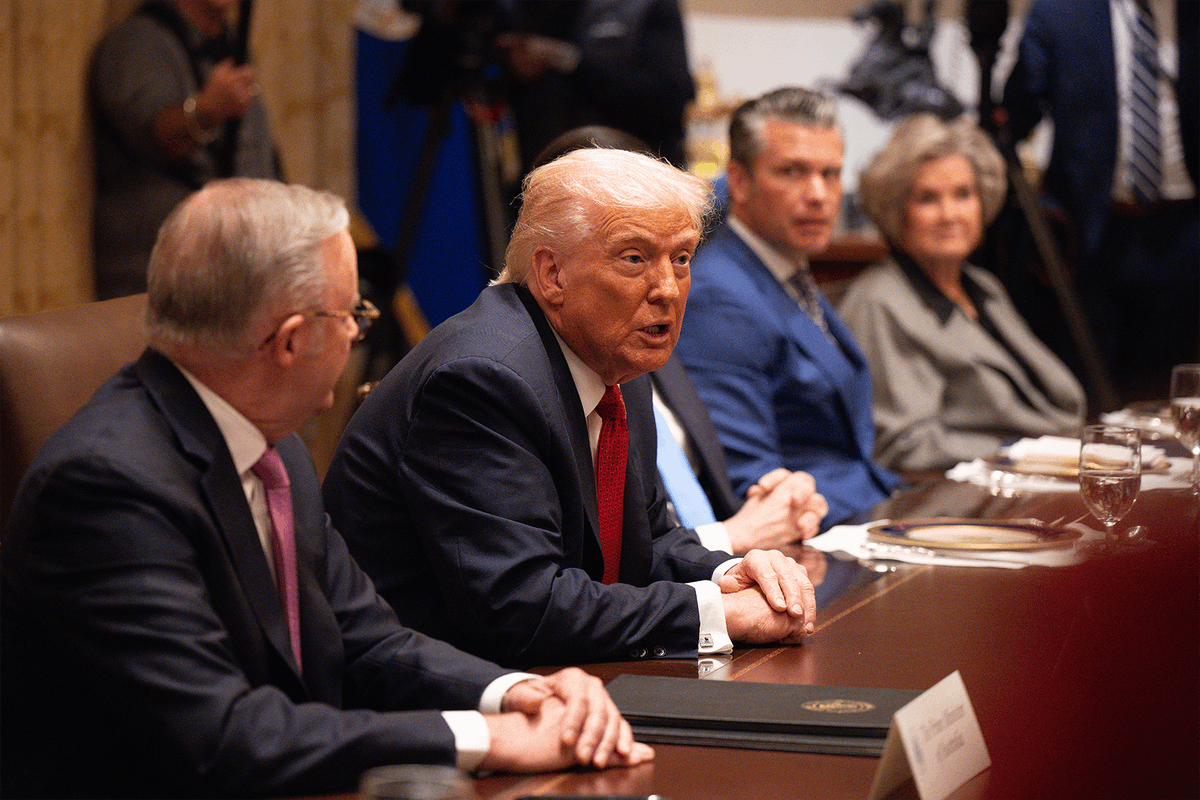
Photo: AAP Image/Lukas Coch


The botched execution of a Death Row inmate in Tennessee and her emergency transfer to hospital is a reminder — if we need one — of the brutality and callousness of much of America’s approach to law and justice. For all the institutional and structural resonances between America and Australia, the differences between our civic values are as stark as ever.
Prime Ministers and other high-ranking government ministers love to trumpet how we share values with the nations whose leaders they meet here or elsewhere. It’s the platitude of first resort in so many banal commentaries on “close bilateral relationships”. Like Clayton’s Tonic — the drink you have when you’re not having a drink — it’s what they say when they’ve got nothing much to say. And that’s a lot of the time.
They rarely enumerate what those values are, though “democracy” and “the Rule of Law” are often trotted out as the default conversation stoppers. Once they’re centre stage, the conversation has nowhere else to go, so we can bask in mutual congratulations without considering whether there is any substance to the relationship at all.
“The Australia-United States relationship is based on shared values” is the mantra that has stood the test of time. But it can’t withstand the test of scrutiny. Where is respect for common humanity? Where is the sanctity of human life? Where is care for children, the aged and the defenceless? Where is kindness to the downtrodden? Where is the right of peoples to self-determination? Where is “no war without just cause”? Where are the more homespun values of care, compassion, inclusion and mutual respect? They’re overlooked because they are not high-sounding enough. They don’t reflect the rhetoric.
The claim of shared values is the leitmotif of almost every set-piece declaration of Australia’s enduring relationship with America. Sure, we have enduring economic, political, social and strategic interests with America. But are these interests tantamount to values? For starters, over half of the States of the Union retain capital punishment on their statute books, and over twenty still practise it, though horrifyingly blind to human dignity, as the Tennessee case exemplifies.
Capital punishment is a legal penalty that America has in common with Belarus, China and Russia, along with Indonesia, Iran, Japan, Malaysia, Saudi Arabia and Singapore, among others with which Australian politicians would never claim shared values. But they remain silent on the barbaric habit of our great and powerful friend.
For its part, the Trump administration has ridden roughshod over the rule of law as it locks up and forcibly deports refugees and other immigrants awaiting due process to have their claims assessed. According to the Brookings Institution, around 400 thousand people have been held in Immigration and Customs Enforcement (ICE) facilities since Trump’s inauguration, many in flagrant breach of habeas corpus.
Quality research, analysis, explainers and factchecks from experts you can trust.
Repeated denials from the Trump administration notwithstanding, Brookings records that over 200 thousand children, 71 percent of them US citizens, have been separated from at least one parent. Some 35 thousand children have been left with no parents at all. And according to The Atlantic, in a complete rejection of the principles underpinning the Rule of Law, in July 2026 ICE agents arrested 49 thousand people, most of them without any criminal record.
Nor does America’s habit of interfering directly in the internal affairs of other countries represent a value that Australia shares. Unilateral intervention in Iraq, Afghanistan and Iran —without any UN mandate — was disastrous, and the abduction and subsequent incarceration of Venezuelan President Maduro and his wife were also in breach of international law.
Australia and America share many institutional and structural similarities. Yet respect for the political independence of the courts and the public service is certainly not a distinguishing feature of the Trump administration. The Supreme Court of the USA frequently divides along politically partisan lines in a way that the High Court of Australia would never contemplate. The US Department of Justice has become a political arm of the White House while the current heads of agencies like the CIA, the FBI and even the US Federal Reserve are better known for their political alignment than for their professional qualifications.
Even the US military leadership, traditionally conservative but not politically aligned, has been captured by Trump’s Oval Office. The submissive performance of over 800 generals and admirals assembled at Quantico as they were harangued by President Trump and Secretary for War Hegseth was demeaning. Hegseth’s firings and hirings are not consistent with anapolitical and professional military — characteristics in which the US military has long evinced great pride.
Fundamentally, however, the question of values is not one of rhetoric. Values go to the heart of ethical behaviour which, in turn, drives a nation’s moral authority. And America’s moral authority, which has been largely consumed by the bonfire of Trump’s vanity, matters. Without its moral authority, America cannot aspire to leadership or sustained influence.
That is not in the interests of either America or Australia. Instead of asserting platitudes, the leaders of both our nations should mark the eventual passing of the Trump administration by embarking on a much more serious conversation on exactly what they mean by shared values, and whether values guide their behaviour as national leaders.
Allan Behm works in The Australia Institute’s International and Security Affairs Program

