Climate integrity is a topic that seems to have been buried by other inhumane priorities, yet is so fundamental to our human existence. Indeed, climate integrity seems to be in very short supply. It is our moral and humane duty to save the islands and the world against climate change, as a matter of urgency.
Tue 6 Oct 2026 01.00 AEDT
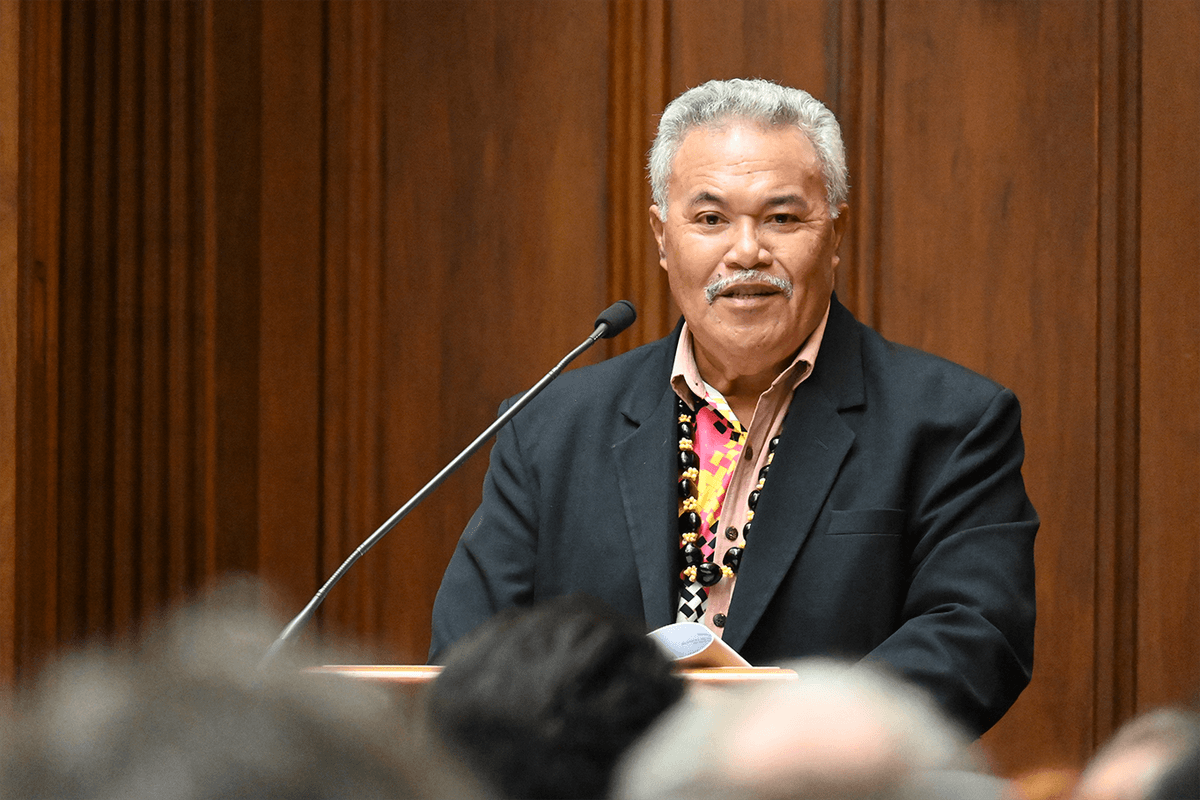
Photo: AAP Image/Ben McKay


Climate integrity is a topic that seems to have been buried by other inhumane priorities, yet is so fundamental to our human existence. Indeed, climate integrity seems to be in very short supply.
It is our moral and humane duty to save the islands and the world against climate change, as a matter of URGENCY.
In my seven years as Tuvalu High Commissioner to Fiji, seven years as Ambassador to the UN, five years as AOSIS Chairman and Negotiator, and seven years as Prime Minister of Tuvalu, I have always concluded my statements with the punch line: “Save Tuvalu to save the World” against climate change. This is not a self-serving proposition. Yes, we may be the first to suffer, but if we go, you go – everyone faces serious consequences.
My choice of the title: “Saving the Islands and world climate urgency: Less COPs, actions now, stop fossil fuels”, is deliberate.
After years of work, we know what climate change is, its causes, effects and options to save us. But despite our calls, containing our survivability targets to 1.5’C temperature increase and other Paris targets, these have obviously been overtaken by so many geopolitical pressures, including fighting never-ending wars, releasing more greenhouse gases (GHGs), irrational trade and economic policies, diplomatic attacks on international law and relations and irresponsible leadership.
In the face of it all, the situation of destruction in the Pacific Islands due to climate change and sea level rise is dire. Pacific island leaders, communities, and negotiators have repeatedly called for urgent action to stop climate change. It appears our call has fallen on deaf ears. There is much confusion. The onslaught continues on livelihoods. While big emitters like Australia continue to dig and export coal and gas, and expand fossil fuel mines.
Instead, the islands are inundated by millions of dubious official development assistance (ODA) projects, visas, mobility schemes, unbid outside contracts, external interference, and dubious insurance schemes, mostly beyond local capacity to absorb, let alone sustain. And, often, unrelated to local needs whilst greenwashing climate change.
Instead, we are also inundated by social media Tiktoking and AI-ing fake stories about our demise and sinking into the sea, without the honesty of telling their home public and governments to reduce GHG emissions. There is no urgency even to contribute to the Tuvalu Survival Fund nor the Pacific Resilience Fund.
Just in the last week of August, we heard of how the Tuvalu Trust Fund (TTF), under the directorship of Australia, has had linkages to investments in fossil fuel companies, like the Indian Reliance Industries, which owns the world’s largest crude oil refinery, and the Southern Company, the second largest GHG emitter in the US.
“It is utterly incongruous that the TTF, with Australia as a board member, would be investing in the means of Tuvalu’s destruction” – by Wes Morgan.
And I agree with the Tuvalu Minister of Climate Change when he said this is a totally “immoral” thing to do whilst keeping it a secret to the people of Tuvalu. I suggest that thorough investigations be made into the reported TTF fossil fuel investments. Again, where is climate integrity in these irresponsible actions – and I also wonder how many other externally funded bilateral, regional, and multilateral projects in Tuvalu have had investments in fossil fuels.
While I appreciate the enormous funding by Australia to sponsor the holding of the two upcoming pre-COPs in Fiji and Tuvalu. I strongly believe these two side events must be utilised to mobilise the widest possible Pacific participation to line up for COP31. There is no need to rewrite Paris. But we must remind ourselves and the world of the urgent need for a comprehensive strategy to save the islands and the world through urgent concrete actions by all, particularly through financing, renewables, and phasing out fossil fuels.
These said, we cannot repeat the unfortunate hijacking of our Pacific Small Island Developing States (SIDS) priorities by geopolitical interests, as seen in Koror. Sadly, we lost unity. We, SIDS, got our appeals for 1.5’C, we got NDCs; and we got loss and damage all put into the Paris Agreement. We situated ourselves better through the Suva Declaration, Blue Ocean Continent, Boe Declaration, Kainaki II, 2050 Blue Pacific Strategy, and through strong and collective Pacific leadership.
If we were able to then, why can’t we get the world REMINDED to act URGENTLY now in COP31? Obviously, we must relook not only at the resources and craving for ODA but also at true coalition building.
Let me illustrate a couple of unfortunate examples of misleading policies by major powers in the Pacific.
Last year, the Tuvalu Government entered into an agreement with Australia to allow 280 Tuvaluans to migrate to Australia in a so-called response to climate change. This is called the Falepili Union Treaty.
Quality research, analysis, explainers and factchecks from experts you can trust.
Unfortunately, this migration scheme has nothing to do with climate change despite assertions by Australia. The selection of Tuvaluans who can migrate is done by ballot. It includes Tuvaluan citizens who are not even living in Tuvalu. If it was a response to climate change, it would have a selection process based on finding the people most vulnerable to the impacts of climate change. The treaty does not do this. There is no climate integrity.
Gravely, the treaty has two very serious consequences.
First, the wording says that Tuvalu must consult with Australia first before entering into any agreements with other nations. Effectively, this is handing over our sovereignty to Australia. We can no longer make decisions on our international relations on our own. So the treaty is really a security agreement.
This is a shameful example of neo-colonialism. As I stated in my speech to the Australia Institute Summit two years ago, I remember when the former Prime Minister of Australia, Kevin Rudd, said that Australia would be happy to take all Tuvaluans if Australia could have access to their fishing zone. I was appalled by this statement. Kevin Rudd’s policy has resurfaced with the Albanese government.
The second consequence of this treaty, which has received little attention, is the social disruption it is causing. People are being pulled from their lives in Tuvalu and transferred to Australia with no guarantee of employment.
In the early European history of Australia, Pacific peoples, including Tuvaluans, were taken from the islands to work in cane fields in Queensland. This was called blackbirding. In a small island nation like Tuvalu, taking people from our economy and community is already having serious social consequences. People holding essential jobs in Tuvalu are leaving, creating a significant vacuum. Furthermore, Tuvaluans have no guarantee that their skills will be transferable to Australia. This has to be the greatest social disruption the country has witnessed in its history.
It may appear that I have strayed a little from the topic of climate integrity, but this migration agreement has been flagged as a response to climate change. It is not. If Australia had any integrity, it would stop exporting fossil fuels. If this were to happen, there would be far less reason for Tuvaluans to leave their country.
Let me quickly turn to the International Court of Justice’s Advisory Opinion on Climate Change. The Opinion clearly states that States should, in the context of climate change, “use all means [at their] disposal in order to avoid activities which take place in [their] territory, or in any area under [their] jurisdiction, causing significant damage to the environment of another State”.
Australia, through its coal mining and gas extraction, is infringing on this obligation. It is carrying out what the ICJ says is an internationally wrongful act. So, clearly, there is no climate integrity there.
Unfortunately, the current Tuvalu Government has been blinded by the Falepili Treaty and fails to see the greater harm it is suffering by Australia’s lack of climate integrity.
Sooner or later, Australia will be held to account for its failure to show climate integrity and for its internationally wrong fossil fuel exports. I hope there are lawyers out there ready to litigate this shameful disregard for Tuvalu’s future.
We want to live in Tuvalu, not to become a second-class citizen of Australia. And likewise, our grandchildren, who would be in their thirties around the time for net zero carbon in Australia, would like to remain in Tuvalu.
Saving them and others would need no more COPs, no more fossil fuels, but an urgent climate change integrity strategy of concrete actions.
Thank you. Fakafetai lasi
Rt Honourable Enele S Sopoaga, CMT, OBE former Prime Minister of Tuvalu, and Founding Member, Pacific Elders’ Voice

