Last week, the Australian Parliament’s Joint Select Committee on Artificial Intelligence held public hearings with some of the world’s largest AI companies, including OpenAI, Anthropic, Google and Microsoft.
The headlines promised a “grilling”. AI bosses would be “hauled before” Parliament and made to answer for safety failures and threats to Australians’ privacy.
And then the hearing happened. But what followed felt less like parliamentary scrutiny and more like a corporate sales pitch with parliamentary stationery.
The questions being asked genuinely made me feel like I was losing my mind. The Committee’s questions repeatedly boiled down to: Tell us how Australia should regulate you and what might stop you from investing here.
That’s like asking the bank robber whether the vault door is stifling innovation!
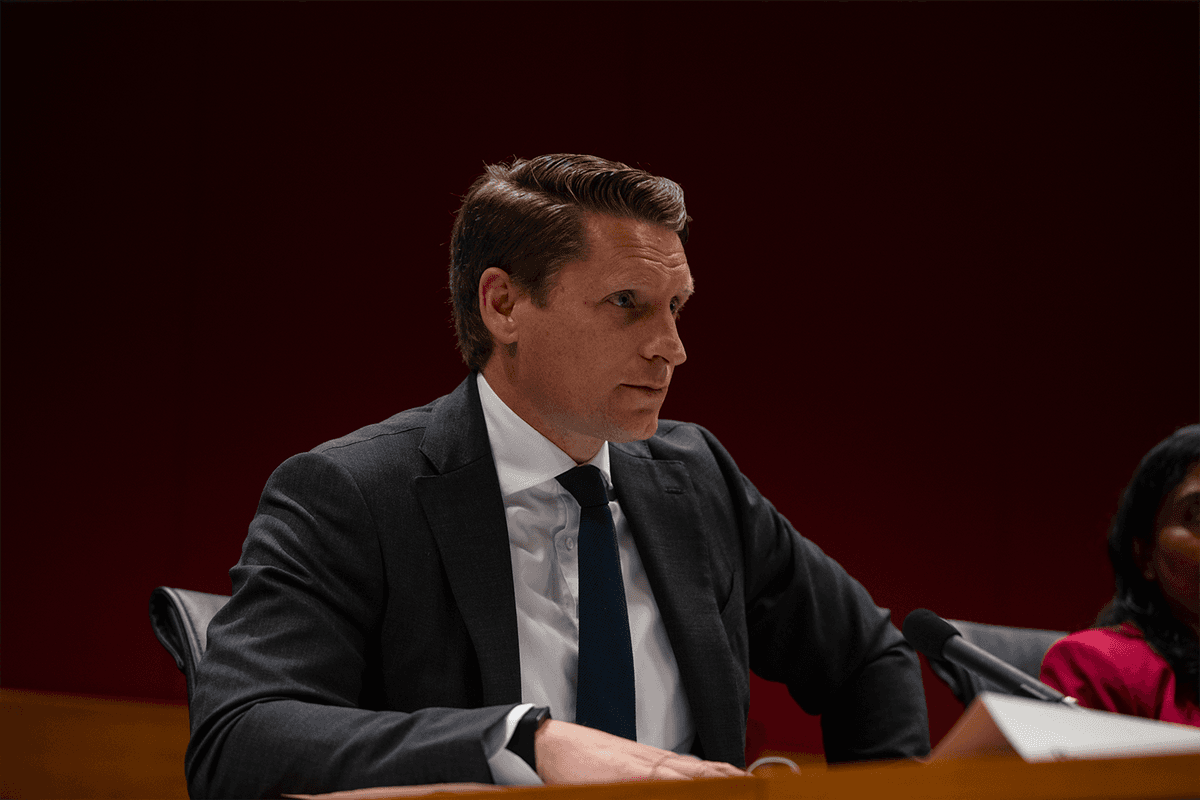
This question from Andrew Hastie was put to OpenAI (after one of its AI agents gained unauthorised access to a Medicare statistics portal and the company took almost three months to notify the Australian Government) and was my favourite:
What is your elevator pitch… in 60 seconds as to why we need AI investment in this country?
Asking the hard-hitting questions!
When the discussion turned to copyright, OpenAI was asked which copyright settings might constitute a “red line” for investing in Australia:
What are the things that could scuttle an investment because it doesn’t work, it makes it too hard, it makes it too risky, it makes it too uncertain or whatever the dynamic is?
On national security, AI companies were asked:
What does it look like for Australia to play a leading role in how this tech is governed… and what does that mean in connection with our national sovereign capability?
And:
What’s the opportunity cost in national security terms if we miss this moment, this opportunity?
Why are multinational corporations being invited to define Australia’s national security interests when their own commercial interests are directly implicated in the answer?
There is something deeply circular about asking multinational technology companies what national security risks Australia faces, whether we urgently need their products and how their industry should be regulated.
These companies are not neutral observers. They have a direct commercial interest in convincing governments that AI adoption is inevitable, that delay is dangerous, and that regulation must be globally consistent, or weak enough not to interrupt their business models. Their evidence may be relevant, but it should not be confused with an independent assessment of Australia’s national interest.
Get our newsletter
Quality research, analysis, explainers and factchecks from experts you can trust.
The harms are already here
My greatest concern is not actually that parliamentarians gave AI companies free rein to advertise at a parliamentary hearing. It’s that conversations around AI safety remain heavily dominated by what the technology may become. Considerable attention is directed towards future systems that could escape human control or pose existential threats. But this focus is eclipsing what AI is already doing.
AI is already being used to perpetrate gender-based violence. It allows perpetrators to take an ordinary photograph and manufacture sexualised pictures. It can be circulated to the person’s family or workplace, used to humiliate them publicly or weaponised as a means of coercion.
Generative AI is also leading to an explosion in the production and distribution of synthetic child sexual abuse material (CSAM). AI is scraping photos of children from social media or school websites to train the model. AI tools are then used to create synthetic CSAM.
These are not entirely new forms of violence. What has changed is the capacity of perpetrators to automate abuse. AI can intensify longstanding violence while placing the burden of containing the harm on the person targeted.
AI systems are also reproducing discrimination in employment, housing, financial services and health care. They are being built on data shaped by existing inequality, then deployed into institutions that already produce unequal outcomes.
These harms may not resemble the singular catastrophe that dominates discussions of national security and existential risk. That kind of threat is undeniably more cinematic. It gives us The Terminator: one spectacular machine threatening the fate of all humanity. The harms happening now are arguably less compelling because they are borne disproportionately by people whose safety has never commanded urgency.
They occur across many systems, often without one dramatic moment that commands public attention. Their cumulative effect is to deepen inequality. Meanwhile, AI is still being described as a future risk. The scale of these harms is genuinely frightening, despite being absent from the Committee’s questioning.
AI policy should not be separated from online safety
This gap is particularly difficult to reconcile with the Governments narrative around the proposed Digital Duty of Care, and the under 16’s social media ban.
The Government launched the reforms with a stark account of the harms flowing from digital platforms. It spoke about algorithms promoting misogyny and abuse, and young people pushed to suicide. It said some of the most powerful companies in the world must be required to prevent foreseeable harm rather than left to regulate themselves. The message is extremely clear: these companies cannot be trusted to put public safety ahead of profit.
Yet when the conversation turns to AI and national security, the tone changes completely.
The caution disappears. Companies developing technologies that are already generating harmful content and reproducing discrimination are welcomed as partners in Australia’s economic future. Instead of asking how their products will be made safe, policymakers ask what Australia must do to attract their investment.
These are not separate conversations. The systems used to create abusive content and the algorithms that amplify misogyny are part of the same digital environment the Digital Duty of Care seeks to reform. AI chatbots are expressly within the proposed framework, yet the broader AI policy debate continues as though online safety is somebody else’s problem.
If the Government believes digital services must anticipate foreseeable harms, that principle must apply equally to the companies developing and deploying AI systems. Australia cannot condemn Big Tech’s business model in one policy debate while rolling out the red carpet for it in another.
The AI industry is presenting Australia with an artificial choice: embrace AI on its preferred terms or risk being “left behind”. We should reject that premise. Australia does not have to choose between innovation and safety. It must decide whether innovation will be governed in the public interest or whether the profiting will be allowed to set the terms.
Darcie Newland is the Gender-Based Violence Senior Policy Officer at the Working for Women Alliance. Read the Alliance’s new policy brief, The Window Is Now: The Case for a Gender and Safety Lens in Australia’s AI Policy.