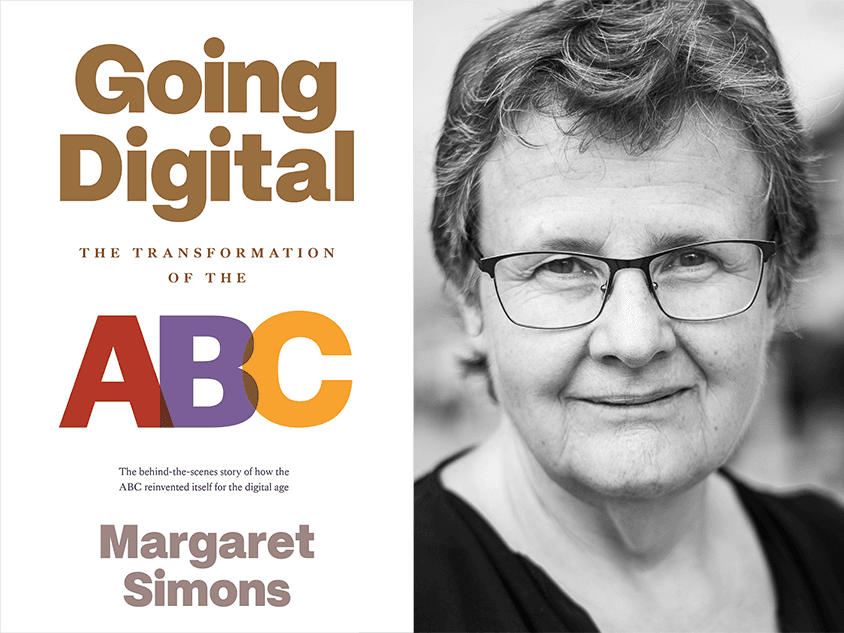
This is an edited extract of 'Going Digital: The Transformation of the ABC' by Margaret Simons, published by Black Inc Books and available from the 3rd of November in all good bookshops.

Mon 2 Nov 2026 08.36 AEDT


Mark Scott was as new technology optimist – an early adopter in both his personal and professional life. He was later to write that during his decade running the ABC, he saw himself “as being in the business of the future. We wanted to make a public broadcaster for the digital age, and for that you needed to embrace technology and the opportunities of the new.” He had read widely on digital technology and how it was changing audience expectations. His contract at the ABC was for a five-year term, and he tried to compose a five-year plan, but the job defeated him. “It was virtually impossible to know where the media world was going to be in five years’ time. It was all changing so quickly.”
In interviews for this book, he remarked had he nailed that plan when he started in 2006, he would have missed some important things. “I’d have missed the iPhone, the iPad, Facebook, Twitter, streaming giants like Netflix and Spotify, YouTube. But what I did get a sense of was the future was that way, you know? And it was to do with more content, more personalised choice for audiences … Those broad things, I struck quite early.”
Talking to staff, he often quoted The Leopard by Italian novelist Giuseppe Tomasi di Lampedusa: “If we want things to stay as they are, things will have to change.” He told them that if the ABC was to remain central, relevant and compelling, the new opportunities had to be embraced. That would mean some missteps, some calculations that didn’t come off, and some courageous innovations.
In particular, it seemed that new media and social media would change journalism. There was a great deal of optimism about what this might mean. Scott was influenced by the US media academic Jay Rosen. In the 1990s, Rosen had founded what became known as the public journalism movement, which advocated for journalists gathering and then following a “citizens’ agenda” through town hall meetings and constant interaction with the public. By 2005, Rosen was saying that the public journalism movement had been overtaken by technology. Anyone could now publish, and “the people formerly known as the audience”, as Rosen called them, had arrived in the middle of the news-making process, whether journalists liked it or not.
Rosen was hostile to professional journalism where it meant “insiders” reporting to a largely passive audience. On a visit to Australia in 2010, he was interviewed by Leigh Sales on Lateline. He decried “horse-race journalism”, in which the focus was on who was ahead or behind in a political race, rather than on policy. He said it was dangerous for journalists to portray themselves as “insiders” or to promote the “cult of the savvy”. He went on: “I’m told you actually have a program here on Sunday morning called Insiders?”
“We do,” confirmed Sales.
“And the insiders are the journalists?” Rosen continued. “That’s remarkable.” He clearly did not approve.
Rosen was a critic of journalists, but he thought they were important. Others were arguing that the profession was about to become redundant, as citizens would be able to do it themselves. Social media was quickly wiping out blogs in their traditional form. Instead, blogs became absorbed into traditional media, and “live blogging” was a new and important journalistic skill. The first pictures available of an unexpected event – a disaster or a crime scene – were often taken by citizens using a smartphone, and the media vacuumed them up.
These ideas – people generating their own content, audience members interacting with journalists to drive news coverage – seemed uniquely relevant to public broadcasters, which were already paid for by, and in the service of, citizens. But what were the rules when it came to what became known as “user-generated content”? How should it be verified and used? From his earliest days in the job, Scott described the ABC as the nation’s town square – a place where citizens could come together and interact. The phrase appeared in almost all his major speeches in his first five years in the job. This rhetoric was born of the optimism about what social media could mean for democracy and the media.
The idea of the ABC as a town square was based on the principle that representative democracy was improved by “authentic citizen participation”. Only a publicly funded organisation could do this. Commercial media talked to people as consumers. Public broadcasters addressed them as citizens.
In 2009, Paul Chadwick, the ABC’s director of editorial polices, updated them to include social media – the first time it had been mentioned. The additions were brief and permissive. They encouraged staff to use MySpace, Facebook, YouTube and Twitter to engage with audiences within certain rules: journalists should not mix professional and personal attitudes in a way that could bring the ABC into disrepute, should not undermine their effectiveness at work, should not imply ABC endorsement of personal views and should not disclose confidential information received through their work at the ABC. Within these guidelines, there was at first a wide licence for journalists to converse with their audience, and to use their wit, personality and insights.
Quality research, analysis, explainers and factchecks from experts you can trust.
Chadwick also wrote new guidelines for user-generated content. It would not always have to meet the ABC’s normal standards of impartiality, the guidelines said, and would not always be moderated before being posted to ABC sites. “The ABC recognises that social and political activity is a necessary and desirable aspect of a healthy democracy,” the guidelines said. “It is the nature of online and interactive services that from time to time, particular perspectives may dominate due to the flow of contributions from users.”
Scott himself was an early adopter of social media, Twitter in particular, and he encouraged ABC journalists to join him. Journalists including Leigh Sales, Annabel Crabb and Mark Colvin acquired large audiences for their personal Twitter accounts. For audiences, it was a way to feel in touch with journalists who had previously been available only through broadcasting. Now it was possible to ask them questions, critique them – perhaps, even, to influence them. Twitter was far from the largest social media platform, but it quickly became an important site of political speech.
Not all journalists were enthusiasts. Kerry O’Brien was sceptical of Twitter as a tool for journalists. Programs needed to be promoted, of course, but “having anchors and reporters promoting themselves on social media was always potentially going to be fraught,” he says. He opened a personal social media account only after he became the anchor of Four Corners, and he used it conservatively and sparingly. Tony Jones never had a personal Twitter account.
Scott’s push to make the ABC more than a broadcaster raised numerous challenges and tensions. First, how to maintain the obligation to be objective, when social media demanded journalists show personality and wit? How could the ABC’s charter obligations marry with the expectation that the audience become part of the process, generating content and sharing it on ABC platforms? As well, the ABC was on a collision course with commercial media organisations. Its website competed directly with theirs, and with startup operations trying to make sustainable news businesses online.
For ABC journalists, the instantaneous, interpersonal nature of social media was thrilling, but it also left them exposed. Progressively, controversies over imprudent tweets and posts resulted in changes in attitude, and more chilling guidance notes. By 2011, there was a new policy, more managerial and less optimistic. It clarified that the ABC was not responsible for content posted to personal social media accounts. Staff could be dismissed for improper behaviour on personal accounts. More broadly, as the years wore on, it became clear that an era in which anyone could publish might not, as some had argued, lead to a new enlightenment.
Nor did it guarantee healthy democratic participation. In 2011, prospective US presidential candidate Donald Trump started to question whether President Barack Obama had been born in the USA. Obama released his birth certificate, including on Twitter. It showed that he was born in Hawaii and was therefore eligible to be president. That didn’t stop @realdonaldtrump from continuing to suggest it was a fraud. The impact of social media on misinformation-fuelled populism was becoming a commonplace of the metaphorical town square.
Scott had been right about the enormous shifts social media ushered in. It did change media, journalism and democratic discourse. But as the dark side of those changes became increasingly evident, it was not audience participation that was advanced as the reason for the ABC’s continuing relevance. Rather, it was reliable, professional journalism, and the ABC’s reputation for providing it in an age of misinformation.
Under Scott, the ABC was to become more porous, more accessible and available everywhere, through social media and online. The relevance of thinking in terms of separate platforms – television, radio and even online – would fade. This would make ABC content hard to avoid, but, also, critics would suggest, too thinly spread.
Despite Jay Rosen’s disapproval, Insiders survived – a testament to the continuing institutional power of journalists and their privileged access to the powerful.
Margaret Simons is an award-winning journalist and the author of thirteen books, including biographies of Penny Wong, Tanya Plibersek and Malcolm Fraser; the latter won the Book of the Year and the Douglas Stewart Prize at the 2011 NSW Premier’s Literary Awards.
This is an edited extract of ‘Going Digital: The Transformation of the ABC’ by Margaret Simons, published by Black Inc Books and available from the 3rd of November in all good bookshops.

