The first real scrutiny of AUKUS is to be delivered this week, with the Public Inquiry delivering its report in a National Press Club Address on Wednesday, November 4th. The desire for more transparency around this pact is almost universal.

Mon 2 Nov 2026 11.20 AEDT
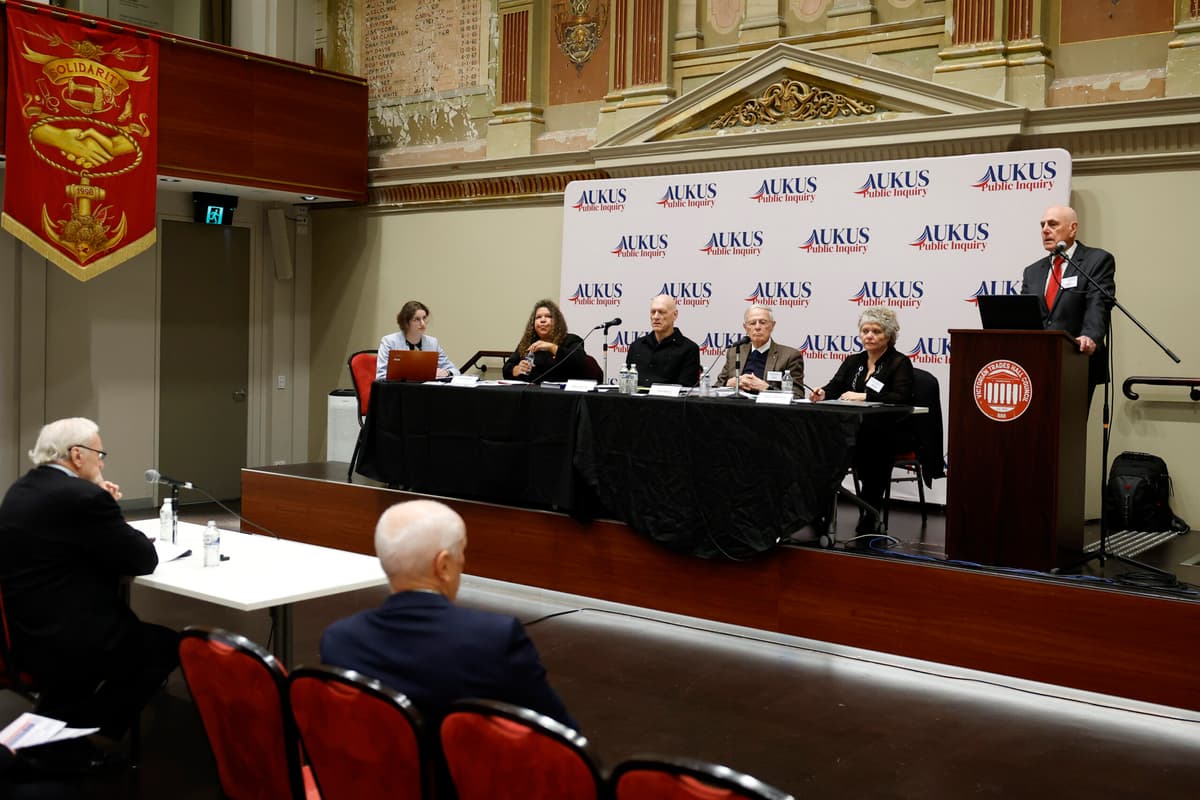
Photo: AAP Image/Con Chronis


I have always revelled in the geopolitical irrelevance Australia’s geography has afforded us.
As recently as the 1950s, it would have taken 10 to 20 days for a submarine to get from China to Australia. Our continent has been left off international maps so often there is a lost Australia meme for it.
It doesn’t stop there. Who could forget George W. Bush thanking then Australian Prime Minister John Howard for visiting the ‘Austrian’ troops in Iraq?
Far from being embarrassed by these gaffes, I’ve always felt smug – and safe – happy in the knowledge that maybe we just didn’t matter. If people don’t know who or where you are, they are less likely to invade you.
But times change.
I was born into the Cold War era – dominated by uprisings against colonisation like the East Timor resistance and the Mozambique War of Independence. Global conflicts were driven by the ideological divide between the U.S. and the Soviet Union. The Vietnam (or American) War lasted for 20 years, cutting short the lives of millions of people.
The collapse of the Soviet Union changed the world’s political map. The number of large wars between nation states fell dramatically and, by the mid 2000’s, people were talking about relative peace and the new world order.
The rise of ultra-violent transnational extremist movements, like ISIS in the 2010’s, shattered the relative ‘peace’, making many believe the violence couldn’t get worse.
Until it did.
Over the past four years, a return to state-based warfare has led to the highest number of active conflicts since 1946: the invasion of Ukraine by Russia, the horrendous terrorist attack on Israel by Hamas followed by an even more horrendous genocide against Palestine by Israel, a civil war in Sudan and more.
There are currently 65 active conflicts across 35 countries, the highest number since 1946. So, whilst some media and politicians disingenuously fan Australians’ fears of conflict, it’s undeniable that the vibe out there is a little heightened.
It was with this basic understanding of global conflict that I joined the public inquiry into AUKUS as a commissioner. Six months, seven public hearings and over 1000 submissions later, I am far more informed. And I’m scared. Really scared.
First, some agreed and basic facts:
And now for some concerns.
All three leaders who signed us up for AUKUS – Joe Biden, Boris Johnson and Scott Morrison – are no longer in politics. Yet their decision – made in private – remains locked in. It’s worth remembering that the PM who secretly signed us up for AUKUS also secretly appointed himself to five ministries.
Without any warning and with no public or parliamentary scrutiny, Australians woke up on September 15, 2021, to the breaking news that we were now part of a new security pact with the U.S. and the U.K. and that, for the first time, our country would own nuclear-powered submarines.
Australia is still yet to have parliamentary public scrutiny of this, the most consequential military and cultural decision our government has ever made.
I heard and read a lot during the public inquiry. Witnesses came from every corner of Australia, from young people to octogenarians, experts to punters, offering localised concerns and global perspectives.
Quality research, analysis, explainers and factchecks from experts you can trust.
There were strong common threads of concern woven through the diverse tapestry of representations.
Will AUKUS defend us from a real threat, or will AUKUS itself create that threat? Will our regional neighbours, especially China, see AUKUS as a threat?
Former Prime Minister Malcolm Turnbull, who attended the inquiry in Sydney, described AUKUS as the most expensive submarines Australia will never get. Were alternatives to AUKUS investigated before the deal was made? What else could Australia spend $368 billion on?
Australia is a non-nuclear state, and concerns were raised that owning nuclear-powered submarines would weaken our nuclear non-proliferation treaty commitments. Nuclear waste has long been an issue for Australians and AUKUS would require a nuclear waste storage site.
There were many concerns raised that AUKUS takes away Australia’s right to decide when and how we engage in armed conflict.
Experts explained that tying ourselves completely to the U.S. was an act of self-harm and to distance ourselves completely was an act of self-delusion.
A reflection from Professor Joe Camilleri at the first hearing in Melbourne stayed with me throughout the entire inquiry. His belief is that, at our core, white Australia is addicted to imperialism.
Australia, according to Joe, weaned itself off Great Britain, only to replace it with the U.S.
I asked him if imperialism is our drug, how do we get off it? He suggests we lean into our natural and unique advantages: as a nation with no land borders, the most successful multi-cultural community in the world and the wisdom of the world’s longest continuous culture.
Whatever the concerns and the diverging views, the desire for more transparency around this pact was almost universal.
The Public Inquiry report will deliver its report at an address at the National Press Club on Wednesday, November 4th.
Leanne Minshull is co-CEO of The Australia Institute and is a Commissioner on The AUKUS Public Inquiry, headed by the Hon Peter Garrett.

