Now a staple of global finance, GSS bonds offer a powerful mechanism to fund pressing environmental and social initiatives that lie outside traditional government budgets.


Tue 10 Nov 2026 15.11 AEDT
Photo: AAP Image/Richard Wainwright


Green, Social and Sustainability (GSS) bonds have emerged as a critical bridge for fast-tracking public-good outcomes, driving over A$55 billion in private capital across Australia in just ten years (See The Point’s explainer on green bonds). Now a staple of global finance, these bonds offer a powerful mechanism to fund pressing environmental and social initiatives that lie outside traditional government budgets.
Western Australia is a prime candidate for this capital, as the state grapples with a compounding mix of environmental and social pressures. On the environmental front, WA faces concerning biodiversity loss, escalating climate impacts, and rising greenhouse gas emissions. Socially, it is confronting a deepening housing shortage, a rise in family and domestic violence, and persistent inequities affecting First Nations communities – all of which could be directly targeted by GSS bond proceeds.
WA has some runs on the board. Since launching its Sustainability Bond Framework in 2023, the Western Australian Treasury Corporation (WATC) has successfully issued two green bonds: a A$1.9 billion debut in its inaugural year and a A$2 billion follow-up in 2025. Designed to fast-track green infrastructure, the proceeds fund projects like utility-scale batteries, wind farms, and EV charging networks. The market’s response has been overwhelmingly positive, with the two issuances drawing a combined A$11.5 billion in bids, signalling strong investor appetite for WA’s green economy.
Despite these positive steps, WA’s cumulative bond volume lags significantly behind interstate peers. The state trails Queensland (nearly A$14 billion), New South Wales (>A$12 billion), Victoria (>A$11 billion), and South Australia (>A$9 billion) (see Figure 1). As Australia’s fourth-largest economy – nearly rivalling Queensland, and heavily anchored in natural resources – WA has potential to scale up its issuance strategy. Pound for pound, WA remains A$10 billion behind Queensland in unlocking private capital to fund its green transition.
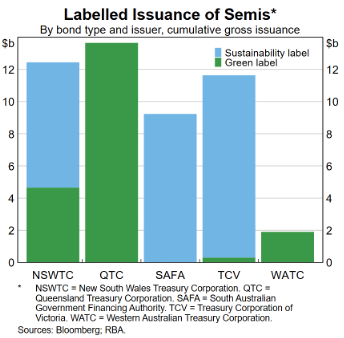
Figure 1 – Labelled issuance of semi-government bonds, by bond type and state issuer (cumulative gross issuance) (Adapted from Alexander & Jayawardhana, 2025)
To date, WA’s green bonds have targeted traditional climate mitigation categories like energy efficiency and clean transit, but the broader policy environment complicates the narrative. The concurrent state and federal approvals for the North West Shelf gas extension in May 2025 coincided precisely with the state’s second bond issuance. Because this extension could unlock $215 billion in royalty-free gas over 46 years, it risks diluting WA’s green credentials with international investors. Suddenly, the state’s cumulative green issuances are dwarfed in comparison.
Quality research, analysis, explainers and factchecks from experts you can trust.
Despite these policy tensions, the Framework’s power to unlock private capital remains a crucial lever for transformative change. A wealth of eligible project categories still sits untouched. On the environmental front, the framework can channel funding into biodiversity conservation, circular economy, climate change adaptation, and green buildings. Socially, it can facilitate investments in affordable and social housing, improved essential services, employment generation, and socioeconomic empowerment – with explicit support outlined for vulnerable groups including youth, women, regional towns, and First Nations communities.
Looking ahead, WA has a clear opportunity to not only close the capital gap with its interstate peers but to mature its sustainable debt market. WA could evolve its core energy and transport focus into a broader framework that encompasses social and conservation categories – perhaps drawing inspiration from pioneering initiatives like Canada’s proposed Indigenous Sustainable Bond Framework and emerging biodiversity bond models.
As the state’s initial green proceeds begin to deploy, the true test will lie in successive issuances. Broadening this strategy offers a pathway to drive inclusive growth for all Western Australians while firmly positioning the state as a rising powerhouse in sustainable finance.
Dr Brad Hiller is a Lead Climate Change Specialist at a multilateral development bank and recently contributed to a €500 million issuance on the London Stock Exchange.
Dr Brad Pettit is the Parliamentary Leader of the Greens in Western Australia and a Member of the Legislative Council (MLC).

