Global North governments and development finance institutions portray themselves as supporting the interests and development needs of Global South countries, without recognition of the financial architecture which they have imposed upon developing economies for their own benefit.

Mon 16 Nov 2026 01.00 AEDT
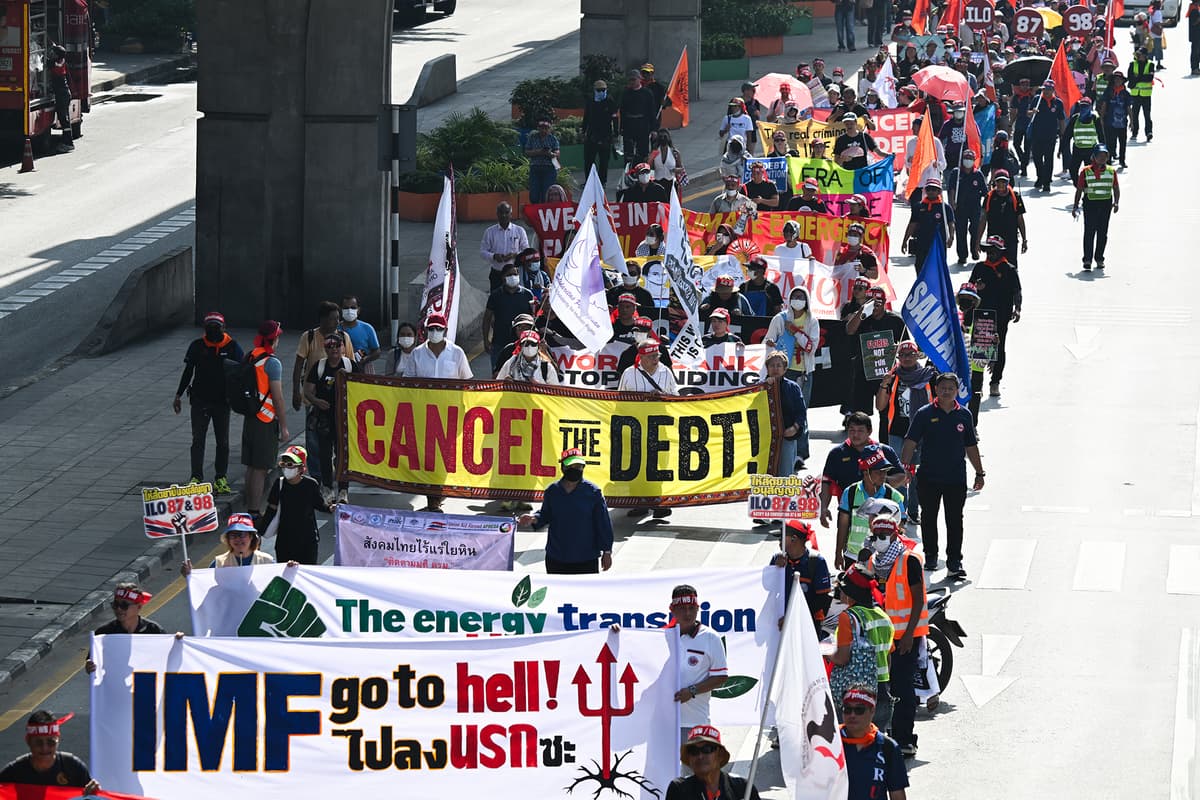
Photo: Panumas Sanguanwong


A few weeks ago, Bangkok hosted the World Bank and International Monetary Fund (IMF) annual meetings; as governments, banks and corporations came together to shape the economic futures of the Global South, trade unionists, climate activists, Indigenous Peoples, feminist collectives and young people from around the world mobilised alongside these meetings to demand an overhaul of the international financial architecture created by and for the Global North.
Global North governments and development finance institutions portray themselves as supporting the interests and development needs of Global South countries, without recognition of the financial architecture which they have imposed upon developing economies for their own benefit. With deep roots in colonialism, economic growth in the Global North has relied on a net appropriation of resources and labour from the Global South; this has been estimated at USD 242 trillion over the period 1990 to 2015. This ‘unequal exchange’ is enabled by the power Global North countries have in global economic governance; for example, in the World Bank and IMF, Northern states hold a majority of votes, with the US holding a veto. These institutions push the privatisation and financialisation of essential sectors, including energy, to drive profits. This acts to enforce an extractive development model which in turn fuels debt and fossil fuel expansion.
Global public debt is increasing; this year, Global South countries are due to pay nearly US$400 billion to external creditors – double the amount they paid a decade ago. A third of this goes towards interest payments rather than paying off the original loans. Because external debt must largely be repaid in foreign currency, this creates pressure to earn foreign exchange through exports, reinforcing dependence on extractive, export-oriented sectors, like fossil fuels. However, anticipated revenues from fossil fuels are often overinflated and require huge investments to reach expected returns, leading to further debt. Global South countries are also now facing a growing demand for extraction of critical minerals. This has been labelled by civil society as neo-colonial extractivism disguised as green transitions, with demand driven by uses outside of the energy transition, including defence and AI, and supporting export-oriented growth models that favour big tech, foreign mining corporations and multinational corporations.
An increasing number of countries are now spending more on debt repayments than education, public health or climate action. In fact, climate-vulnerable countries are being forced to spend nearly 25 times as much on repaying debt as on climate action, and the most climate-vulnerable countries are using nearly two thirds of their national revenues to repay debt. The high cost of climate disasters forces many countries to take on huge loans to survive and rebuild – loans which often come with high interest rates because of climate vulnerability. Recent data shows that 93.5% of the countries that are most vulnerable to climate change are in, or are at significant risk of, a debt crisis. This diverts money away from climate adaptation and transitioning to renewable energy. Our recent analysis on the situation in the Pacific highlights the vast shortfall in the grant-based climate finance needed for these countries, particularly in adaptation, in order to avoid further debt risks.
A recurring theme from the International People’s Assembly, which ran alongside the World Bank and IMF Annuals, was the lack of public participation in economic decision-making and the need to democratise development planning and economic governance. New processes are needed that allow full participation of workers, farmers, women and Indigenous Peoples to answer questions such as: how can a country’s resources be utilised, and for what goals and priorities?
Quality research, analysis, explainers and factchecks from experts you can trust.
If we look at government spending as an indication of priorities, military spending is increasing year on year; global military expenditures now exceed USD 2.9 trillion annually, according to the latest Civil Society Equity Review (CSER) report, Militarism in the Time of Climate Emergency, which outlines the multiple ways in which militarism amplifies the climate crisis and undermines climate action. The report shows that cumulative military expenditure of OECD countries since the Paris Agreement was USD$15 trillion – nearly 20 times greater than their cumulative climate finance, which was USD$799 billion according to OECD climate finance reports, or 50 times greater than Oxfam’s estimate of USD$302 billion, which provides a more realistic assessment of climate finance.
We can see these priorities playing out in our region, where the Australian government is spending record amounts on defence, while cutting overseas development assistance and not coming close to meeting Pacific climate finance needs. Instead, the government has been focused on security agreements, most recently with Timor-Leste, where Senate Estimates revealed the government’s recommitment to the development of the Greater Sunrise gas project in the wake of Woodside pulling out and major doubts about its commercial viability – rather than support for a more sustainable, diversified economy.
As COP31 kicks off this week, it is vital to address the intertwined causes of the climate crisis and barriers to climate action, which extend far beyond energy systems, to a restructuring of international financial architecture, cancellation of debts and a significant decrease in military activity – including an end to wars and genocide. As the latest CSER concludes, “a framework dominated by militarism, oligarchic power, and extractive international competition cannot solve the climate crisis.” Global North countries like Australia will attempt to maintain the status quo in order to continue reaping the benefits of the current structure of the global economy. We must push for systemic change, with solidarity across social movements, across the South and North – because we are stronger together.
Dr Suhailah Ali is the Director of Climate Justice at Jubilee Australia Research Centre, originally from Fiji and currently based on unceded Bidjigal country.

