Who spent big in Canberra’s last election – and how proposed changes would hurt newcomers
Could big spending explain the success of the independents at the ACT election? New data from the ACT Electoral Commission shows this isn't the case.
Are voters missing out on more than their democracy sausage?

Wed 10 Sep 2025 16.42 AEST
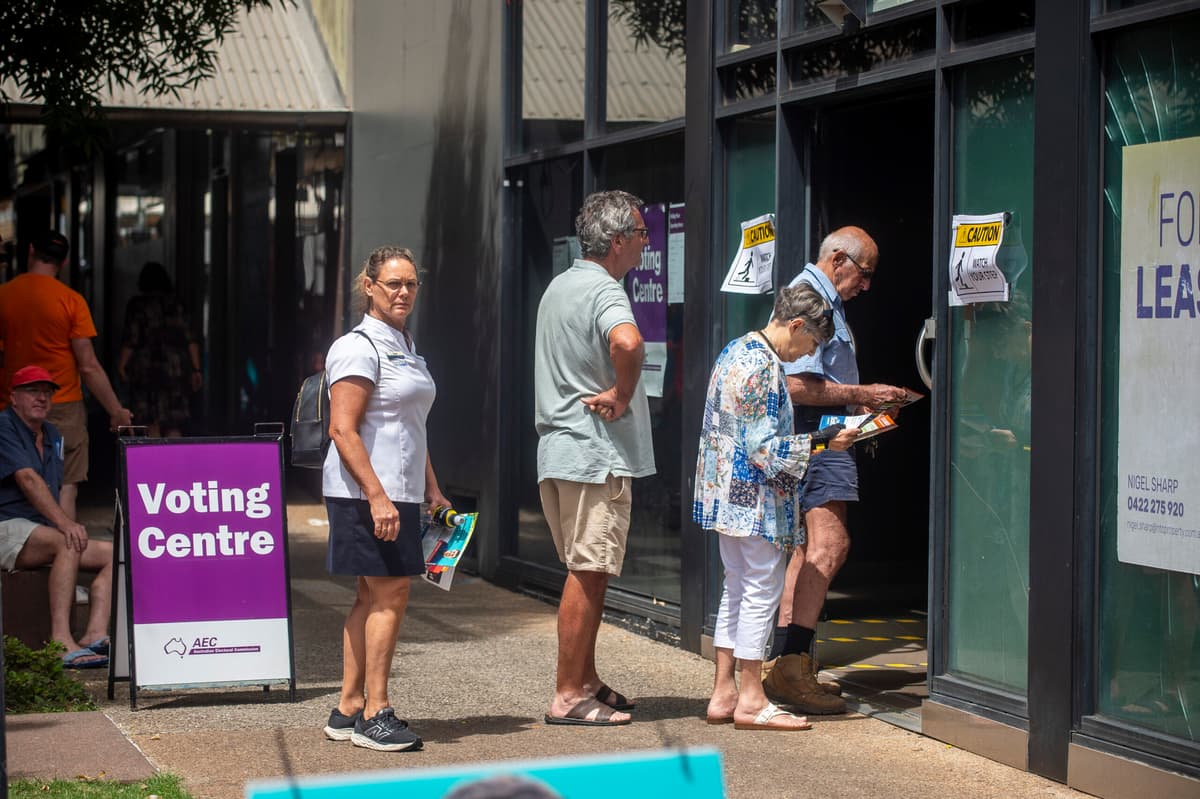
Photo: AAP Image/Aaron Bunch


If you rocked up to cast your ballot on polling day a few weeks ago, you may have noticed it was a bit quieter than it used to be. More and more Australians are forgoing their democracy sausage – and more importantly – voting before the final days of the election campaign. In fact, only 45% of Australians voted on election day, a record low that could be hampering Australians’ collective democracy.
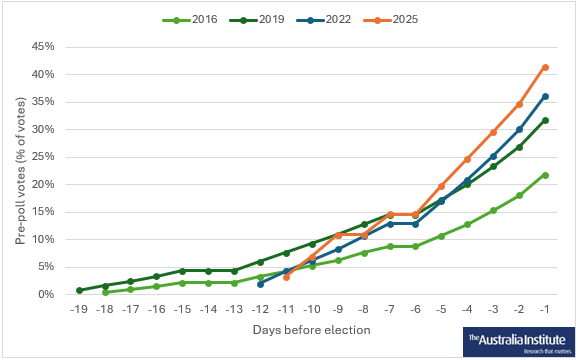
Despite the shortest pre-poll period in living memory, with booths opening only 11 days out from the election (over a week later than in 2019), Australians set pre-poll records several times during the campaign.
Figure 1: Pre-poll votes in the days before Federal elections
(Source: AEC)
On top of a delayed start, there were also pauses for ANZAC day and the Sunday before election day, but 2025 quickly outpaced every other year for early voting. On the Friday before polling day, 1.1 million people turned up at a booth to cast their vote, the first time more than a million Australians voted on a day other than election day.
There are six categories of voting in Australian elections:
Figure 2: Vote type by Federal election
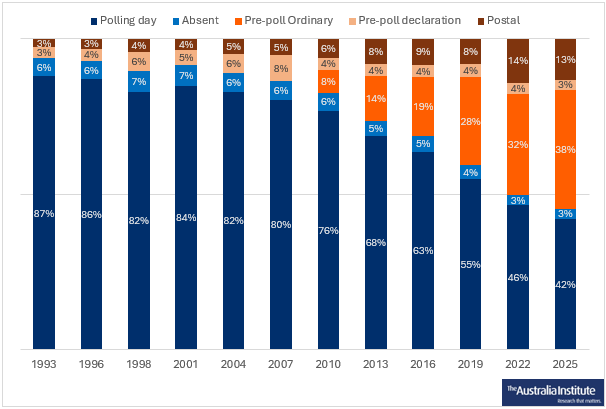
(Sources: Antony Green for 1993-2019, AEC for 2022 and 2025; Note: 2025 figures are not final)
Advertisement

Prior to 2010, pre-poll votes all required a declaration with a specific reason that the voter could not cast their ballot on polling day. From 2010 onwards pre-poll voters have not needed to provide a reason, and early voting has dramatically risen in every election since then. 2022 was the first where most Australians didn’t vote on polling day, and 2025 saw that number grow even higher.
A slightly smaller share of Australians voted by post this election than in 2022, though still far-above pre-covid numbers. Historically, postal voters are older on average, and their votes tend to favour conservative parties, but the surge of postal voting in 2022 shifted those trends somewhat. The pandemic convinced a wider array of people to mail in their ballots, and postal votes did not favour conservative candidates as much as in previous elections.
However, in 2025 the Coalition fared better enough on postal votes to hand them victory in some close races. In Goldstein for example, where Liberal Tim Wilson is expected to win by less than 200 votes, 60% of postal votes favoured him over Zoe Daniel, the only type of vote to do so.
It can be more convenient for someone to vote according to their own schedule rather than on a specific Saturday. However, individual convenience may be diminishing the significance of election day and with it, the ability of Australians to effectively exercise their democratic rights.
A key aspect of an election campaign is hearing the parties’ full list of policies, seeing how their leaders perform under the stresses of a campaign, and then coming together as a country to make a choice about who should represent Australians in the next parliament. As more and more Australians vote early, are they really coming together?
Early voting can have real political consequences when issues surface late in an election cycle. At last year’s Queensland election, Labor lost government with a 7.0% swing against them – taking only 46.2% of the two-party-preferred vote. However, Labor narrowly won votes cast on election day with 50.6% two-party-preferred. To some extent, this reflects that early voters tend to be more conservative than the electorate as a whole. However, it is also the case that those who vote on the day see more of the election campaign than early voters – particularly on the issue of abortion rights in the case of the recent Queensland election.
When voters go to the ballot box, it’s important that the choice they make is informed as much as possible by the knowledge of what the different candidates, parties, and leaders are offering. Millions of Australians – more every election – are missing out on the twists, turns and policy announcements of the final weeks of an election campaign.
How can they make a fully informed choice about who they want to represent them if they’re don’t see those critical final days?
Skye Predavec is an Anne Kantor Fellow at the Australia Institute.
Could big spending explain the success of the independents at the ACT election? New data from the ACT Electoral Commission shows this isn't the case.
The Australian Electoral Commission (AEC) has been urged to rethink plans that could shut or merge about one third of its divisional offices, with a union warning the loss of local expertise could disrupt future elections.