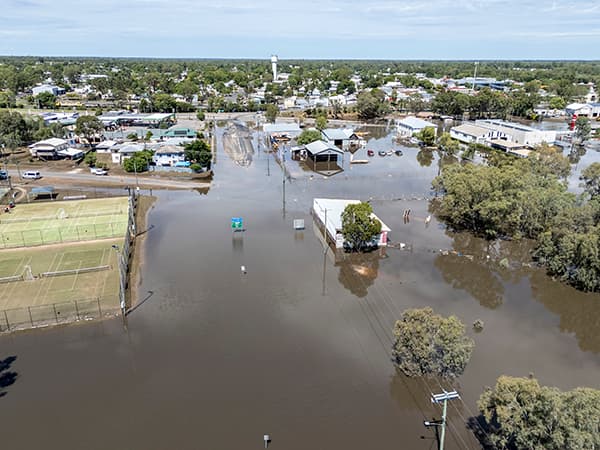
Whether we realise it or not, everyday Australians are already paying for the damage fossil fuel companies are causing to our climate through more frequent and extreme fires, floods, heatwaves and other disasters
The Australia Institute has proposed a Climate Disaster Levy on fossil fuel exports to ensure the companies exporting fossil fuels (coal, gas and oil) from Australia pay for some of the damage they are causing, rather than leaving Australian households and businesses to foot the bill.
Who is paying for climate disasters?
When fires and floods hit Australian communities, many people have their properties damaged or even lose their homes and businesses.
Some of those costs are insured, many are not. Whether or not you are directly impacted, we all pay for emergency response, recovery and reconstruction through our taxes.
On top of that, the increase in climate related disasters drives up insurance premiums for everyone, but particularly for people in more impacted regions. Millions of ordinary Australians are facing unaffordable insurance costs and potentially uninsurable properties.
Disasters already cost Australians around $38 billion a year, around $3,800 per household on average. Not all of this is due to climate change, but climate change is expected to dramatically increase the costs over coming years.
Australia Institute research also shows:
- Climate change is making insurance more expensive in Australia. Since 1989 insurance costs have increased nearly three times as much as overall inflation.
- Insured catastrophe losses reached a record $8 billion in 2022.
- 1.25 million people – suffer home insurance affordability stress and pay more than four weeks gross income on home insurance premiums.
- Some Australian households spend eight weeks of income on insurance per year, effectively working almost all of January and February, simply to pay their home insurance.
Who isn’t paying?
The largely foreign owned energy corporates making windfall profits exporting coal and gas from Australia pay virtually none of the costs of the fires, floods and other disasters they are fuelling, and often little or no tax or royalties.
- Australians get few benefits from fossil fuel exports.
- High levels of foreign ownership mean most of the profits from fossil fuel exports from Australia go to foreign owners of global energy giants exporting Australia’s resources.
- Big Gas gets more than half the gas they export from Australia for free.
- Australian Treasury revealed that as of 2023, no gas export project had ever paid petroleum resource rent tax (PRRT), the main tax on the oil and gas industry, which has been in place for nearly40 years.
- Gas export companies often pay little if any company tax. For instance,
Climate Disaster Levy. A simple and fair and economically sound solution.
Australia is the third largest fossil fuel exporter in the world, and second-largest exporter of fossil fuel CO₂ emissions. Fossil fuel exports from Australia are having a significant impact on the world’s climate.
The Australia Institute has proposed a Climate Disaster Levy on fossil fuel exports to pay for the increasing costs of climate related disasters.
The Climate Disaster Levy would not increase energy prices in Australia, because it is entirely on exports.
It is a fair and economically sound solution to the dramatically increasing costs of climate change falling on Australian households and businesses, as it imposes the costs on the companies causing the problem, rather than ordinary Australians.
If the levy imposed on emissions of fossil fuel exports from Australia is the same as the current Australian Carbon Credit Unit Scheme price of $36 per tonne of carbon pollution, it could raise up to $36 billion annually for the Australian community. With the European Union Emissions Trading Scheme price of $151 per tonne, it could rise to $151 billion annually.
These carbon costs are far below the actual cost of the damage cause by fossil fuel exports from Australia which could be as high as $440 billion annually if it reflected certain estimates of the full social cost of carbon.
With the costs of climate disasters certain to rise dramatically over the coming years, Australia can’t afford not to have a Climate Disaster Levy or some similar mechanism. If we don’t make the fossil fuel industry pay for the enormous damage they are causing, ordinary Australians will foot the bill.