Resilience and reform
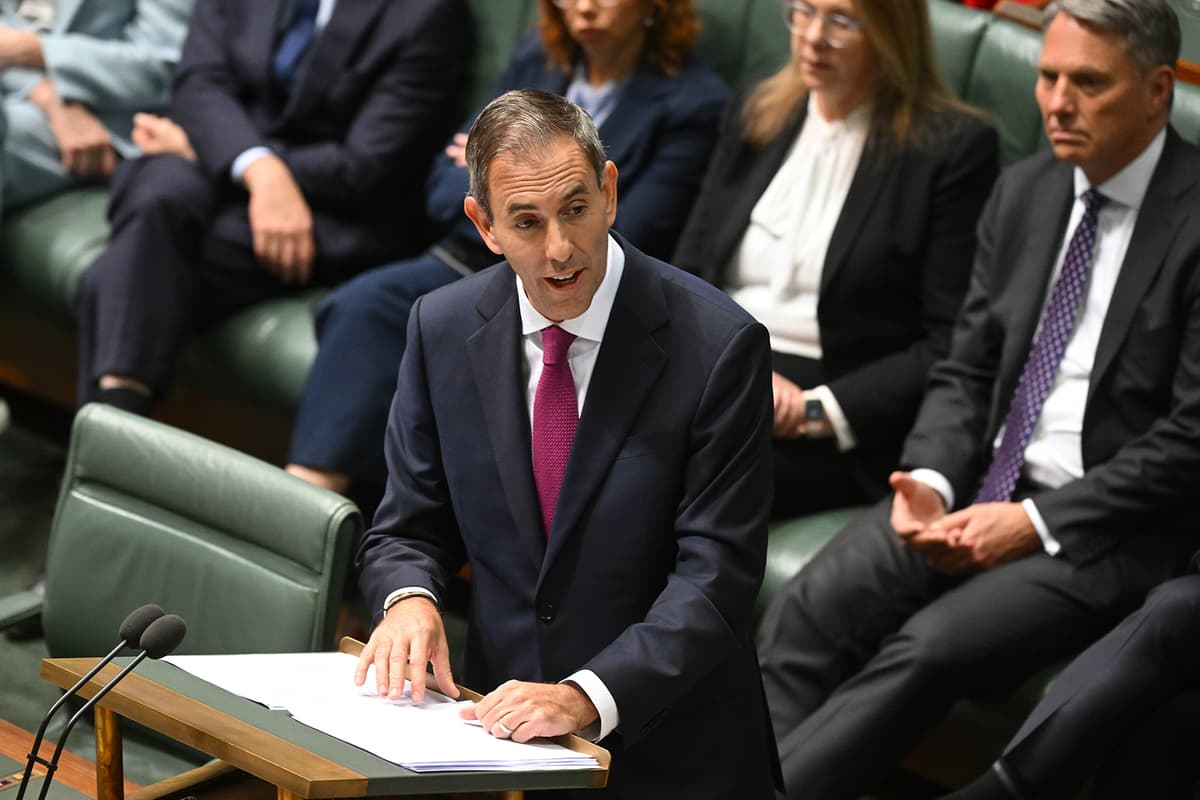
Speaker –
I acknowledge the Ngunnawal people here, and the Yagara and Yugambeh back home in Logan.
Speaker –
This is the most important and ambitious Budget in decades.
[Greg: It actually is. This might be damning with faint praise, given how pathetic previous budgets have been. But this budget is taking down one of the worst tax changes done by John Howard. So ring the bell and cheer]
Important because the world is throwing a lot at us – and this Budget is about helping Australia deal with these challenges.
And ambitious because we have so much going for us – and this Budget is about Australia seizing those opportunities.
War in the Middle East has been pushing up prices, pushing down growth, and punishing Australians.
[Greg: Thanks Donald]
It has exposed weaknesses in the global economy and intensified longstanding challenges here at home.
We didn’t decide when this war began and have no control over when it will properly end.
[Greg: Don’t worry Trump doesn’t know either]
But how we respond is up to us.
How we help each other through.
And how we come out of this a stronger, fairer, more productive and more resilient nation.
This Budget is ambitious in the face of adversity.
[Greg: Chalmers has a real emphasis on ambition but also stability, And while it does veer a little bit into Veep territory, what he is trying to do is massively change housing, but do it in a way that doesn’t scare people by making them think things are changing too fast]
It’s a responsible Budget, and a reforming Budget, which builds resilience and bolsters our economy.
There is more cost-of-living relief, more Medicare and more aged care, and more housing.
It makes the tax system fairer and stronger for workers, businesses, first home buyers and future generations –
Responding to the pressures of the here-and-now while embracing our intergenerational responsibilities.
The core of this Budget is an economic strategy with five main parts:
- Getting through the global oil shock and building resilience;
- Taking the pressure off people where we can;
- Making the economy more productive to lift living standards over time;
- Reforming the tax system for workers, businesses and future generations – including a new tax cut for every working Australian taxpayer; and
- Making the budget stronger, more sustainable, and helping to take the pressure off inflation by saving more than we spend.
Global and domestic outlook
Speaker –
We’re dealing with a fifth economic shock in less than 20 years.
[Greg: GFC, Pandemic, Ukraine, Iran War… errr minimg boom is a shock I guess?]
The conflict in the Middle East and closure of the Strait of Hormuz has disrupted the global economy and the global outlook.
Oil production fell by 8 million barrels a day in the first month of the war – almost eight times more than any of the oil shocks since the 1970s.
The global oil price started the year around $60 and has now been above $100 for the bulk of the past two months.
A third of the world’s seaborne fertiliser has been stuck, putting pressure on food production, food security and supermarket prices.
All of this has made the outlook much more uncertain.
Treasury’s central forecast assumes oil stays around $100 per barrel until the end of next month and glides to $80 by the end of June next year.
On that assumption, it would still be above its pre-conflict price in 12 months’ time.
[Greg: And so at this point I would like to say to the President of the Untied States, f*ck you.. Oh wait, sorry that was me, not Jim Chalmers]
This means Treasury now expects global growth to slow from 3.5 per cent last year to just 3 per cent this year.
Inflation is spiking all around the world – and Australia is not immune from these global price rises.
Australians have been paying a hefty price for this war, at the bowser and beyond.
[Greg: Those global price rises also affect LNG prices. But guess what? Revenue from the Petroleum Resource Rent Tax is set to fall – from a “high” – lulz – of $1.9bn in 2026-27 to just $1.25bn in 2029-30. This is despite gas companies telling senator at last month’s gas tax inquiry that the PRRT boom would hit “at the end of this decade”.
In this current financial year PRRT is set to be $1.3bn LESS than beer excise. By 2029-30 it will be $1.85bn less. Yeah. Gas companies are taking the piss and the calls to tax the gas will only get louder after tonight]
We were already dealing with price pressures in our economy, but Treasury’s now forecasting inflation to peak around 5 per cent in the middle of the year because of the conflict.
For the same reasons, it’s expecting growth to come in ½ a percentage point lower next financial year, to be 1 ¾ per cent overall.
Treasury also presents a more severe scenario where the oil price peaks at $200 and takes three years to fall back down.
[Greg: Yep, the worst case scenario is US$200bbl – so a doubling!. Would you like unleaded petrol to rise by $1 a litre?]
We would still avoid a recession, but unemployment would spike to pre-pandemic levels and inflation would peak above 7 per cent.
[Greg: Chalmers in his press conference was very much not promising we would not go into a recession should the worst-case scenario occur. It was “just a forecast”. One would hope should the worst case occur the RBA might help out… but perhaps Jim is thinking the RBA would only help to make sure of a recession…]
As Australians, we confront these serious challenges together from a position of strength.
We are much better placed and better prepared than most countries to deal with this global crisis.
Growth here is still higher than our peers, real incomes have been growing strongly, unemployment is historically low, and we have one of the strongest budgets in the world.
Before the war, GDP growth was strengthening and broadening.
The outlook for business investment remains robust, with a solid pipeline of data centre and renewable energy projects.
Employment is still growing, and even if unemployment ticks up as expected it will stay around the mid 4s.
[Greg: ‘4s’ is a bit different from 4.0%. The RBA is ok with it rising to 4.7%, the budget figures only have it going up to 4.5%]
Nominal wages growth is expected to remain above 3 per cent and annual real wage growth will return from next year, after growing for eight of the last nine quarters.
[Greg: Real wages according to RBA will be pretty meagre for the next couple of years. The budget is a bit more optimistic, but we remain a long way from getting back to the value of wages we had before the pandemic]
We know there’s more work to do because the immediate costs and consequences of this war are already serious and could be severe.
At the same time, our economy is being reshaped by structural shifts across energy, industry, technology, demography and geopolitics.
And we have longstanding challenges when it comes to our productivity performance, our housing market and tax system.
This Budget is about getting us through the global oil shock and taking pressure off Australians –
While building a stronger economy, better tax system, more sustainable budget and lifting living standards for our people.
[Greg: Ok, that’s the prelude, let’s get into it]
Responding to the global oil shock
Speaker –
We are responding to the biggest oil shock in history with a comprehensive $14.8 billion plan to secure more fuel, strengthen our supply chains, build resilience, and take the sting out of prices.
The Strengthening Australia’s Fuel Resilience package will deliver more fuel for drivers and industry, more fertiliser for farmers and more fuel security for our economy.
Its centrepiece is a $10 billion investment in immediate fuel supplies and a permanent Australian Fuel Security Reserve to get the fuels and fertiliser we need.
We’re helping businesses and manufacturers bolster supply chains, with $1 billion in interest free loans through the National Reconstruction Fund and incentives to get more freight moving on trains and ships.
Targeted support for electric vehicles, building more charging stations, and heavy vehicle reform are all investments in our long-term fuel resilience.
We’ll produce more fuel through our $1.1 billion Cleaner Fuels Program, backed with reforms to our low carbon liquid fuels market to support demand.
We’re reserving 20 per cent of gas exports for Australian users so there’s more supply at lower prices.
And we’re making more progress on our Future Made in Australia agenda, supporting mining and processing through our Critical Minerals Strategic Reserve, and investments in domestic smelting and manufacturing.
[Greg: This has all been announced already. At this point it is worth reminding everyone that the gas reservation policy will raise not one dollar of revenue. Gas companies still hate it because gas companies hate selling gas to Australians – they want to end as much as they can overseas as LNG rather than keep it here as natural gas. Not only are their better profits overseas, it is easier to avoid tax when you introduce the LNG aspect]
Taking the pressure off Australians
Speaker –
We understand this crisis is adding to the cost-of-living pressures facing Australians.
That’s why we are taking some of the sting out of global price rises, by:
- More than halving the fuel excise;
- Reducing the heavy vehicle road user charge to zero;
- Putting petrol companies on notice by doubling the consumer watchdog’s maximum penalties and ramping up enforcement and monitoring;
- Giving businesses a bit more leeway at tax time if they’re facing fuel supply problems; and
- Continuing to make it easier and quicker for small businesses to get access to credit if they need it.
[Greg: nothing new here yet, but you can bet Jim would really not want oil to go to US$200bbl, because that halving of the petrol excise would be insignificant, whereas right now it is giving Austrlaians cheaper unleaded than they were paying before the Iran War]
Tax cuts to help with the cost of living
Speaker –
Immediate relief from the fuel crisis is coupled with lasting and responsible cost-of-living measures.
This Government cut taxes two years ago, we’re cutting them again this year, and next year too.
Tonight, we are proud to be delivering another round of ongoing tax cuts for Australian workers.
We will put more money into the pockets of 13.3 million workers with a new $250 Working Australians Tax Offset.
It will begin from the second half of 2027 and be paid each year, ongoing and automatically in your tax return just like the instant deduction we’re rolling out as well.
This offset is targeted to workers and represents the most meaningful, permanent increase to the effective tax-free threshold since Labor last increased it more than a decade ago.
Altogether our five different tax cuts will benefit the average worker by up to $2,816 in 2028.
Averaged out over the year, our three tax cuts, instant deduction and the new offset are the equivalent of up to $54 back in the average earner’s pocket each week.
[Greg: Every budget needs a good acronym, and now we have the WATO. It will work a bit like the old low-middle income tax offset, and you’ll only get it in July 2028 (it starts in July 2027, but you get it after the end of the financial year). Good thing about that is it is not a cash splash that will have the RBA thinking it needs to increase interest rates (you know because it believes govt spending is causing inflation even though it isn’t).
It also means it does not hit the budget balance in 2026-27 and 2027-28.
It’s also a clever tax cut because it is only for wages/salaries. You don’t get it if you get your income through investments. So it is about giving workers tax cuts and not investors etc.]
Cheaper medicines and better healthcare
The $6.4 billion tax offset is the biggest cost-of-living measure in this budget –
But it’s not all we’re doing to support families under pressure.
As a Labor government, we will always invest in Medicare, cheaper medicines and public health so Australians get the care they need, when they need it.
This Budget includes another $25 billion for public hospitals.
[Greg: Always good to fund public health]
We’re also investing $5.9 billion to list more medicines on the Pharmaceutical Benefits Scheme, so Australians continue to access life changing medicines at cheaper prices.
For example, cutting the cost of treatment for cystic fibrosis will save some Australians around $250,000 a year.
[Greg: Not said, but implicit is “No Donald we are not going to dump the PBS, so f*ck you and your threats of tariffs”]
Medicare Urgent Care Clinics reduce out of pocket costs, because more bulk billing means less pressure on household budgets and emergency departments.
By July, four in five Australians will live within a 20-minute drive of one of the 137 clinics around the country.
We’re permanently funding every one of them with $1.8 billion over the next four years and about half a billion dollars every year after that.
More homes and a fair go for first home buyers
Speaker –
Australia’s longstanding housing shortage is making homes unaffordable.
This challenge hits young workers and families hard and we’re addressing it from every responsible angle.
The reforms in this Budget will lift our total investment in housing to a record $47 billion.
We’re levelling the playing field for first home buyers with 5 per cent deposits and tax reform to help more young Australians into their own home.
[Greg: This as you know is great, but also increasing demand so, not so great.]
We’ll invest another $2 billion in the power, roads and drains needed for new housing developments, which will help build around 65,000 new homes over the next decade.
We’re working with states to cut red tape and planning delays which could unlock tens of thousands more.
[Greg: This is a little bit “Abundance” stuff, and Dutton also had a bit of a policy to fund local infrastructure. Chalmers has stolen it. But importantly, unlike Dutton that is not where he stopped]
We’re extending our ban on foreign investors buying existing homes to take pressure off the market.
And helping to fix the youth housing penalty, to secure homes for 4,000 young people at risk of homelessness.
[Greg: The interesting bit is Chalmers does not mention the Capital Gains Tax discount changes here]
Reforms to build an economy that works for more Australians
Speaker –
These housing reforms go to the core of our Budget strategy.
Dealing with the very real pressures on people right now –
While taking responsibility for the challenges facing the next generations.
The shocks from around the world are coming at us faster and more frequently.
That global uncertainty is not a reason to delay reform, it’s why we must move with urgency and ambition.
The challenges coming at us, the opportunities ahead of us and the better future that Australians deserve, will not wait for a time when all is quiet in the world.
That’s why this Budget invests in resilience and reform, to grow our economy the right way and lift living standards over time.
We will do that through three ambitious policy packages.
A productivity and investment package.
A tax reform package.
And a savings package.
[Greg: As he toured around the press gallery, Chalmers’ big line was that the Iran War could have been an excuse to do nothing, but he was using it as a reason to do something]
Making our economy more productive
Speaker –
To lift wages and living standards we have to lift productivity.
In the market sector, productivity has now grown for 5 consecutive quarters, and 1.5 per cent last year.
This Budget is about going further and moving faster.
This productivity package will help us attract and absorb more investment, make it easier and quicker to build, and slash compliance costs.
The reforms we are announcing tonight will cut regulatory costs by $10.2 billion every year.
Our efforts in National Competition Policy alone could boost GDP by $13 billion.
This is the broadest productivity push in a budget since the 1990s.
Boosting productivity
Speaker –
Our productivity plan starts with incentivising investment and innovation through the tax system for businesses, start-ups and venture capital.
We’re cutting the unnecessary red tape holding us back, including $780 million every year in the financial sector alone.
We’re also making tax time simpler for small businesses which will save them 376,000 hours a year.
We’re getting rid of almost 600 more tariffs to reduce trade barriers, as well as expanding our Trusted Trader program and streamlining biosecurity for fertiliser imports.
We’re also building a Single National Market through our National Competition Policy reforms, so Australia works as one economy not eight, with new work to make mandatory standards free for workers and businesses.
And we’re making government simpler to deal with, through a “tell us once” approach so Australians don’t have to keep submitting the same information, and expanding the Digital ID.
We will speed up approvals so businesses can quickly move from an investment decision to shovels in the ground.
That’s the motivation behind our environmental law reforms, the Investor Front Door and a second round of foreign investment changes.
We’ll also simplify building regulations for when those projects start construction.
And we’re doing more on skills recognition and education so tradies can get their qualifications recognised more easily and businesses can find the skilled workers they need.
We’re progressing the most significant reforms to the National Electricity Market since the 1990s as the world moves to net zero – including changes to help attract more investment in renewable energy and increase competition.
[Greg: To be honest maybe this is all good. It’s pretty much impossible to measure if it will do anything. Cutting red tape can sound good, but worker safety laws ae “red tape” so you know, watch for the details]
We’re also modernising our energy system with a domestic gas reservation, and getting more solar and batteries into homes, which could save $7 billion in systems costs by 2050.
We’re seizing the vast opportunities from AI with grants to commercialise AI innovations and making government more efficient.
[Greg: AI will deliver IMO zero efficiencies, but hey it’s a buzz word, so through it in. Probably back in 1995 they were talking about the information superhighway. The difference there, was that actually did deliver productivity benefits. AI delivers slop and bias that requires checking. Apparently though it is good for coding. So much for telling journlists they should learn to code, I guess]
We’re investing billions more in science and innovation, through the Medical Research Future Fund, and in the CSIRO and the Square Kilometre Array.
And billions in the infrastructure we need to get people to work and to improve our regions, towns and cities.
We’re also strengthening the performance test, so our $4.5 trillion super sector isn’t being discouraged from investing productive capital in areas like energy and housing.
Tax reform for workers, businesses and future generations
Speaker –
The productivity package is ambitious and so are our tax reforms.
This Budget includes the most significant tax reform package in more than a quarter of a century.
This is about tax relief and tax reform to make our economy work for more Australians, businesses and future generations.
We’re delivering a fairer tax system for workers, first home buyers and future generations.
This will help rebalance a system which is more generous to assets than it is to labour.
And help rebalance a system where house prices have decoupled from incomes.
[Greg: This is the big part of the budget. What follows might have been taken verbatim from our many, many, many ope-eds, research papers, speeches etc on the topic over the past 25 years]
Since 1999, house prices have risen over 400 percent, more than twice as fast as average incomes.
Our tax changes will help about 75,000 Australians achieve the dream of home ownership.
We’ll limit negative gearing for residential property to new builds from July next year.
And we’re replacing the 50 per cent capital gains tax discount with inflation-adjusted indexation, to restore the taxation of real gains.
These changes will be prospective, and new builds will retain the option to use the 50 per cent discount.
We’ll also introduce a minimum 30 per cent tax rate on capital gains from July next year, and on discretionary trusts from July the year after.
[Greg: Brilliant changes. Keeping the discount and negative gearing for housing construction kills off anyone saying investment is hurt, and the 30% minimum is brilliant, and unexpected. Think on it – currently the 50% discount meant you could cut the 47% tax rate to 23.5%. Not no more! Love it.
A year ago, I would have said there was no chance of this being done. This is a significant change that stops housing being treated as a casino where housing investors always win. It won’t fix everything, but after 26 years we are tearing down one of John Howard’s prized policies. Celebrate.]
This is about better aligning the taxes paid on these types of income with the taxes paid on wages.
These changes will level the playing field for workers and first home buyers, and support investment in productive assets, including new housing supply.
And they will fund our new round of tax relief for more than 13 million Australian workers.
Speaker –
We’re building a better tax system for businesses, with over $3.5 billion in new measures that lower taxes, to encourage investment and innovation.
[Greg: This is about start ups and designed to counter claims getting rids of the discount will hurt entrepreneurs]
We’ll permanently introduce two-year loss carry-back for all companies up to $1 billion in turnover – bolstering resilience and risk taking.
[Greg: To be honest, not that I like this policy, I am glad it is permanent. It was always brought in each year. Time to end the farce and make it permanent]
And we’ll introduce loss refundability for start-ups, to help new businesses invest and grow in their first two years.
We’ll also expand tax incentives for venture capital and better target the Research and Development Tax Incentive to support more high-impact innovation.
The third part of our tax reform package is to make the tax system simpler and more sustainable.
Simpler for workers with a $1,000 instant deduction, and simpler for small businesses with a permanent instant asset write off and more dynamic tax instalments.
[Greg: Again this had been announced and it a pretty cool idea]
And we’ll put in place more sustainable long-term settings to support the take up of electric vehicles.
Speaker –
Our tax reforms will help workers, create a fairer housing market, and drive more productive investment across our economy.
They build on the significant reforms we’ve already delivered, and they complement our other efforts to increase housing supply, boost productivity and reduce compliance costs.
The new revenue raised will be returned to workers and businesses over the next four years –
So more Australians can earn more and keep more of what they earn.
Savings and budget sustainability
Speaker –
This means the heavy lifting on Budget repair is being done by savings and spending restraint, not tax increases.
This Budget delivers the largest savings package on record.
There are $63.8 billion in savings.
[Greg: Ok, time to get cruel]
Our decisions improve the Budget in net terms by $26.1 billion once you take our responsible provisions into account.
A big part of our savings package will restore the NDIS to its original intent and secure its future, so it grows in a sustainable way in line with programs like Medicare.
This difficult but necessary reform will save $37.8 billion over the forward estimates.
[Greg: What is worse about this is that $37.bn is over 4 years, but $16.3bn of it comes in one year in 2029-30. By my calculation that will be about a 10% cut in real terms (ie as a % of GDP). That is not a trim. That is going to leave people off the system. The good news is there is time to prepare and hopefully come up with ways to adjust, but bloody hell this is cruel.
Yes you can say the NDIS was “out of control” But that’s what happens when you listen to the Productivity Commission and unleash the private sector to deliver public services. Profit becomes the motive and the shonks take over.
Sigh.]
On top of savings there’s also very substantial spending restraint.
Real spending growth averages just 1.5 per cent for the eight years to June 2030.
This is the lowest average growth rate in any eight-year period for almost three and a half decades and less than half the 30-year average.
As a result:
- We’ve returned every single dollar of revenue upgrades to the bottom line for the second consecutive update; and
- Payments as a share of the economy are forecast to go down from 26.8 per cent next year to 26.2 per cent by the middle of 2030.
This responsible economic management means that:
- The budget deficit next financial year is $2.8 billion lower at $31.5 billion;
- The bottom line is better in every year over the forward estimates and medium term;
- The budget position has improved by $44.9 billion and this makes it more than a quarter of a trillion dollars better than when we came to office;
- Gross debt will be $982 billion at the end of this financial year, and it peaks lower, peaks earlier and is lower in every year for the next 11 years; and
- This means, in share of economy terms, gross and net debt remain well below what we inherited in every year going forward.
[Greg: What he’s really saying here is “NO RBA, this is not inflationary so bugger off trying to blame me”]
Debt is lower and the budget position is stronger in every year of the medium term because of our savings.
The medium-term budget position is much stronger and more sustainable as a consequence, creating more room for future tax relief.
Making room for our priorities
Speaker –
We’ve made progress getting the Budget in much better shape at the same time as we’ve found room to fund the services and security Australians rely on.
This Budget includes record investments in healthcare, defence, and economic resilience.
Reforming and strengthening care
There’s $3 billion to deliver more beds, more packages and better aged care for older Australians –
$2 billion for the Thriving Kids program and a $3 billion provision for other foundational supports outside the NDIS –
And $2.2 billion to strengthen Services Australia and ensure Australians continue to receive safe, secure and reliable services quickly and easily.
[Greg: This is about trying to suggest those about to be kicked off the NDIS are not being kicked into the gutter. But these dollars are a hell of a lot less than the cuts to the NDIS]
Broadening opportunity
Speaker –
We’re building an economy that is stronger, fairer, and gives more Australians a stake in our success.
We’re investing an extra $1.2 billion to close the gap.
Doubling the number of jobs created as part of the Remote Jobs and Economic Development program.
Improving housing quality and expanding our support for grocery stores in remote First Nations communities.
Supporting gender equality
Speaker –
The gender pay gap has never been narrower and women’s workforce participation hit record highs last year.
We are proud to have backed $21 billion in wage rises for women working in sectors like aged care and childcare which have been undervalued for too long.
[Greg: no free child care though]
Since 2022, we’ve also invested more than $4.4 billion to deliver the National Plan to End Violence against Women and Children.
This Budget includes hundreds of millions of dollars for front-line services and to make our child support system safer, so children get the financial support they need and women are protected from abuse.
Resilience and national security
Speaker –
Economic security, economic resilience, and national security are now one and the same.
We’re investing an additional $53 billion over the next decade in our defence force to keep Australians and our region safe.
[Greg: “Over the next decade” is the key bit. It ids becoming more and more clear that the government knows AUKUS is dead, so all new/extra spending is off in the never never. They ain’t about to hand over $384bn just yet, and probably never will because we are never getting any submarines out of AUKUS. Hopefully a government will soon admit to this and dump it officially]
And there’s almost $800 million for veterans as part of our response to the Royal Commission into Defence and Veteran Suicide.
We’re also taking action to strengthen our national security and national unity since the devastating antisemitic terror attack at Bondi Beach.
We’re adopting every recommendation from the Royal Commission on Antisemitism and Social Cohesion’s Interim Report and fast-tracking tougher gun laws through the National Cabinet.
There is $600 million for a new Counter-Terrorism Online Centre, grants to support affected communities and money for our law enforcement agencies to crack down on the hate speech, violent extremism and terrorism which has no place in Australia.
[Greg: Weird how the is always more money to be found to fight terror. I will just note that since 2001 the amount of funding for counter-terrorism, ASIO, ASIS, the AFP etc etc etc has been increasing and ongoing with new and extra powers of draconian observation. And yet the Bondi massacre occurred. Good thing security agencies never have to meet any performance standards to justify thee budgets. Good thing no one ever says their spending is “out of control” ]
Conclusion
Speaker –
Against a backdrop of global uncertainty, this Budget invests in Australia’s resilience, economic sovereignty and national security.
At a time when Australians are under pressure, this Budget delivers more help with the cost-of-living and new tax cuts for workers.
And in an era where people feel like the system no longer works for them, this Budget doesn’t just acknowledge that – it acts on it.
By levelling the playing field for first home buyers, backing the aspiration and innovation of small business –
And renewing the fundamental bargain between generations, to help bring the dream of home ownership within reach of more young Australians.
No other budget in the 2000s has set out this much responsible Budget repair and this much economic reform.
These are difficult decisions to ensure a stronger bottom line every year, to give us greater insurance in uncertain times.
At the same time as we build a more resilient, productive and competitive economy.
This is a strategy which helps shield people from the harshest consequences of a global oil crisis –
Stabilises our economy and our Budget at a time of extreme uncertainty and volatility in the world –
And strengthens Australia for the next shock.
Faced with a choice between resilience or reform, this Budget demonstrates our Government and our country are capable of both.
Tonight, we choose the hard road of reform, not the path of least resistance.
By responding to the pressures Australians confront today.
And fulfilling our obligations and responsibilities to the generations to come.
I commend this Bill and this Budget to the House.
[Greg: I too commend the Bill.. but not all of it and we have a lot of work still to do]