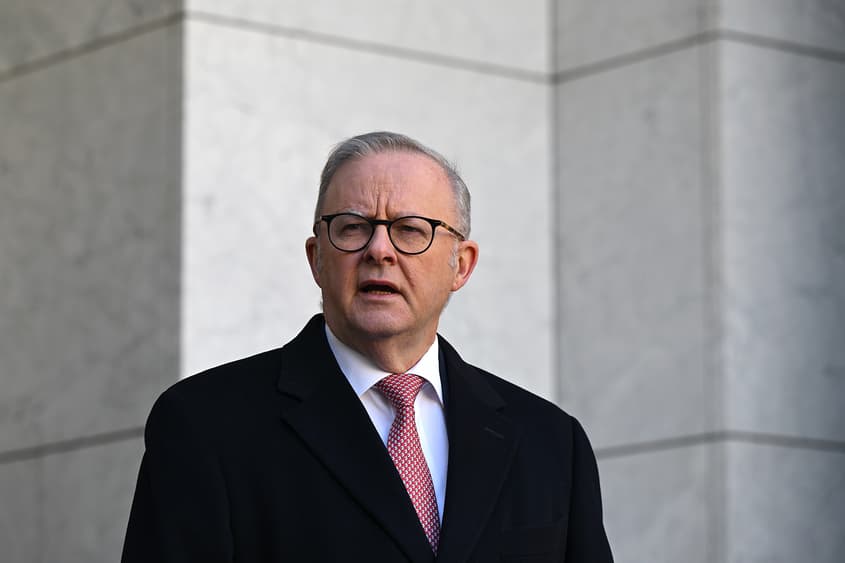
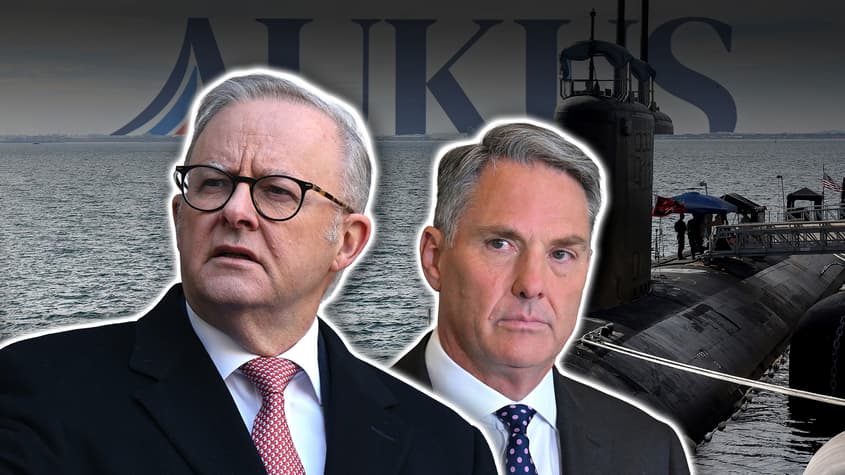
Prime Minister Anthony Albanese argues his hands are tied on a 25% tax on gas exports because of the war in Iran. “Our gas exports are directly linked to our national fuel security”, he told the Chamber of Minerals and Energy of Western Australia in April.
Gas companies loved hearing this: since the beginning of the Ukraine War in 2022, global energy prices have spiked, and they have enjoyed windfall profits close to $100 billion.
But the nation has been through wars before, and history shows us that national governments have tended to let extractive industries dictate tax policy during these periods.
In 1950, the Broken Hill Proprietary Company (BHP) successfully fought out a proposed levy on metal exports during the Korean War, allowing them to profit handsomely off war-driven price increases.
Whether the Prime Minister knows it or not, the Labor Party’s support of an extractive industry during war is following the playbook of Robert Menzies – an unlikely political icon for the party, but one who might recognise today’s ALP as the true inheritor of his legacy.
BHP and the Korean War Boom
On 25 June 1950, North Korea invaded South Korea, marking the start of a war that would last for more than three years.
To fight the war, UN forces (which included Australia) needed wool to make warm uniforms that could withstand the Korean winter, and lead and zinc to make ammunition. Australia, being a significant exporter of these products, was in a prime position to take advantage of this increased global demand.
This was great news if you were a wool grower out in the Australian countryside, or a mining magnate in Broken Hill: the war sent wool, lead, and zinc prices climbing, and producers could sell as much as they wanted.
But for the rest of the country, it marked the start of hard times: inflation at home began to rise rapidly in August 1950, peaking two years later at 22.5%, the highest rate of inflation since the 1850s gold rushes.
By comparison, the recent inflation crises in Australia have been relatively mild: inflation is 4.2% today, and it peaked at 7.9% during the Covid-19 pandemic.
The Menzies government was placed under immense political pressure to cut inflation and slow down the economy. In early September, it considered imposing an export levy between 20 to 30% on wool, lead, and zinc exports to address the problem.
Two weeks later, BHP wrote to Menzies to ask for “an opportunity to express our views before any contemplated action is taken”.
They made three arguments against an export tax.
First, BHP said they could not afford another tax. They argued that because they already paid a resources royalty to the NSW Government “it is unnecessary to point out what effect [another tax] would have on the future of the Broken Hill enterprise”.
This is very similar to what the gas industry have been arguing with regard to the Petroleum Resource Rent Tax – despite the fact that it is “unclear if gas exporters in Australia pay any PRRT at all”.
Second, BHP predicted an export levy would lead to industrial action. BHP said that if the tax was introduced they would end a lead price bonus with Broken Hill unions. This would “lead to great discontent among the Broken Hill Labour Force, with possibly a strike and dislocation of the industry, heavy loss of production, and consequent effect on the National income.”
This is a rare moment in Australian labour history when a firm – not a union – threatened industrial action against a government.
And third, an export levy would kill capital investment in the industry – a classic argument that is still used by the Commonwealth and the gas industry today. On 5 March, Resources Minister Madeleine King told the House of Representatives: “a tax on gas exports … would discourage investment in the new supply we need to back up our transition to net zero”. Two weeks later, Australia Energy Producers CEO Samantha McCulloch claimed “higher taxes on Australian gas producers would stop investment in new gas supply, leading to gas shortfalls, higher energy prices, and the closure of Australian industries that rely on reliable and affordable gas”.
Back in 1950, this line of attack was successful for BHP. In the end, the Menzies government announced they would legislate a tax on wool exports, but not lead and zinc. Treasurer Arthur Fadden’s official reason was that the metals industries “subsidised the home market,” while the wool market did not.
The historical record tells a different story. By the 1950s, wool’s historical economic and political power was coming to an end, while mining was at the start of its “second rush”. The Menzies government decided high inflation and lost tax revenue was worth paying to keep the mining industry on their side.
Today, the Albanese government seems similarly more interested in pragmatic politics than good economic management. The small difference is that at least Menzies wanted an export tax.