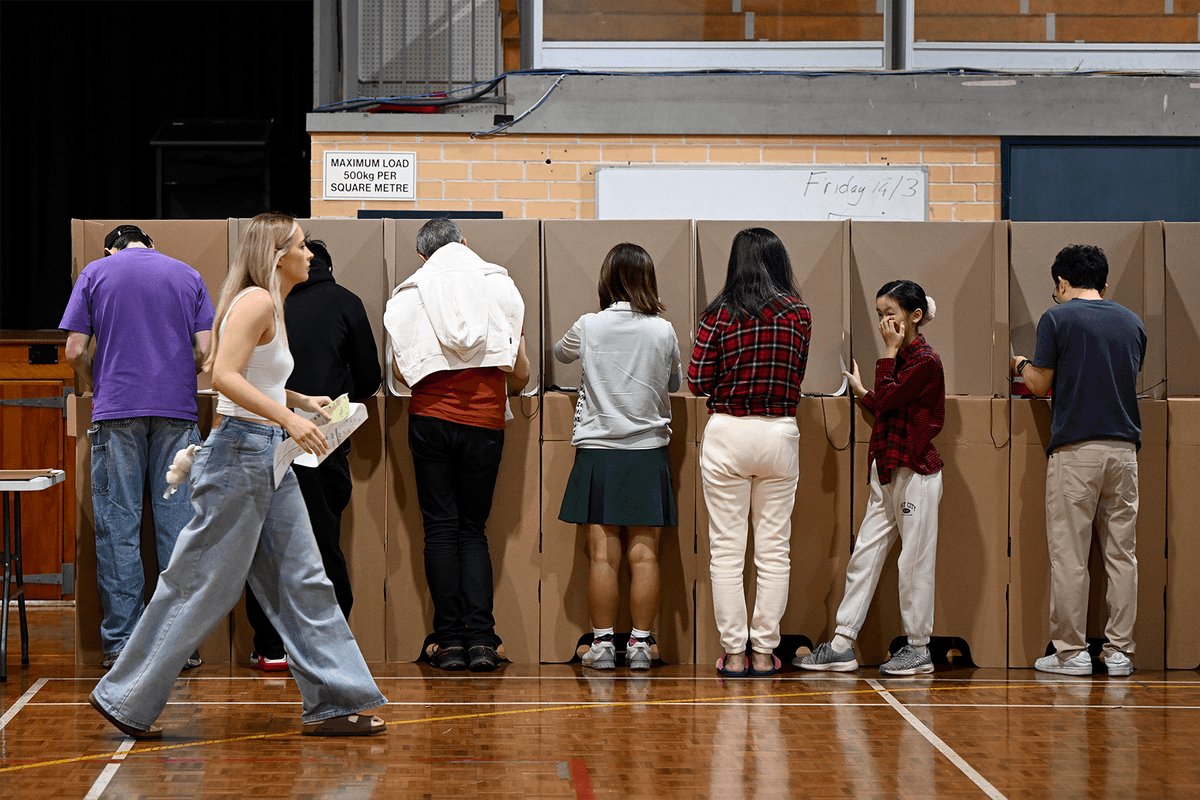
Because Australia has two houses of Parliament, every Australian gets two votes: one for their local member in the House of Representatives and one for their state or territory’s senators in the Senate.
For their House vote, around 900,000 Australians (5.6%) cast an invalid vote. Around 600,000 Australians (3.5%) did so in the Senate.
To make sure your vote is counted, number every box and double-check that you have not repeated any numbers. Do not write your name on the ballot paper.
With invalid votes excluded, only 15.9 million Australians had their Senate vote counted at the last election. Even fewer, 15.5 million, had their House vote counted – in a country with about 22 million adult residents.
Australian democracy is not as participatory as it first appears
When non-citizen residents, no-shows and invalid voters are considered, Australia’s elections are less participatory than turnout figures suggest. Only about 73% of the voting-age population in Australia were counted at the last election, about the same as New Zealand.
Since New Zealand has no compulsory voting, this shows that compulsory voting alone cannot ensure Australia’s democracy is as participatory as possible.
Several other countries, like Jamaica and the UK, allow Australian expatriates to vote in their national elections. New Zealand allows all long-term residents to vote. Australia does not return the favour.
Australia could increase democratic participation by extending the vote to adult permanent residents, either by making the pathway to citizenship easier or by allowing some permanent residents to vote.
Non-adults
There is also a case to be made for allowing 16 and 17-year-olds to vote. As Troy Bramston argues:
“Lowering the minimum voting age from 18 to 16 will encourage a more active and engaged democratic citizenry, and when coupled with increased public information and civics education in schools, there is no valid argument against this reform.”
The voting age is lower in countries like Indonesia (17), Greece (17), Austria (16) and Brazil (16). The United Kingdom will reduce voting-age to 16 at its next election.
If Australia allowed 16- and 17-year-old citizens to vote, another 600,000 or so Australians could participate in elections.
Conclusion
Australia’s strong democratic institutions and compulsory voting keep participation high by international standards.
Even so, several million people living in Australia go uncounted: because they cast an invalid vote, because they fail to turn out or because Australia does not let them vote at all.
As a result, Australia only sees as much democratic participation as some countries without compulsory voting. Australia’s representative democracy is not as representative as it could be.