In a new ad campaign, a mining lobby group claims that mining companies pay “enough tax to fund Medicare.” This is not true. Over the past ten years, the total cost of Medicare was $322 billion, while the mining industry paid $228 billion in tax, a gap of some $94 billion.
Wed 1 Apr 2026 22.34 AEDT

Photo: AAP Image/Con Chronis


In a new ad campaign, a mining lobby group claims that mining companies pay “enough tax to fund Medicare.”
This is not true. Over the past ten years, the total cost of Medicare was $322 billion, while the mining industry paid $228 billion in tax, a gap of some $94 billion.
Let’s look at the details.
What is Medicare and how much does it cost?
The full name of ‘Medicare’ is the Medicare Benefits Schedule (MBS). It’s a national scheme which covers a long list of medical interventions ranging from GP visits to MRI scans and elective surgery.
According to data published by the Department of Health, Disability and Ageing, the MBS cost $43.8 billion in financial year 2025, up from 40.1 billion the year before. It cost $322 billion over the decade to 2024. The cost of Medicare is paid by the Commonwealth ($21.3 billion in 2025) as well as patients and private health insurers ($22.5 billion in 2025. See columns M, N and O in this spreadsheet).
It’s important to note that the MBS is just one aspect of the Australian health system. Public hospitals, for example, are funded by state and territory governments, which also fund other local health initiatives. State spending on health services costs far more – $82 billion in FY 2024 and $586 billion over ten years.
How much tax does the mining industry pay?
The lobby group claiming that mining pays enough tax to fund Medicare is the Minerals Council of Australia (MCA). The MCA represents most of the big mining companies – BHP, Rio Tinto, and Gina Rinehart’s Hancock Prospecting (among others).
According to an MCA report that it commissioned from consultants Ernst and Young, miners paid $32.5 billion in company tax in FY 2024 – while Medicare cost $40.1 billion.
So, what’s going on?
The chart below compares the cost of Medicare to mining company tax payments over the last decade:
The chart shows that in eight out of the last ten years, mining companies paid less tax than the total cost of Medicare.
However, in 2022 and 2023, mining industry tax payments peaked just above the cost of the MBS. This explains why the mining lobby campaign is based on the FY 2023 tax figure. That year saw the highest tax-paid figure in the past ten years, caused largely by the resource price spike from the Ukraine war. As the chart shows, mining company tax payments have since declined, and over the long term could not sustainably fund Medicare.
Despite this, the MCA’s ads have appeared on roadsides, websites and in shopping malls:
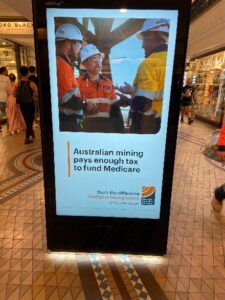
Photo: supplied.
Look at how the ad claims that “Australian mining pays enough tax to fund Medicare.” The ads on the Minerals Council website make the slightly different claim that “the mining industry paid $74 billion in tax and royalties in one year…enough to fund Medicare.”
The differences are important.
For a start, the “mining industry” is a more specific claim than “Australian mining.” The reality is that most big mining companies in Australia are majority foreign-owned.
Second, the physical ads only refer to “tax,” while the online claim is extended to “tax and royalties”. This is important because royalties and taxes are different.
Royalties are the price that mining companies pay for the minerals they use, which are owned by Australians. Just as builders need to purchase bricks and mortar to build a house, miners must buy the minerals that they extract and sell. Builders do not claim their payments to brick companies as “tax”.
The role of royalties as an input cost is explained by every Treasury in the country. State and territory governments collect these payments, not the Commonwealth, which means this money does not help pay for Medicare, which is a Commonwealth program. And royalties from mining are not enough to cover what the states spend on health, as the chart below shows.
Finally, look at how the website quote describes tax and royalty payments “in one year,” while the text in the physical ad says nothing about years, which gives the impression that mining could fund Medicare permanently.
This is misleading, because while mining company payments were higher than MBS fees charged in some years, this is not the case in total, over the long term.
The verdict
The claim is not true. The mining industry does not pay enough tax to fund Medicare. Apart from two financial years, the amount of company tax paid by miners over the past decade falls about $94 billion short of the money spent on Medicare.
Royalties aren’t taxes, and they are paid to the states and territories, which have nothing to do with the MBS. The things the states do fund – like public hospitals – cost $586 billion over the past decade, way more than the $167 billion paid in royalties.
Advertisement