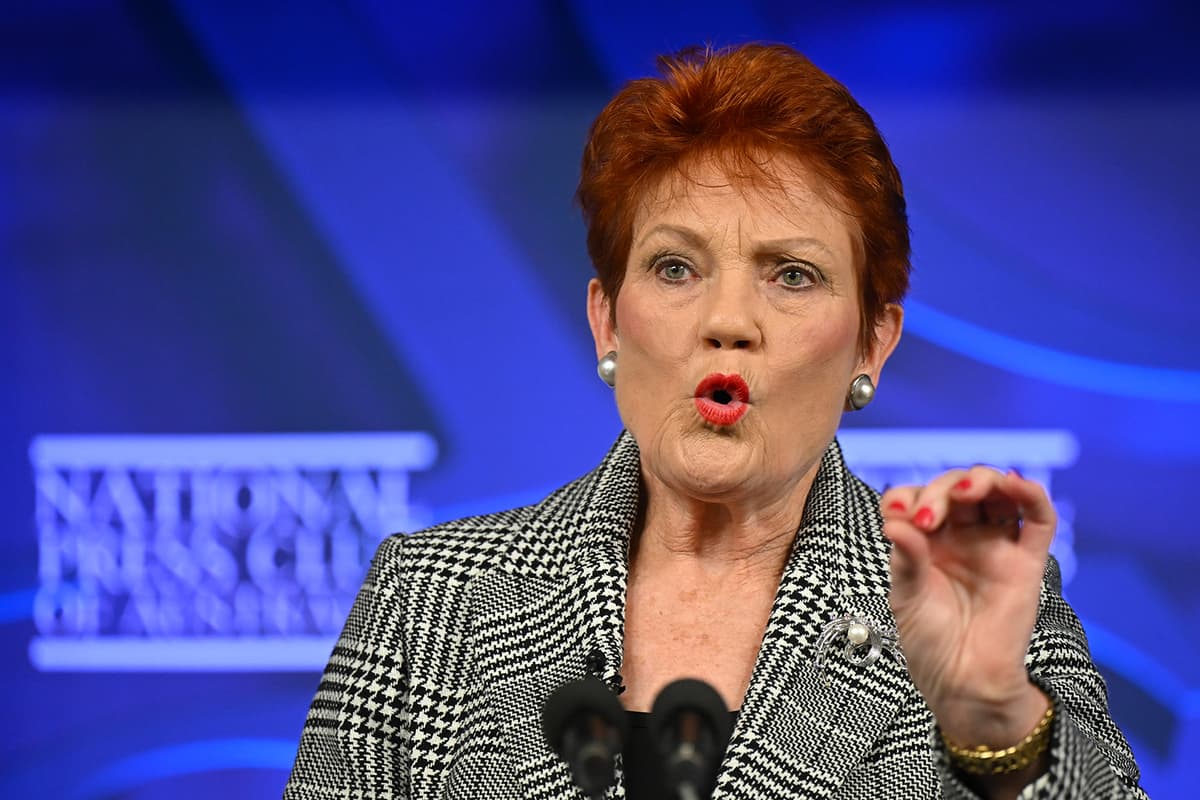
At her press club speech last week, Pauline Hanson asked:
How can you generate social cohesion if people can’t speak the language? In [the 2021 census], 872,000 people self-reported, as speaking English “not well” or “not at all”.
Is that true?
On the face of it, Hanson is right that the 2021 census reported 872,000 people spoke English either “not well” or “not at all”. But that number hides details that make Hanson’s claim highly misleading.
First, there’s a pretty big difference between speaking a language badly and not speaking it at all, and over three quarters of that figure (657,000 people) comes from those who reported speaking English “not well”.
These aren’t the results of a rigorous language test either, but self-reporting, and the ABS encourages caution in interpreting these figures as a “definitive measure of [a person’s] ability” to speak English.
Zoning in on those who reported speaking no English reveals a larger problem with Hanson’s narrative.
Of those who reported speaking English “not at all”, most are Australian citizens. And about half of those have a pretty good reason for not speaking English – they’re babies.
All up, one in eight of the people included in Hanson’s figure are there not because of some refusal to assimilate, but because they’re more fluent in baby-talk than English.
Pauline Hanson’s wider complaint is that there are hundreds of thousands of migrants who have “failed” to assimilate after arriving in Australia. Hanson has been making similar claims for almost a decade, one of which was factchecked by The Conversation in 2018.
Is she right?
The first problem with this is that both permanent residency and Australian citizenship require proficiency with the English language. This means that, even among those who self-describe as speaking English “not at all”, many are likely understating their ability to speak the language.
But even with that caveat, Hanson’s wider claim doesn’t line up with the data.
Among those who arrived in Australia within six months of the last census, English language proficiency was high, with over 80% reporting they spoke English well, very well, or as their only language.
Just under 18% said they spoke English “not well” or “not at all”, but that share drops off quickly – down to 10% for those who arrived five years before the census, and less than 8% for those who arrived before 2010.
Fewer than one in 25 of those who arrived at least five years before the Census in 2021 reported speaking English “not at all”.
While Hanson is quoting the raw 872,000 figure accurately, her interpretation is misleading. But, if she did want to improve the language skills of the 105,000 babies included in her figure, she could start by reversing one of the other policies she announced in her press club speech: opposition to childcare funding.
Verdict: Misleading