If you don't have Australian artists on your Spotify Wrapped, you're not alone - it's the result of a structural, not individual, problem.
Thu 4 Dec 2025 06.00
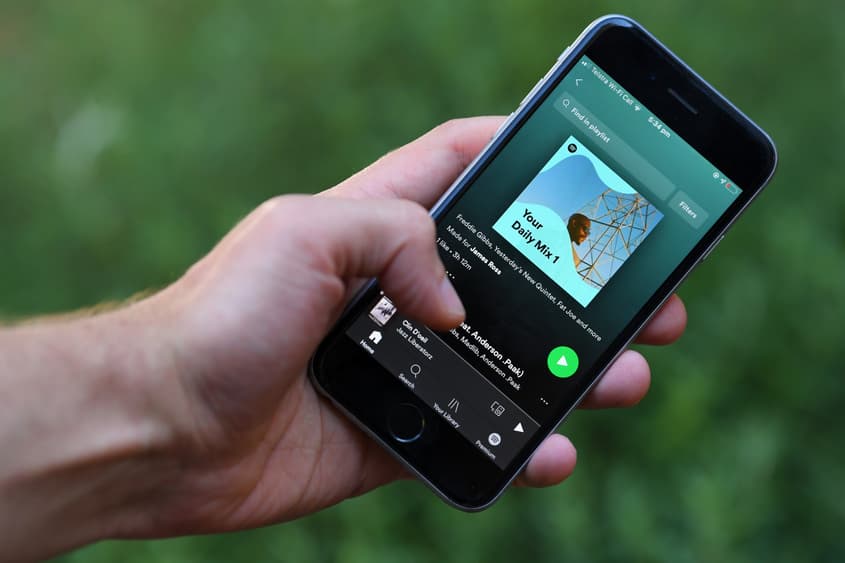
Stock image of a Spotify app on an iPhone in Melbourne, Monday, November 2, 2020. (AAP Image/James Ross) NO ARCHIVING


Today is Spotify Wrapped day, when people around the world will, like kids following the latest playground craze, share their ‘top five’ list. For most people, this list won’t include any Australian artists, and if it does it’s likely to be someone well-established, like Vance Joy or The Kid Laroi.
New research by the Australia Institute looked at the top 10,000 artists being streamed inside Australia between 2021 and 2024 and found that the presence of Australian artists has been declining, both in terms of the total number of artists and the total number of streams. In 2024 Australia’s most streamed domestic artist was The Wiggles. The number of Australian artists appearing in even the bottom 5000 has dropped, which means new artists aren’t getting a look in.
The reason? If you rely on automated playlists – like the mixes Spotify recommends to its users – algorithms are deciding what music you hear. Most streaming services now use large language models (LLMs) to make these playlists, which are based on the data of masses of listeners with similar tastes. These algorithms can filter for language, but not for geography or culture, which means that all English language listeners – be they American, British, Irish, Canadian, Kiwi or Australian – are put into the same pool.
Research by former Spotify Chief Economist Will Page shows that these algorithms benefit countries with a unique national language, like Germany and Italy, where domestic artists are thriving. Denmark, which has just 5.5 million people speaking the same language, is seeing Danish-language artists dominate their charts. This is because the algorithms know Danish people listen to a lot of Danish-language music, so they get fed more of it, which pushes domestic artists to the top of their charts.
But this same algorithm is working against countries in which English is the dominant language, because the sheer number of Americans means that anyone listening to English-language music of a certain genre is going to get recommended whatever Americans like. Artists from Australia now compete against everyone else singing in English for an audience on the same handful of streaming services. Far from creating a free, global market for music, algorithms are handicapping Australian artists.
Advertisement

One way to avoid this trap is to proactively search for new music, and not just depend on the algorithm. The ‘Ausify’ campaign that ran as part of AusMusic month in November asked Australians to do exactly that. But the reality is that 25 million Australians could never outweigh the preferences of 340 million Americans, even with the most successful campaign. And even if you want to hear more Australian music, where do you start? How do you know what to listen to?
This is why DJs are still important. Locally based content curators – online or on the radio – can make playlists relevant to a particular city or country in ways the algorithms either cannot or do not. Public radio shows how effective this can be. At the national level, stations like Triple J and Double J play a lot of new music, much of it Australian. They support national tours and give up-and-coming artists a national platform. Would Amyl and the Sniffers have been nominated for a Grammy in 2026 if they hadn’t first been a featured by Double J as early as 2019?
At a regional level, stations like 3RRR and PBS (Melbourne) FBi (Sydney) RTM FM (Perth) and 4ZZZ (Brisbane) not only play local music, but they also promote nearby events that bring community together. But the reason these stations champion Australian music isn’t that they are more altruistic than global streaming services; it’s because of requirements to play a quota of Australian music. Even big commercial stations are required to play some Australian content, but streaming services, for some reason, get a free pass.
This isn’t because the algorithms can’t be manipulated. Through its ‘Discovery Mode’, Spotify will modify its algorithm to increase the chances that an artist’s song is listened to – for a 30% commission. Could a similar amendment to the algorithm make sure Australian listeners hear more Australian music?
In March, a Commonwealth Government inquiry into live music in Australia recommended that streaming services increase the proportion of Australian content that algorithms and automated playlists generate for Australian users. The inquiry said that, if this doesn’t happen, the Commonwealth should consider a ‘mandate’ to ‘enforce’ Australian content requirements for music streaming services. Until then, new Australian artists are likely to be drowned out in the global content stream.
The claim that half of voters rely on the Government for 'most of their income' that has been repeated across the media and by politicians, simply isn't true.
Advertisement
If you live in Sydney, do you know how many guns are being stockpiled just down the road?

The debate over the capital gains tax discount comes down to a very simple question: who do you think should pay more income tax? Should a high-income executive who makes a $400,000 capital gain (that is, a profit) from selling an investment property pay a higher tax rate than a full-time retail worker on minimum wage who decides to pick up a few extra shifts?