The Queensland Museum is being urged to terminate its partnership with Shell’s QCG gas business following claims its branded teaching materials are misleading students on climate change.
Sun 7 Dec 2025 06.00
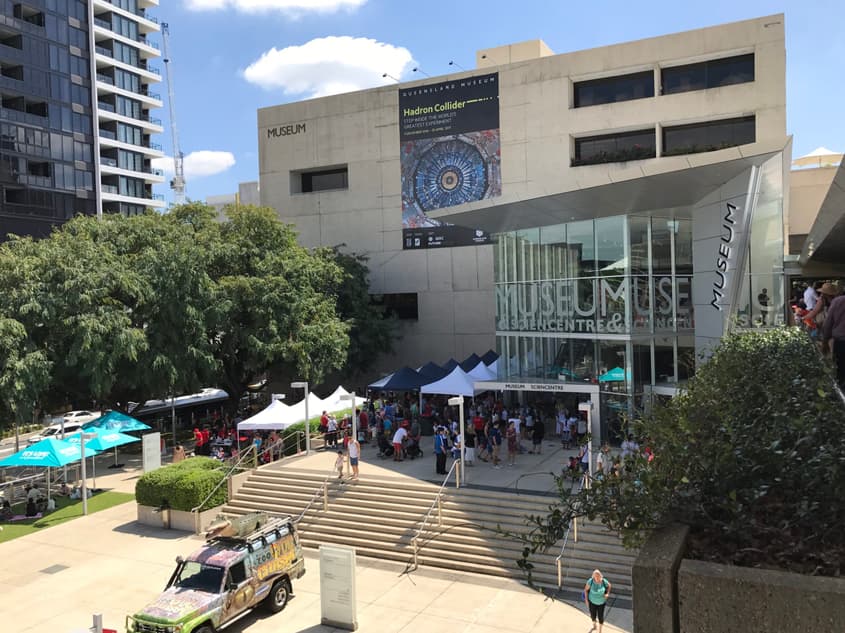
Photo: Chris Olszewski - own work, CC BY-SA 4.0, https://commons.wikimedia.org/w/index.php?curid=57409890


The Queensland Museum is being urged to terminate its partnership with Shell’s QCG gas business following claims its branded teaching materials are misleading students on climate change.
“This is climate obstruction dressed up as education,” said Belinda Noble, founder of Comms Declare.
The advocacy group has raised concerns that students as young as ten, “are being taught climate change lessons shaped by a fossil fuel company”.
“We wouldn’t let Big Tobacco sponsor teaching materials – fossil fuel companies shouldn’t shape how kids learn about the climate,” said Ms Noble.
Comms Declare has released a report into the arrangement, titled Queensland Museum Learning Resources: Climate Accuracy and Sponsorship Concerns.
Since 2015, it notes Shell’s QGC has contributed $10.25 million to Queensland Museum, which describes itself as a ‘celebrated and valued cultural and scientific leader’.
However, the report found that its educational materials “downplayed or omitted fossil fuels as the primary driver of climate change”.
“As a climate change scientist I’m appalled that a fossil fuel company is involved in science education for our young people, who will be the ones to suffer the most from their climate-wrecking activities,” said Climate Councillor, Professor Lesley Hughes.
The report notes a document introducing Years 9-10 students to ocean acidification explains how the process works but fails to mention it’s driven primarily by the burning of fossil fuels.
“This omission is scientifically indefensible,” wrote report author Lisa Wills.
“(The) framing aligns with fossil-fuel industry talking points and encourages students to see technological innovation, not fossil fuel phase-out, as the central climate solution.
Queensland Museum asserts it “maintains full independence in its research, exhibitions and educational activities.
In defending the partnership, it pointed out that such arrangements help foster “critical thinking, evidence-based learning, and engagement with Queensland’s natural history,” and are structured “without influencing scientific content, priorities, or public messaging.”
However, the report states, “the omissions and distortions within Queensland Museum’s Shell-branded learning materials are not minor” and “they constitute a fundamental miscommunication of scientific reality”.
Another example featured is the museum’s States of Matter: Our Warming World resource.
The report found the Year 8 material “introduces global warming through physics but … never connects energy use to emissions”.
“The omission of fossil fuels, coupled with Shell branding, normalises the company’s presence in climate education while stripping the issue of moral and political context,” wrote Ms Wills.
“We are living in times when young people urgently need accurate, age-appropriate resources to make sense of climate change and to imagine and work towards just energy transitions,” said Dr Eve Mayes, Senior Research Fellow (Pedagogy and Education) at Deakin University.
“Yet it’s troubling that the learning experiences offered in cultural institutions are being compromised by vested interests.”
Last month Monash University announced it was cutting its controversial ties with fossil fuel giant Woodside Energy.
The University’s vice-chancellor, Professor Sharon Pickering, confirmed the news during her appearance at a Senate committee hearing on the Greens’ End Dirty Uni Partnerships Bill.
“It has been abundantly clear through communications with our broader community [that] they expect us to work in alignment with our values and, indeed, to ensure that we are always partnering well,” Ms Pickering said.
Comms Declare is urging museums, galleries, science centres and education authorities across Australia to follow suit and commit to fossil fuel-free education.
“As parents, we simply want our children to learn the truth about the world they will inherit,” said Nic Seton, CEO of Parents for Climate.
The report also calls for national standards to prevent fossil-fuel companies from abusing sponsorship agreements to influence climate or environmental education.
A significant shift is already underway in the UK, with museums and galleries recently voting to adopt new ethics guidelines to help facilitate the ‘transition away’ from such sponsorship deals.
It now implores museums to, “Consider climate and ecological impacts and social responsibility in all decision making”.
Several British institutions such as the Royal Shakespeare Company, Tate, the National Portrait Gallery have already ended their relationships with fossil fuel companies like BP and Equinor.
“Our kids deserve independent, accurate climate education that empowers them to thrive in a rapidly warming world, not materials that protect corporate interests at the expense of their future,” said Mr Seton.
Advertisement
New research shows fossil fuel subsidies will reach $16.3 billion in 2025–26, rising faster than the NDIS. Handouts to mining giants are growing faster than support for Australians with disability.
A sharp rebuke of Australia’s gas industry was delivered in Parliament overnight, as Labor MP for Chifley, Ed Husic, accused major exporters of putting profits ahead of the public interest and called for a stronger national approach to managing the country’s gas resources.

Australia’s struggling wildlife rescue sector is calling for the Albanese government to fund a national system for treating injured and orphaned native animals.