Australia’s struggling wildlife rescue sector is calling for the Albanese government to fund a national system for treating injured and orphaned native animals.
Thu 12 Mar 2026 13.00
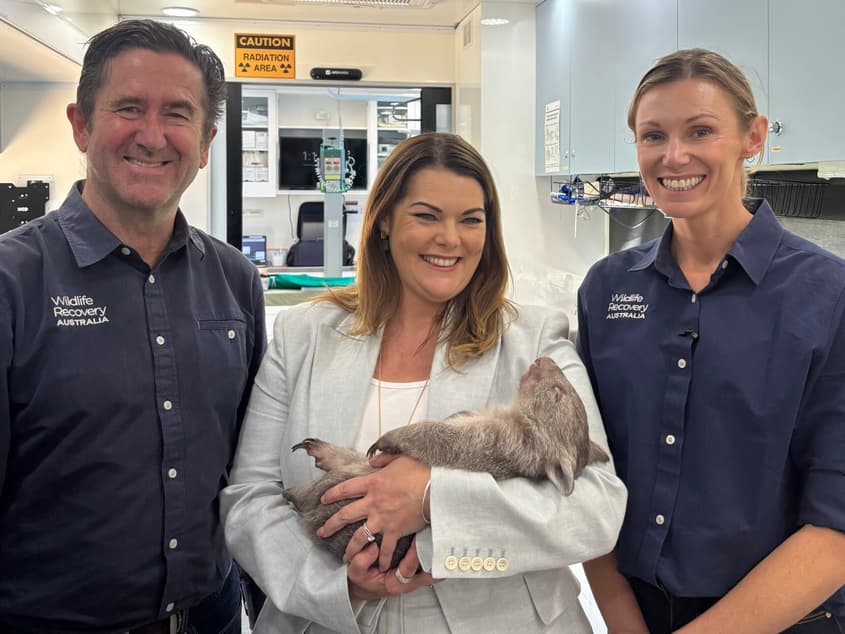
Photo: L to R: Dr Stephen Van Mil, Founder and Chief Executive Officer, Wildlife Recovery Australia; Senator Sarah Hanson-Young, Greens environment spokesperson; and Dr Bree Talbot, Chief Veterinary Officer, Wildlife Recovery Australia, with Beau the wombat.


Australia’s struggling wildlife rescue sector is calling for the Albanese government to fund a national system for treating injured and orphaned native animals.
Wildlife Recovery Australia has launched a national tour with the country’s first mobile wildlife hospital, Matilda, arriving at Parliament House this week to demonstrate the services that could be at risk without Commonwealth support.
Dr Bree Talbot, Chief Veterinary Officer at Wildlife Recovery Australia, said secure funding would mean they wouldn’t always have to “scramble to find money” for treatments and medicines.
“They are part of our life, our culture,” she said. “They belong here just as much as we do.”
“If we can’t look after our greatest national asset, we are in serious trouble,” added Dr Stephen Van Mil, Founder and Chief Executive Officer of Wildlife Recovery Australia.
The Greens proposed a $20 million-a-year wildlife rescue strategy in March 2025 and are again urging their Canberra colleagues to back the plan.
“Wildlife rescue services across the country are struggling to keep their doors open,” said Greens spokesperson for the environment, Senator Sarah Hanson-Young.
“Our environment is in crisis, and as a consequence our wildlife are paying the price. We are seeing decreasing native wildlife populations and a number of species, including the koala, are facing extinction.”
The call is backed by a coalition of wildlife organisations in NSW, VIC, QLD and WA, which have developed a pre-budget submission for a National Framework.
“It’s a national problem. There’s a scarcity of volunteer carers and rescuers. There’s a scarcity of wildlife trained vets, and there’s an absolute scarcity of wildlife hospitals. So, we want to try and help fix that,” Dr Van Mil said.
The proposal aims to establish consistent national support for wildlife carers and rehabilitation services, which currently rely heavily on volunteers and charitable donations.
Senator Hanson-Young said increasing threats to wildlife meant Australia had a responsibility to act.
“Habitat destruction, motor accidents, all of the other dangers … that humans bring onto them, we’ve got a responsibility to look after them,” she said.
Wildlife Victoria responded to more than 160,000 calls in 2024, providing over-the-phone advice and dispatching volunteers to assist over 97,000 native animals across the state.
Its WV travelling veterinary team also responded to over 1,650 cases of wildlife requiring veterinary assistance across 91 species.
“Wildlife organisations across the country have been doing this important work on the smell of an oily rag,” said Senator Hanson-Young.
WA Wildlife Chairperson Diane Munrowd shared in her 2024/25 annual report that “The ongoing lack of state and federal funding for operating expenses remains a significant barrier to growth and sustainability across the sector” and that “volunteers remain the lifeblood”.
She revealed six major wildlife rehabilitation centres in Perth collectively provided care for more than 20,000 native animals each year.
Senator Hanson-Young said “These organisations deserve full funding, so they can focus more on saving lives without worrying about keeping their doors open.”
Advertisement
Visitors to the Twelve Apostles along Victoria’s Great Ocean Road will soon be asked to pay an entry fee, with the Vic State Government arguing it’s ‘only fair’ that visitors contribute to maintaining one of Australia’s most visited natural landmarks.
When INPEX Australia admitted it had under-reported benzene and toluene emissions from its Ichthys LNG facility by orders of magnitude, Territorians were told we were “lucky” nothing worse happened.
Environmentalists have accused the Albanese Government of making a “mockery” of Australia’s new nature laws, saying they’re “gobsmacked” by its decision to greenlight the destruction of threatened bird habitat in the Northern Territory.