The people most vulnerable to extreme heat either live below the poverty line, have a long-term health issue, and/or are aged 65 and older.
Fri 19 Dec 2025 06.00

Photo: AAP Image/Joel Carrett


As the east coast of Australia sweats through another heatwave, research from The Australia Institute shows the inequitable effects of Australia’s most lethal form of weather. Older, poorer, sicker people living in places away from the coast are worst affected by extreme heat and, as Australia warms, targeted interventions are needed.
A grey-haired couple walk into a pub in Sydney’s west. It’s a Saturday and although it’s barely midday the mercury is already pushing 35 degrees, so when they fling open the door a blast of hot air infiltrates the airconditioned front bar. The woman calls out for help as the man, white as a sheet, slumps into an empty stool. She’s on the phone to triple zero because he has a heart condition, and the heat has triggered what the whole pub now fears is a heart attack.
Extreme heat is the number-one cause of weather-related illness and death in all parts of Australia – except, for obvious reasons, Tasmania. The critical threshold for “extreme” heat is 35°C, because at that temperature exposure of six hours or more can be fatal. The people most vulnerable to extreme heat either live below the poverty line, have a long-term health issue, and/or are aged 65 and older.
This is because people on lower incomes may not be able to afford things like air-conditioning, robust home insulation, or to rent in suburbs that benefit from cooling ocean breezes. When people who cannot keep afford to keep cool in a heatwave also have chronic health condition or are simply older, the impacts can result in hospitalisation and even death.
By analysing data from the Australian Bureau of Statistics, the CSIRO and the Bureau of Meteorology we found the parts of Australia with the highest concentration of people vulnerable to extreme heat. At a national level, the Northern Territory, South Australia and Western Australia are most vulnerable to the effects of extreme heat. The top ten worst affected places are shown in the table below.
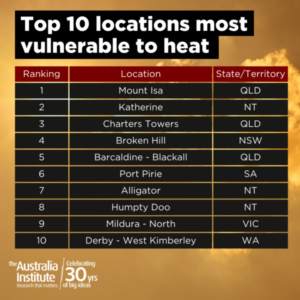
But extreme heat is also a problem for Australia’s major cities, particularly in outer suburbs. Even within cities, the effects of extreme heat are not evenly distributed. Around Australia, the coastal suburbs of capital cities tend to be both cooler and wealthier than the outer suburbs. The northern part of Adelaide, the eastern part of Perth, and the western parts of Brisbane, Sydney and Melbourne are all more vulnerable to extreme heat than the beach suburbs. The same trend repeats at the regional level: coastal towns and cities are cooler and wealthier, but extreme heat poses a greater threat to outer-urban and inland rural areas.
Ever-increasing global average temperatures mean that the frequency, duration and intensity of heatwaves is also increasing. 2025 was the hottest year on record, beating 2024, which in turn beat the nine years before that, all of which are at the top of the charts. If global average temperatures continue to rise, heatwaves will only worsen for Australia. Climate scientist Bill Hare has warned that parts of northern Australia including Broome and Katherine could become unliveable.
Unless action is taken to mitigate the effects climate change, over the next 50 years Australia can expect rates of heat-related illness and death to increase. In this way, climate change is exacerbating existing inequalities and disproportionately impacting the most vulnerable Australians. Although heatwaves are uncomfortable for everyone, the poor, the sick, and the elderly suffer the most.
Back in the pub, an ambulance arrives, and the man is driven away. Ambulance call outs can increase by up to 10% during heatwaves, which means increasingly severe heatwaves will put pressure on our health services, not to mention people with a heart condition. Meanwhile, the Australian Government continues to approve new projects that will see more of the fossil fuels primarily responsible for climate change dug up and burnt. In fact, the Australian Government subsidises the fossil fuels industry to the tune of $14.9 billion a year. The federal budget shows that these subsidies will cost $67 billion over four years. That money could instead pay for a lot of ambulances, and eliminating the subsidy could ultimately help reduce the number of extremely hot days which, for some, are a matter of life and death.
In February the unemployment rate rose from 4.1% to 4.3%, providing further evidence the Reserve Bank misread the economy when it raised rates in both February and this week.
Advertisement

Amid global turmoil, the report of the Strategic Examination of R&D (SERD) calls for “bold reform” of Australia’s “broken” research and innovation system. What better time to prepare for an uncertain future.
As South Australia prepares to vote amid escalating anti-abortion rhetoric, new polling research shows that a clear majority of Australians support a woman’s right to choose.