As South Australia prepares to vote amid escalating anti-abortion rhetoric, new polling research shows that a clear majority of Australians support a woman’s right to choose.
Wed 18 Mar 2026 14.00
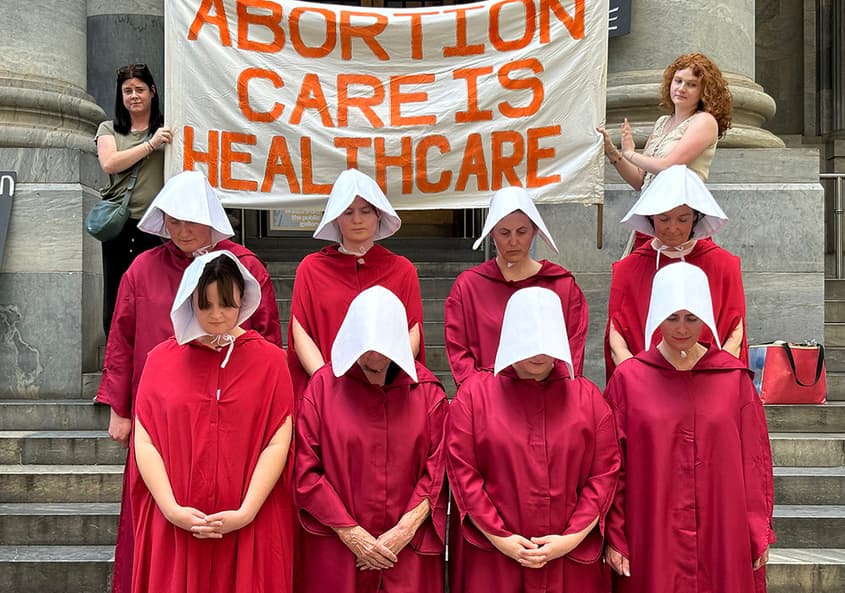
Photo: Protesters gather ahead of a vote on an abortion reform bill put up by Liberal MP Ben Hood, at Parliament House in Adelaide, Wednesday, October 16, 2024. (AAP Image/Abe Maddison)


As South Australia prepares to vote amid escalating anti-abortion rhetoric, new polling research shows that a clear majority of Australians support a woman’s right to choose.
The polling, conducted for the Australia Institute, found 62 per cent of Australians support access to abortion services, with a further 25 per cent supporting access in limited circumstances.
Just 8 per cent of respondents said they oppose abortion access entirely, while 5 per cent remain undecided.
“Abortion is legal across Australia and this research shows a majority of Australians support access to abortion, whether they live in cities or country towns, or where they sit on the political spectrum,” said Ebony Bennett, deputy director of the Australia Institute.
South Australia has seen two attempts to change its abortion laws in recent years.
In September 2024, Liberal MP Ben Hood introduced amendments to ban abortion after 27 weeks and six days; it was narrowly defeated, 10 votes to 9.
Less than a year later, independent MP Sarah Game, formerly of One Nation, launched a bill to restrict abortions after 23 weeks; it too was rejected, 11 votes to 8.
“Our research shows that any party or candidate with a policy to wind back access to this vital medical service for women is likely out of step with voters on this issue, regardless of which party they are running for,” Ms Bennett said.
Advocates warn that the rhetoric reflects a wider global trend.
Working with Women Alliance executive director Dr Gemma Killen said “Attacks on abortion rights and access have proliferated globally over the last decade, especially following the overturning of Roe v Wade in the US Supreme Court in 2022.”
The ruling ended a woman’s constitutional right to abortion.
As a result, 41 US states have introduced bans or significant restrictions.
Dr Killen said, “In 2021, three in four Australians supported access to abortion, with more than half supporting access whenever a woman decides she wants one.”
However, she noted, “before the fall of Roe, most Americans supported access to abortion too.”
One Nation has vowed to “seek every opportunity” to roll back SA’s “brutal and extreme abortion law” as it looks to convert its surge in support into parliamentary seats.
However, the latest survey suggests its position may be at odds with its own voter base.
Half of One Nation voters said they support abortion access, while 34 per cent support access in “only in limited circumstances”.
Fewer than one in ten (9 per cent) oppose it outright.
The polling also found support for abortion access is strongest in rural Australia, where 66 per cent are in favour, and a further 24 per cent support access “only in limited circumstances”.
“People who live in rural Australia are the most likely to support access to abortion. Perhaps because people in rural Australia understand the difficulties and risks in not being able to access the healthcare they need,” said Ms Bennett.
Dr Killen said while legislative attacks on the right to receive abortion care are serious, the real barrier to access is cost.
“For someone earning the minimum wage, an abortion could cost the equivalent of between three and a half days and eight weeks of salary,” she said.
While abortion has been fully decriminalised nationwide since 2023, Dr Killen said, “access to care is deeply uneven, with some people living in “abortion deserts.”
“Unsurprisingly, people in lower socio-economic areas are often further from public abortion services and must rely more heavily on expensive private services or miss out altogether,” she said.
In a submission to a Senate inquiry, advocacy group Fair Agenda warned that without a national approach, any reforms “would likely be ‘piecemeal’ and maintain the existing ‘postcode lottery’.”
Dr Killen argued that “Australia cannot continue to treat abortion as essential healthcare in principle but optional healthcare in practice.”
She is calling on the Albanese Government to increase Medicare rebates, mandate public hospital provision, and invest in national data collection and oversight.
“When people are forced to travel hundreds of kilometres, pay thousands of dollars, or delay care because they cannot find or afford a service, we do not have a functioning universal health system.”
Advertisement
As we approach the Federal Budget, speculation is swirling about changes to the Capital Gains Tax (CGT) discount and negative gearing. And just yesterday a senate committee handed down its report on the CGT discount after hearing evidence that it worsens inequality and encourages property investors to gamble on housing.
Behind the closed doors of a consultation room, or concealed by impenetrable medical jargon, wrongdoing in the healthcare sector impacts the lives of every Australian.
An investigation into the illegal Robodebt scheme has found two senior public officials engaged in corrupt conduct, but the Greens say the political and bureaucratic “architects” have “walked away scot-free”.