PM Albanese rocks band t-shirts and Arts Minister Tony Burke plays the guitar in his office. It would be a shame if they oversaw an unprecedented decline in Australian music.
Fri 23 Jan 2026 01.00
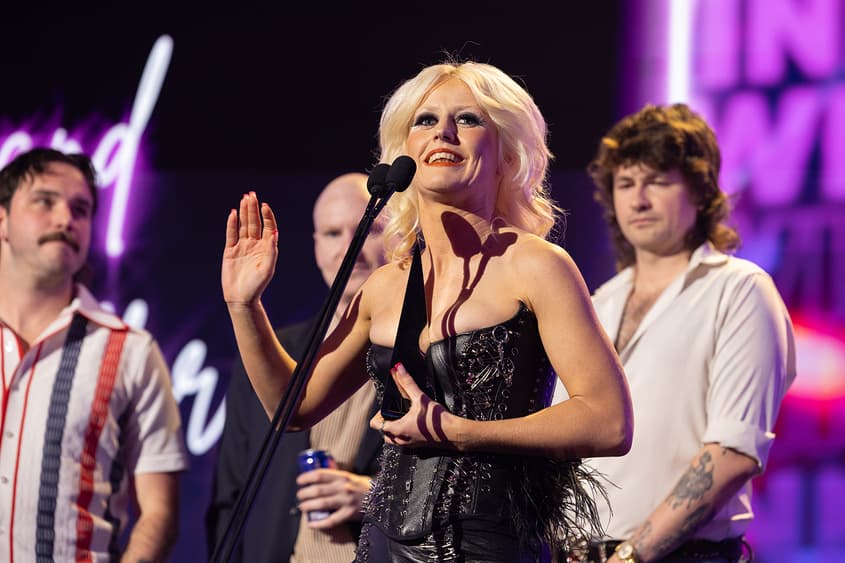
Amyl and the Sniffers win Best Group during the the 2025 ARIA Awards at Hordern Pavilion in Sydney, Wednesday, November 19, 2025. (AAP Image/Sitthixay Ditthavong)


Triple J’s annual Hottest 100 has long been the barometer of trendsetting music in Australia. Often billed as the “world’s biggest musical democracy,” the countdown offers listeners an opportunity to vote on their favourite song released in the previous 12-months.
In this wide-open playing field, the success of Australian artists is especially celebrated. But the number of home-baked songs in the countdown is collapsing.
Although the number of voters increased in last year’s countdown, the 2024 Hottest 100 featured just 27 Australian songs – the least since 1995. And many of these were older acts, which suggests newer artists aren’t breaking through.
Every Hottest 100 between 2016 and 2020 featured at least 65 Australian songs, but the presence of Australian artists has since dropped off. Have Australians simply lost interest in Australian music? That seems hard to believe.
Australia’s national youth radio station operates in a vastly different environment than it did when the Hottest 100 started for the 1993 countdown.
Streaming has changed everything.
People – especially the younger people that Triple J is intended for – are much more likely to hear new music online than on any radio station. Music discovery is more likely to happen on a streaming service, or a social media site like TikTok. So it is concerning that the amount of Australian music being streamed is also dropping.
Australia Institute research shows that, among the top 10,000 most streamed songs in Australia, the number of Australian artists has declined by about one-fifth, from 962 in 2021 to 776 in 2024. Streamshare – the number of times Australian artists inside the top 10,000 have been streamed – also declined, from 12% to 8%.
The reality is that Australians are streaming less Australian music less often. Of the top 100 artists streamed in Australia in 2024, just six were Australian: The Wiggles (41st), The Kid LAROI (43rd), AC/DC (65th), Vance joy (77th), Hilltop Hoods (95th), and RÜFÜS DU SOL (100th). As with the Hottest 100, most of these are well-established artists. This kind of trend does not bode well for new Australian artists.
But Taiwan provides an interesting example of how public investment in the arts can pay international dividends.
Musicians in Australia and Taiwan face a similar challenge – they have to compete with all the singers from a much larger country with which they share a language. Taiwanese bands sing in Chinese and compete with Chinese acts, just like Australian bands compete with Americans singing in English.
This is a problem because the algorithms used by streaming services filter for language, but not for geography or culture. But while Australian musicians are losing listeners to acts from the USA, Taiwan’s popular music is thriving not only in Taiwan, but in mainland China where Taiwanese artists like Jay Chou are superstars.
Despite the competition from the larger neighbour, in 2023 Taiwanese artists accounted for about 35% of what appeared on the top charts of Taiwan’s YouTube Music – more than Mainland China’s share of 31.5%. In fact, in 2024, three of the top ten selling live performing musicians or bands in mainland China were from Taiwan.
Well, the Taiwanese Government spends nearly twice as much on contemporary music as Australia. The chart below, from this Australia Institute briefing note, shows that Taiwan’s music funding-to-GDP ratio was just over $19 per million, whereas Australia’s is about $12 per million. If Australia spent as much as Taiwan, there would be roughly $20 million more available every year for the kinds of bands you might hear on the Hottest 100.
The low support for Australian music is in line with Australian governments’ funding for the arts more broadly, which ranks well below the average for the developed world. The Commonwealth would need to increase funding by over $5 billion per year just to meet the OECD average. To put the difference that would make into perspective, Creative Australia has an annual budget of about $318 million.
Aside from more funding, the Australian Government also has the power to regulate online content. The News Media Bargaining Code and the ban on social media use for Australians under 16 years are world-first policies. This kind of legislation shows that the Australian Government has the power to regulate big tech, and this power could be used to ensure more Australians have the opportunity to listen to more Australian music. This could be done by imposing local content quotas on streaming services, or by better resourcing Australian streaming services.
In the streaming era, Australian artists are not getting the support necessary to break through the torrents of online content. Without more investment and better regulation it’s going to be harder and harder for Australians to celebrate what makes us us, as we have done when Australian artists have topped the Hottest 100 in years gone by.
Advertisement
The idea that there’s only so much money to go around makes a bastard kind of sense to the poor. If impossible decisions abound in their lives, it must be true of governments, too. Certainly, that’s how federal budgets are framed. But beyond impressionism, we know the household budget is not analogous to state budgets in any meaningful way.

AI deepfakes used in online fraud are a global problem. In Australia, Hong Kong, Taiwan, the United States, the EU, and Southeast Asia, scammers often use deepfake images of public figures to trick people into handing over money. But Australia has been at the forefront of many of the regulation discussions.

Economists are warning the Albanese Government must act immediately to end “Australia’s enormous gas giveaway” as households begin to see – and feel – the economic fallout of war in the Middle East.